Blog

  • Against a conservative turn by the People’s Republic of Donetsk Statement of Union Borotba (Struggle)

    According to the Draft Constitution of the People’s Republic of Donetsk published in the press, the fundamental law of the new state is to include a state religion — Orthodox Moscow Patriarchate.

    Union Borotba strongly protests against the institution of a state religion in the Republic created by the people. We insist on the inclusion in the Constitution of DNR rules on freedom of

  • Categorical Imperative for Anti Fascists by Victor Shapinov

    Democracy and Class Struggle says Borotba has now moved fully underground in Ukraine to continue the struggle against the fascist infested Kiev Putchists.

    There has been a continuous information war against Borotba organised in the Ukraine and in the West and comrade Victor Shapinov warns comrades against falling for some of the Western organised propaganda on behalf of the Kiev Putchists

  • Isn’t ‘illegal Bangladeshi’ Racist Shorthand for All Bengali Speaking Muslims in Assam?

    – Bonojit Hussain
    Note: A shorter version of this article was published in today’s Calcutta edition of The Telegraph.

    The fragile and unstable peace in Bodoland Territorial Autonomous Districts (BTAD) of Assam has once again been ruptured. The recent massacre of Muslims of East Bengali descent in Kokrajhar and Baksa districts of BTAD on 1st and 2nd May has already taken toll on 46 lives; with many people still missing, the dead count might go up.
    This is not the first time that targeted ethnic violence has occurred in what is today BTAD. Through out the 1990’s armed Bodo groups have indulged in pogroms against Nepalis, Adivasis and Muslims and Hindus of East Bengali descent. But since the creation of BTAD in 2003, increasingly only Muslims of East Bengali descent are being targeted. Worst among all was the so-called ‘riots’ of 2012 where 108 people died. According to sources in Assamgovernment, 79 were Muslims of East Bengali descent, 22 were Bodos and 4 were from other communities.
    A lot has been written about the underlying causes of these recurring targeted killings and we need not dwell upon that here. (for an overview see Sanjib Barua, “Assam: The Politics of Electoral Violence”, Outlook Magazine, May 09, 2014). What should bother us all is how quickly discourse over the recurring massacres in BTAD is transformed into a debate on the question of illegal immigration from Bangladesh, wherein the victims are immediately labeled as ‘illegal Bangladeshis’. Even if the victims were ‘illegal Bangladeshis’, the barbaric act of killing 46 people in a span of 36 hours is a crime against humanity.
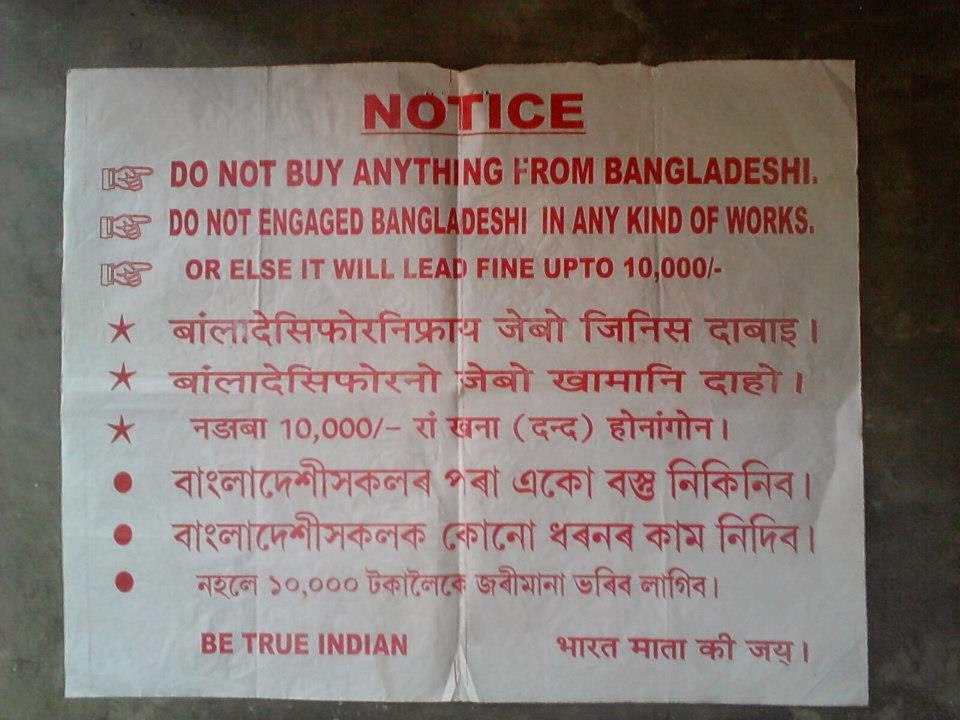
    Poster in Kokrajhar district during 2012 riots. Photo: Bonojit Hussain
    Like in 2012, immediately large section of Assamese society, a section of the national media and the BJP leadership raised the bogey of ‘illegal Bangladeshi’ to justify the killings and divert attention from the real causes of the massacre. Some even went to the extent of likening victims of the massacre with locust. Verbal attacks and abuses are also being launched on social media against anyone who dares question the hypocrisies of Assamese society. Recently an Assamese research scholar at Jawaharlal NehruUniversity was subjected to threats and abuses by Assamese xenophobes, she was also asked to re-locate to Bangladeshowing to her sympathies for these ‘locusts’.
    If one poses the question as to how these xenophobes know that Assam is being swarmed by ‘illegal Bangladeshis’, the answer is always about increasing visibility and numbers of Miyas (slur used to denote Muslim Bangladeshis) in urban clusters, new settlements in peripheries of forest land and settlements near river embankments. I argue this is a racist way of telling.
    It is a difficult question to answer how many undocumented Bangladeshis are there in BTAD area let alone in all of Assam. However, it is impossible to refute that from 1901 to 1941, encouraged by the colonial administration, over 10 lakhs migrated and settled in Assam from East Bengal. The geographical area of present day BTAD would fall under what were Goalpara and Kamrup districts during the colonial era. So, it is worth mentioning that East Bengali Muslim peasants first settled in undivided Goalpara district, before they spanned out to other parts of western and central Assam. The decadal growth of population in Goalpara district had shot up by 30 % as early as 1901-1911 compared to 1.4 % and 2 % in the preceding decades respectively. In 1921-1931, the decadal growth of population of Goalpara dropped to 15.8 % because most of the suitable wasteland in the district had already been occupied by immigrants who poured into the district in 1901-1921, and that the immigrants had found a larger scope for settling in Kamrup and Nagaon districts. During 1921 to 1931 Barpeta subdivision of Kamrup district saw an enormous 69 % increase in population. Between 1901 and 1931, 4.98 lakhs East Bengali Muslim peasants are recorded in Goalpara district alone. Here, then, the question arises – Where are the descendants of the lakhs of Muslim peasants of East Bengali descent who settled in the region before partition? (for a detailed discussion see, Banajit Hussain, “The Bodoland Violence and Politics of Explanation”; Seminar Magazine, No: 640, December, 2012)

     Considering the abysmal level of socio-economic development among Muslims of East Bengali descent in Assam, the reason for increasing numbers and visibility of the so-called Miyas in urban clusters, in the peripheries of forest land and near river embankments could very well be migration from rural areas to urban centres of Assam in search of livelihood. But more importantly it could be because of internal displacement from Char areas of Assam.
    Chars are the extremely braided mid-channel bar of Brahmaputra and its tributaries. These Chars were populated by Muslims of East Bengali descent for cultivation in the later decades of the Colonial era. Due to subsequent neglect and apathy of the Government the socio-economic indicators among Char dwellers have remained extremely depressing. Assam Government’s socio-economic survey in 1992-93 and 2002-03 revealed that Char dwellers constituted 9.35 % of the total population of Assam; the population density in the Chararea was 690 persons per sq. km (Assam’s overall density in 2001 was 340 person per sq. km); between 1992-93 to 2002-03 literacy rate in Char area increased marginally from 15.45 % to 19.31 % (Assam’s overall literacy rate in 2001 was 63.25 %); in 2002-03 67.90 % of Char dwellers lived below the poverty line, an increase of 19% from 1992-93 (34 % of Assam’s population was below poverty line in 2001).
    By their very nature of being integral part of the fluvial process of the river Brahmaputraand its tributaries, Chars are pre-disposed to erosion and Chardwellers pre-disposed to become internally displaced persons. Though hard data on displacement from char areas is hard to come by, some micro-level studies provide adequate insight into flood, erosion and displacement. One such study conducted by Dr. Gorky Chakraborty in the chars of Barpeta district reveals that “during the period (1989-98) when there was no high intensity flood in Assam, 45% of the total households were affected and 51% of the total land was lost by the surveyed char households. Similar study over a period of 25 years (1980-2004) in the Beki River, a tributary of Brahmaputra in Barpeta district reveals that 77% of the surveyed households suffered due to land erosion and 94% of their land was lost.” (Gorky Chakraborty, “Assam’s Hinterland: Society and Economy in the Char Areas”; Akansha Publishers, Delhi, 2009) With such abysmal socio-economic conditions and such high degree of erosion and displacement, lakhs of Chardwellers are left with no option but to migrate to the mainland.
    With such complexities involved in differentiating between an undocumented Bangladeshi migrant and a Muslim citizen of East Bengali descent; how do Assamese xenophobes and leaders of BJP conclusively declare that the villagers of Balapara, Narasinghbari and Narayanguri (3 villages where the massacre occurred) were ‘illegal Bangladeshis’?
    What are the ways of telling the difference? It is most certainly not difference but similarities between an undocumented Bangladeshi migrant and a Muslim citizen of East Bengali descent. It is physical and cultural markers; in this case it is beard, lungi, religion and language. Doesn’t this make ‘illegal Bangladeshi’ racist shorthand for any Muslim of East Bengali descent in Assam?
    Here it is worth looking at the cliché that are too often deployed – “illegal Bangladeshis are behind Rhino poaching, they loot innocent tribal villagers, they breed faster than dogs, rape and murder women in villages of Assam”. These clichés are becoming a part of a new discursive formation under consolidation which represents Muslims of East Bengali descent in Assam as “lesser human” or in its extreme form as “locust”. It hardly needs to be asserted that the construction of the “lesser human” other that is sexually virulent and is naturally prone to criminality has been the hallmark of racist worldview for more than half a century now.

    **********

    Banajit Hussain is a Delhi based researcher from Assam. He is associated with New Socialist Initiative (NSI). 

  • सिंगरौली में पुलिसिया दमन और कंपनियों के गठजोड़ के खिलाफ जनसंगठनों की लामबंदी तेज

    पुलिस की तानाशाही बनाम जनता के अधिकार के सवाल पर पूरी ताकत से बोलने की जरुरत है। अतः आप सबसे अपील है कि आप भी इस अन्याय, आत्याचार के खिलाफ शांतिपूर्वक तरीके से अपना विरोध दर्ज करवाने के लिए बड़ी संख्या में 19 मई को बैढन चलें। सिंगरौली में पुलिस और कंपनियों के गठजोड़ के खिलाफ़ सोमवार 19 मई 2014 को आयोजित एक दिवसीय विरोध प्रदर्शन के लिये संयुक्त रूप से जारी परचा;

    स्थान – माजन मोड़, बैढन
    समय- 19 मई 2014, सोमवार
    11 बजे दिन।

    सिंगरौली आज अपने सबसे कठिन दौर से गुजर रहा है। कंपनी के हितों की रखवाली के इस समय में सरकार के लिए आम जन जीवन चिंता का विषय नहीं है। पुलिस, न्यायपालिका और प्रशासन सब मिलकर बिजली बनाने वालों की हिमायत कर रहे हैं। स्थानीय लोगों ओर संसाधनों के शोषण से मुनाफा कमाने वाली इन कंपनियों की ताकत केवल पूंजी से ही नहीं आती बल्कि शासन-प्रशासन द्वारा की जाने वाली इनकी चैकीदारी से आती है।

    निगरी, चितरंगी, बंधौरा, अमलोरी, सासन, बर्गवा, महान आदि क्षेत्रों में जंगल बचाने और अपने अधिकारों के लिए लड़ रहे लोगों के आंदोलनों का जिस प्रकार पुलिस द्वारा दमन किया जा रहा है वह अन्यायपूर्ण है। सिंगरौली की जनता पुरुखों से जंगल पर निर्भर रही है। महुआ, तेंदू, पत्ता, लकड़ी, चार-चिरौंजी जैसी तमाम चीजें जंगल से मिलती रही हैं। गांव वालों की पूरी जीविका जंगल में है लेकिन कंपनी अपने फायदे के लिए इन जंगलों को खत्म करने पर तुली है। ऐसे में पुलिस को जनता की मदद करनी चाहिए थी लेकिन वो कंपनी के साथ मिलकर जनता के अधिकारों को कुचलने का ही काम कर रही है। लगातार हो रहे विस्थापन ने लोगों को अपने रहन-सहन, संस्कृति, व्यवसाय, नाते-रिश्तेदारों और ज्ञान की परम्परा से दूर कर दिया है।

    ऐसे में जब महान जंगल पर निर्भर गांव के लोगों के द्वारा महान संघर्ष समिति बनाकर जंगल पर अपने अधिकार की मांग की गई तो प्रशासन और पुलिस उनकी आवाज को दबाने का प्रयास कर रहा है। पुलिस ने 7 मई 2014 को महान संघर्ष समिति के कार्यकर्ताओं को अवैध रुप से रात के 12 बजे उठाया, आनन-फानन में फर्जी मुकदमे कायम किया। इन फर्जी मुकदमों से यही सन्देश मिलता है अन्यायकारी कंपनियों की खिलाफत को पुलिस अपनी खिलाफत के रुप में देखती है। जिले के आला आधिकारियों के निर्देशन में की गई यह दमनात्मक कार्रवायी इस बात का ऐलान है कि पुलिस हमारे लोकतांत्रिक अधिकारों को कुचलने के लिए तैयार बैठी है। यह इस बात का ऐलान है कि सिंगरौली के पास अन्याय सहने के सिवा और कोई चारा नहीं है।

    हमें इस साजिश के खिलाफ खड़े होने की जरुरत है। हम सब को आपसी एकता कायम करते हुए पुलिस-कंपनी गठजोड़ को तोड़ना होगा। अन्याय के विरोध के अपने अधिकार पर पुलिस द्वारा थोपे गए अघोषित आपातकाल को तोड़ना होगा। पुलिस की तानाशाही बनाम जनता के अधिकार के सवाल पर पूरी ताकत से बोलने की जरुरत है। अतः आप सबसे अपील है कि आप भी इस अन्याय, आत्याचार के खिलाफ शांतिपूर्वक तरीके से अपना विरोध दर्ज करवाने के लिए बड़ी संख्या में 19 मई को बैढन चलें।

    स्थान – माजन मोड़, बैढन
    समय- 19 मई 2014, सोमवार
    11 बजे दिन।
    सहयोगी संगठन
    महान संघर्ष समिति, मयुर संगठन-गोंदवाली,
    किसान आदिवासी विस्थापित एकता मंच,
     सर्वहित सेवा संस्थान, अमृता सेवा संस्थान, सुविधा सेवा संस्थान।

     सम्पर्क सूत्र- 7771008961, 8225935599
  • May 15: Dr Saibaba to go on hunger strike

    http://www.thehindu.com/news/cities/Delhi/dr-saibaba-to-go-on-hunger-strike/article6009542.ece ‘Dr. Saibaba to go on hunger strike’ Vijetha S. N Delhi University professor G. N. Saibaba, who was arrested by the Maharashtra police for alleged Maoist links and taken to the State, will go on a hunger strike from Thursday if conditions of his confinement do not improve. This was announced by his family, […]

  • Ras Baraka elected mayor of Newark

    Newark, NJ – The May 13 election of Ras J. Baraka as mayor of Newark is nationwide news, like the 1970 election of Kenneth Gibson. It arouses many expectations.

    Gibson was the first African American mayor of a major northeastern city. The Democratic Party bosses had their own candidate. A homegrown alliance upset the machine’s applecart. A historic Black and Puerto Rican Political Convention was held in 1969. It nominated Gibson and pulled off a major upset of the machine. The architect of the alliance was Amiri Baraka, the father of Ras Baraka.

    Gibson’s election came at time of social upheaval. The defeat abroad of the U.S. wars of aggression in Southeast Asia, the Civil Rights Movement and the succeeding Black Power Movement at home all combined to bring a time of political and ideological crisis. Amiri Baraka later said it was only the time of crisis that allowed for the defeat of the machine.

    There are many parallels today. U.S. imperialism is bogged down in stalemate and disaster in its many wars of aggression, all of which will sooner or later end in defeat. War weariness, worsening abuses of oppressed peoples, the growth of incredible wealth for a few while the majority face depression conditions and loss of constitutional rights have bred a climate of rebelliousness.

    Newark is the scene of a huge parental rebellion against the closing of schools by a state-imposed superintendent. Small children will have to travel around a large city due to the loss of neighborhood schools and district schools are being stripped of resources in favor of charter schools, etc. Youth unemployment, gang violence and imprisonment are acute problems that have gone on for years with nothing being done beyond a little lip service here and there.

    Baraka’s opponent, Shavar Jeffries, was lavishly funded, with at least $2 million to spend. He had the support of two Democratic Party bosses. Joseph D. Vincenzo (“Joey D” to those he likes) can sway any election in the northern part of the state and George Norcross runs things in the southern part. Democrat or Republican, it doesn’t much matter, one or the other of them can pretty much set you up. Both are close to Governor Chris Christie, who also supported Jeffries. Like previous Newark mayor Cory Booker, Jeffries got a totally artificial national media buildup. Jeffries’ big weak point is that he has no real history in Newark.

    In contrast, the Newark-born Ras Baraka, formerly a high school principal and city councilman, has been locally prominent in his own right for decades. He has long spoken out against police brutality, in defense of regular district public schools and on many other issues of immediate interest to the community. Thus the election was a notable test of people’s demands that their needs be met, versus Democratic Party routine. Baraka did not have as much money as Jeffries, but he benefited from a real popular enthusiasm among Newark’s large community of active and aware citizens. That more than made up the difference. The election returns showed him getting 54% of the vote. Just as in 1970, it was an outcome of a time of crisis.

    His written platform statements are much more extensive and detailed than usual – on jobs, education, economic development, etc. There are things that can and must be done. The schools have been controlled by the state since 1995 and the results are disastrous. The school system must be returned to local control, even if it takes a pitched people’s political battle to drive the state out.

    But no bones can be made about it: the possibilities of real benefit to the masses are limited. The city’s problems are the problems of capitalism itself. cannosult of the country having become too rich, or “es are limited. the many other issues of immediaIts finances are firmly in the grip of Wall Street and no election can change or ‘democratize’ that.

    Kenneth Gibson fell back into the Democratic Party mold within a few years. A small sector of middle income and moderately wealthy people benefited. Most did not. The way Gibson’s administration played out was a great lesson to many people, Amiri Baraka not least among them. The challenge before Ras Baraka is to continue to rely on the people and their struggle. More struggle, more active people, more aware people—that is the real criterion of progress.

  • Eastern Ukraine voters show courage, unity in the face of fascism

    Chicago, IL – In spite of the coup government in Kiev, an electoral referendum on autonomy saw huge voter turnout in Donetsk and Lugansk in the east of Ukraine. People lined the streets and waited patiently to cast their votes for self rule.

    The successful vote shows mass opposition to the U.S.-backed seizure of power in Kiev by fascists and pro-NATO oligarchs. On voting day, the U.S.-backed coup-makers in Kiev sent soldiers to intimidate voters, firing on civilian crowds and blocking polling stations with armed personal carriers. People still voted in big numbers.

    Joining the U.S. government in backing the fascists in Kiev are German Chancellor Merkel and French President Hollande. Together they declared the referendum on autonomy illegal, while supporting an unelected government in Kiev.

    Voter turnout reached over 74% in both regions of Ukraine. The referendums addressed the status of the regions, asking voters if they supported the act of state self rule. The results show the popularity and strength of the protest movement. Leading up to the vote, people occupied government, public and media buildings and set up barricades in the city. Some were killed resisting the Kiev coup government’s military crackdown in the eastern and southern parts of Ukraine. There are dramatic videos, one of unarmed civilians stopping a tank in the street at an intersection and the other of voters being shot at by soldiers outside a polling place. Last week in Odessa, fascists burned the trade union hall and murdered survivors of the fire.

    The results of the referendums were announced on May 12: in Donetsk 89.07% voted in favor of state self-rule; in Lugansk 96.2% voted in favor. Clearly the people have spoken: they oppose the U.S.-backed, fascist forces that overthrew the elected government in Ukraine.

    Still, U.S. corporate media tries to dismiss the results of these referendums as the work of a pro-Russian minority, despite Putin’s prior position that the referendums should be postponed. In reality, democratic and left forces such as the Borotba Union and the Communist Party of Ukraine promoted the referendum initiatives. The referendum is the work of brave people within Ukraine, not outside of it.

    The United National Antiwar Coalition (UNAC) is issuing a call for “Emergency Antiwar Actions” through May 26 to protest U.S./NATO war moves and to oppose the role of U.S. and NATO in Ukraine. The U.S. already spent $5 billion backing the fascist-dominated coup government. It is also being reported in Ukraine that 400 mercenaries from the U.S. private security firm Academi (formerly Blackwater) are participating in the Ukraine military attacks that are attempting to suppress the democratic opposition. NATO is positioning warships in the Black Sea in an attempt to bully Russia. This proves once again that the U.S. is not interested in peace or democracy; it is only interested in financial gain and global domination.

  • Professor GN Saibaba, Political Prisoner, ‘Kept in isolation, denied medication’

    By Prateek Goyal, Pune Mirror, May 14, 2014


    Andhra Pradesh Civil Liberties Committee appeals to State human rights commission, claiming G N Saibaba needs to be provided with basic facilities


    The Andhra Pradesh Civil Liberties Committee (APCLC) has appealed to the Maharashtra State Human Rights Commission (MSHRC), asking that wheelchair-bound Delhi University professor G N

  • China’s "War on Terror" by `James Corbett

    Uyghur disenfranchisement is played upon to foment Islamic radicalism and political separatist sentiment. 

    The East Turkestan Islamic movement seeking to wrest Xinjiang from China’s control offers a number of parallels to the shadowy “Al Qaeda” terror organization, including a mysterious leader living in a secret mountain base in Pakistan’s lawless border region and, as FBI whistleblower and

  • জেলখানায় সাংস্কৃতিক প্রতিরোধ

    – সব্যসাচী গোস্বামী প্রেসিডেন্সি জেলে থাকাকালীন হিন্দি ‘ভোর’ ম্যাগাজিনটা আমাদের হাতে আসে, সেখানে অধিকার আন্দোলনের নেত্রী সীমা আজাদের একটা হৃদয়গ্রাহী প্রবন্ধ আমরা পাই, যা পরে আমাদেরই একজন সাথী সুভাষ রায় বাংলায় অনুবাদ করেন, ‘গারদের আধার ফুঁড়ে ভোরের আলো’ শিরোনামে। প্রথমেই বলা ভাল সীমা আজাদ ও তার জীবন সাথী বিশ্ববিজয়কে উত্তর প্রদেশের পুলিশ একটি সাজানো মামলায় […]