Blog

  • ICE raids Milwaukee families’ homes and workplaces, community fights back

    Milwaukee, WI – Voces de la Frontera, Youth Empowered in the Struggle and community members protested at the U.S. Citizen and Immigration Services building in downtown here, May 29, to condemn the May 27 immigration raids. About 22 people were picked up and arrested at their homes and workplaces in the raids.

    The immigration sweep was carried out by Immigration and Customs Enforcement (ICE) in cooperation with the Milwaukee Police Department (MPD). The sweep was executed systematically, digging into government archives in order to find any excuse to validate the arrests. The victims that were picked up by the MPD were accused of bogus and irrelevant charges and included cases which had already been closed.

    The community members detained by the MPD are in diverse stages of the deportation process, with some of them already in the Juno, Wisconsin Detention center and some others in county jail on an ICE hold. After the arrests, MPD officers prevented any type of direct communication between the detainees and their loved ones or their lawyers. Eventually, lawyers were allowed to directly communicate with the detainees as their cases progressed.

    The actions carried out by ICE occurred due to a federal quota system known as the ‘bed mandate’, where all detention center beds need to be occupied.

    Community members at the rally condemned ICE’s and MPD’s actions and described them as variously as violent, unfair, appalling, inexcusable, inhumane and terroristic.

    “The raids happened at people’s homes in front of their families,” Cynthia Tellez, one of the attendees and member of Youth Empowered in the Struggle, commented on the incident. “How can this be done in the name of [national] security? That’s inhumane!”

    Another target of furious chants and speeches was the Service Employees International Union (SEIU) and other liberal organizations which are asking president Obama to delay any type of executive action to stop or reduce deportations. SEIU’s statement coincides with the same day the sweep happened.

    “The SEIU have sold out the movement in an attempt to win over the right wing on this issue. In the meantime, more than a thousand a day will continue to be deported,” said Sean Orr, a local immigrant rights activist. “Organized labor needs to support legalization for all, not more delays.”

    The organizers of the rally plan on continue the fight to free the 22 detainees and to prevent any more immigration raids. They have scheduled call-ins for the coming days. Here is the Facebook event: https://www.facebook.com/events/478322572314345/

  • More crimes of the Catholic Hierarchy in Ireland.

    Galway historian reveals truth behind 800 orphans in mass grave

    \"A

    A septic tank near a long abandoned workhouse in Galway was found to contain the bodies of up to eight hundred infants and children.
    There is a  growing international scandal around the history of The Home, a grim 1840’s workhouse in Tuam in Galway  built on seven acres that was taken over in 1925 by the Bon Secours sisters, who turned it into a Mother and Baby home for “fallen women.”
    The long abandoned site made headlines around the world this week when it was revealed that a nearby septic tank contained the bodies of up to eight hundred infants and children, secretly buried without coffins or headstones on unconsecrated ground between 1925 and 1961.
    ****http://www.irishcentral.com/opinion/cahirodoherty/Nuns-join-Irish-bankers-in-avoiding-justice-over-Magdalene-payments.html
    Now a local historian has stepped forward to outline the terrible circumstances around so many lost little lives.
    Catherine Corless, the local historian and genealogist, remembers the Home Babies well. “They were always segregated to the side of regular classrooms,” Corless tells IrishCentral. “By doing this the nuns telegraphed the message that they were different and that we should keep away from them. 
    “They didn’t suggest we be nice to them. In fact if you acted up in class some nuns would threaten to seat you next to the Home Babies. That was the message we got in our young years,” Corless recalls. 
    Now a dedicated historian of the site, as a schoolgirl Corless recalls watching an older friend wrap a tiny stone inside a bright candy wrapper and present it as a gift to one of them.
    “When the child opened it she saw she’d been fooled,” Corless says. “Of course I copied her later and I tried to play the joke on another little Home girl. I thought it was funny at the time.”
    But later – years later – Corless realized that the children she taunted had nobody. “Years after I asked myself what did I do to that poor little girl that never saw a sweet? That has stuck with me all my life. A part of me wants to make up to them.”
    Surrounded by an eight-foot high wall, Tuam, County Galway locals say that they saw little to nothing of the daily life of The Home or of the pregnant young mothers who arrived and left it without a word over the decades. 
    In the few surviving black and white photographs taken at the site no child is smiling. Instead they simply frown at the camera, their blank stares suggesting the terrible conditions.
    A local health board inspection report from April 1944 recorded 271 children and 61 single mothers in residence, a total of 333 in a building that had a capacity for 243.
    The report described the children as “emaciated,” “pot-bellied,” “fragile” with “flesh hanging loosely on limbs.” The report noted that 31 children in the “sun room and balcony” were “poor, emaciated and not thriving.” The effects of long term neglect and malnutrition were observed repeatedly. 
    Children died at The Home at the rate of one a fortnight for almost 40 years, one report claims. Another appears to claim that 300 children died between 1943 and 1946, which would mean two deaths a week in the isolated institution.
    In The Home’s 36 years of operation between 1926 and 1961 some locals told the press this week of unforgettable interactions with its emaciated children, who because of their “sinful” origins were considered socially radioactive and treated as such.
    One local said: “I remember some of them in class in the Mercy Convent in Tuam – they were treated marginally better than the traveler children. They were known locally as the “Home Babies.” For the most part the children were usually gone by school age – either adopted or dead.”
    Thanks to Corless’ efforts we now know the names and fates of up to 796 forgotten infants and children who died there, thanks to her discovery of their death records when researching The Home’s history. 
    “First I contacted the Bon Secours sisters at their headquarters in Cork and they replied they no longer had files or information about The Home because they had left Tuam in 1961 and had handed all their records over to the Western Health Board.” 
    Undaunted, Corless turned to The Western Health Board, who told her there was no general information on the daily running of the place.
    “Eventually I had the idea to contact the registry office in Galway. I remembered a law was enacted in 1932 to register every death in the country. My contact said give me a few weeks and I’ll let you know.”
    “A week later she got back to me and said do you really want all of these deaths? I said I do. She told me I would be charged for each record. Then she asked me did I realize the enormity of the numbers of deaths there?”
    The registrar came back with a list of 796 children. “I could not believe it. I was dumbfounded and deeply upset,” says Corless. “There and then I said this isn’t right. There’s nothing on the ground there to mark the grave, there’s nothing to say it’s a massive children’s graveyard. It’s laid abandoned like that since it was closed in 1961.”
    ****http://www.irishcentral.com/news/Memorial-campaign-underway-for-forgotten-grave-of-800-babies-in-Galway.html
    The certificates Corless received record each child’s age, name, date – and in some cases – cause of death. “I have the full list and it’s going up on a plaque for the site, which we’re fundraising for at the moment. We want it to be bronze so that it weathers better. We want to do it in honor of the children who were left there forgotten for all those years. It’s a scandal.”
    Corless believes that nothing was said or done to expose the truth because people believed illegitimate children didn’t matter. “That’s what really hurts and moved me to do something,” she explains.
    During its years of operation the children of The Home were referred to as “inmates” in the press. It was believed by the clergy that the harsh conditions there were in themselves a form of corrective penance. The state, the church and their families all failed these women, Corless contends. 
    But even now the unexpected difficulty that the local committee Corless has joined to fundraise for a plaque to remember the dead children suggests that not everyone wants to confront the truth about the building’s tragic past.
    “I do blame the Catholic Church,” says Corless. “I blame the families as well but people were afraid of the parish priest. I think they were brainwashed.  I suppose the lesson is not to be hiding things. To face up to reality. 
    “My fear is that if things aren’t faced now it’s very easy to slide back into this kind of cover-up again. I want the truth out there. If you give people too much power it’s dangerous.”
    Living and dying in a culture of shame and silence for decades, the Home Babies’ very existence was considered an affront to Ireland and God. 
    It was a different time, some defenders argued this week, omitting to mention that the stigmatizing silence that surrounded The Home was fostered by clerics. Indeed the religious orders were so successful at silencing their critics that for decades even to speak of The Home was to risk contagion.
    And now that terrifying era of shame and silence is finally lifting, we are left to ask what all their lonesome suffering was in aid of, and what did it actually achieve?
    To donate to the memorial for the mothers and babies of The Home, contact Catherine Corless at catherinecorless@hotmail.com.

    There is a growing international scandal around the history of The Home, a grim 1840’s workhouse in Tuam in Galway built on seven acres that was taken over in 1925 by the Bon Secours sisters, who turned it into a Mother and Baby home for “fallen women.”

    The long abandoned site made headlines around the world this week when it was revealed that a nearby septic tank contained the bodies of up to eight hundred infants and children, secretly buried without coffins or headstones on unconsecrated ground between 1925 and 1961. Now a local historian has stepped forward to outline the terrible circumstances around so many lost little lives.

    Catherine Corless, the local historian and genealogist, remembers the Home Babies well. “They were always segregated to the side of regular classrooms,” Corless tells IrishCentral. “By doing this the nuns telegraphed the message that they were different and that we should keep away from them.

    “They didn’t suggest we be nice to them. In fact if you acted up in class some nuns would threaten to seat you next to the Home Babies. That was the message we got in our young years,” Corless recalls.
    Now a dedicated historian of the site, as a schoolgirl Corless recalls watching an older friend wrap a tiny stone inside a bright candy wrapper and present it as a gift to one of them.

    “When the child opened it she saw she’d been fooled,” Corless says. “Of course I copied her later and I tried to play the joke on another little Home girl. I thought it was funny at the time.”

    But later – years later – Corless realized that the children she taunted had nobody. “Years after I asked myself what did I do to that poor little girl that never saw a sweet? That has stuck with me all my life. A part of me wants to make up to them.”

    Surrounded by an eight-foot high wall, Tuam, County Galway locals say that they saw little to nothing of the daily life of The Home or of the pregnant young mothers who arrived and left it without a word over the decades.

    In the few surviving black and white photographs taken at the site no child is smiling. Instead they simply frown at the camera, their blank stares suggesting the terrible conditions. A local health board inspection report from April 1944 recorded 271 children and 61 single mothers in residence, a total of 333 in a building that had a capacity for 243.

    The report described the children as “emaciated,” “pot-bellied,” “fragile” with “flesh hanging loosely on limbs.” The report noted that 31 children in the “sun room and balcony” were “poor, emaciated and not thriving.” The effects of long term neglect and malnutrition were observed repeatedly.

    Children died at The Home at the rate of one a fortnight for almost 40 years, one report claims. Another appears to claim that 300 children died between 1943 and 1946, which would mean two deaths a week in the isolated institution.

    In The Home’s 36 years of operation between 1926 and 1961 some locals told the press this week of unforgettable interactions with its emaciated children, who because of their “sinful” origins were considered socially radioactive and treated as such.

    One local said: “I remember some of them in class in the Mercy Convent in Tuam – they were treated marginally better than the traveler children. They were known locally as the “Home Babies.” For the most part the children were usually gone by school age – either adopted or dead.”

    Because of Corless’ efforts we now know the names and fates of up to 796 forgotten infants and children who died there, thanks to her discovery of their death records when researching The Home’s history.

    “First I contacted the Bon Secours sisters at their headquarters in Cork and they replied they no longer had files or information about The Home because they had left Tuam in 1961 and had handed all their records over to the Western Health Board.”

    Undaunted, Corless turned to The Western Health Board, who told her there was no general information on the daily running of the place.

    “Eventually I had the idea to contact the registry office in Galway. I remembered a law was enacted in 1932 to register every death in the country. My contact said give me a few weeks and I’ll let you know.”

    “A week later she got back to me and said do you really want all of these deaths? I said I do. She told me I would be charged for each record. Then she asked me did I realize the enormity of the numbers of deaths there?”

    The registrar came back with a list of 796 children. “I could not believe it. I was dumbfounded and deeply upset,” says Corless. “There and then I said this isn’t right. There’s nothing on the ground there to mark the grave, there’s nothing to say it’s a massive children’s graveyard. It’s laid abandoned like that since it was closed in 1961.”

    The certificates Corless received record each child’s age, name, date – and in some cases – cause of death. “I have the full list and it’s going up on a plaque for the site, which we’re fundraising for at the moment. We want it to be bronze so that it weathers better. We want to do it in honor of the children who were left there forgotten for all those years. It’s a scandal.”

    Corless believes that nothing was said or done to expose the truth because people believed illegitimate children didn’t matter. “That’s what really hurts and moved me to do something,” she explains.

    During its years of operation the children of The Home were referred to as “inmates” in the press. It was believed by the clergy that the harsh conditions there were in themselves a form of corrective penance. The state, the church and their families all failed these women, Corless contends.

    But even now the unexpected difficulty that the local committee Corless has joined to fundraise for a plaque to remember the dead children suggests that not everyone wants to confront the truth about the building’s tragic past.

    “I do blame the Catholic Church,” says Corless. “I blame the families as well but people were afraid of the parish priest. I think they were brainwashed.  I suppose the lesson is not to be hiding things. To face up to reality.

    “My fear is that if things aren’t faced now it’s very easy to slide back into this kind of cover-up again.

    I want the truth out there. If you give people too much power it’s dangerous.”
    Living and dying in a culture of shame and silence for decades, the Home Babies’ very existence was considered an affront to Ireland and God.

    It was a different time, some defenders argued this week, omitting to mention that the stigmatizing silence that surrounded The Home was fostered by clerics. Indeed the religious orders were so successful at silencing their critics that for decades even to speak of The Home was to risk contagion.

    And now that terrifying era of shame and silence is finally lifting, we are left to ask what all their lonesome suffering was in aid of, and what did it actually achieve?

    To donate to the memorial for the mothers and babies of The Home, contact Catherine Corless at catherinecorless@hotmail.com.

  • U.S. trying to oust Assad by any means possible, aims for compliant Syria

    Editors note: Prominent Chicago- based anti-war activist Joe Iosbaker is in route to Damascus, Syria where he will participate in a delegation of observers for the Syrian election’s. Fight Back! will publish commentary by Iosbaker as we receive it.

    Beirut, Lebanon – In a front page story, May 30, headlined “Foreign Jihadis in Syria Pose Risk to West,” the New York Times reports that the U.S. and the UK are concerned about the blowback from the U.S./NATO war on Syria. Hundreds of sectarian fighters have been recruited from the UK and France, and according to the U.S. government, 70 from the US. The article describes efforts by Al Qaeda groups to prepare these recruits to “strike back home.”

    In President Obama’s speech at West Point this week, he announced plans for increasing U.S. support for “moderates” among the Free Syrian Army (FSA). This is another effort to get their war in Syria on course. But this aid to so-called moderates is for public relations in the West. The FSA is not a unified, disciplined army. It is well known that weapons provided to a ‘moderate’ reactionary force today end up in the hands of the most brutal of the sectarian forces tomorrow.

    The most successful armies fighting to overthrow Syria’s government are those of the Al Qaeda-affiliated Al Nusra Front and the Islamic State in Iraq and Syria (ISIS). Fighters tired of losing will join them. In the fall, the largest of the brigades linked to the U.S.-supported Syrian National Council crossed over and announced they would be affiliating with the Nusra Front.

    To spell it out, the U.S. support of the ‘moderates’ won’t achieve the stated objective of countering the influence of sectarians. So what is the real objective of the White House?

    Ousting Assad by any means

    For three years, the U.S. has funded foreign-led, foreign-dominated armies in Syria. U.S. allies Saudi Arabia, Qatar and Turkey have been responsible for most of the direct aid and delivered most of the weapons. The U.S. began directly providing small arms and other battlefield equipment in the summer of 2013, but was involved from the outset in vetting the forces that the Qataris were backing.

    In the U.S., the Obama administration and the mainstream media stick to the mantra that the U.S. allies operate independent of Washington. This is a pretty weak story. Over a year ago, the New York Times revealed that back in 2011, the CIA had been in the Qatari cabinet meetings where the decisions were being made about which of the Syrian fighters to arm. More than that, the Gulf States and Turkey would never have made those moves if the U.S. hadn’t given them the OK.

    The monarchies in the Gulf States have supplied several billion dollars worth of arms, not just to any of the fighters arrayed against the Syrian Arab Army; they have especially backed the most sectarian of those. Saudi Arabia is the main backer of those linked to Al Qaeda. If Washington truly wanted that stopped, how could the Saudi’s have continued it? The tail doesn’t wag the dog.

    New rhetoric, unchanged U.S. objective

    Increased U.S. training of the ‘moderates’ in the FSA has two purposes. The main goal of everything the U.S. is doing in Syria is to get a government that is compliant with U.S. and Israeli wishes. They have decided that President Assad must go.

    But the problems with the jihadists are something that the U.S. has to address. The imperialists have to be concerned that the fighters will move against targets other than Assad – Israel, for example. Or returning to the U.S. or the UK. This is a public relations problem, as well as a military matter.

    But bad PR won’t stop the U.S. from their course: using any means necessary to achieve their objective in Syria. The anti-war movement must build the movement against the U.S. war of intervention in Syria. We have our work cut out for us.

  • Eyewitness to Syria presidential election: Is the end to the U.S. war in sight?

    Damascus, Syria – Ten people from the U.S., Canada and Ireland have traveled to Syria to observe the presidential elections taking place here June 3. Our delegation is mainly anti-war and international solidarity activists who are members of organizations including the International Action Center, Syria Solidarity Committee, the Anti-War Committee-Chicago, the United National Antiwar Coalition and the International Solidarity Movement. We are hosted by a Iranian non-governmental organization, the International Union of Unified Ummah (Muslim community).

    Since arriving in Damascus yesterday, we’ve had several meetings with officials and experts to get an understanding of the elections and what’s at stake. Our first meeting was with Dr. Bassam Abu Abdallah, a local member of the nationalist Baath Party and director of the Damascus Security Center. He talked about how this will be the first multi-party election for president. The rules of the election were established in a new constitution voted on last year.

    The three candidates on the ballot were selected from an initial list of 24. The requirements to run include being Syrian, having lived in the country for at least the last ten years, and having the endorsement of 35 members of the national assembly. Previously, the Baath Party was constitutionally the only party that could lead the government. This change was a big concession to demands raised by the protests in the Arab Spring in 2011.

    Dr. Abu Abdallah was asked if the elections would have an effect on the armies fighting the government. He answered yes, that it will demoralize them, saying, “First, they see that the U.S. won’t send troops. They’re tired of fighting and they have no vision, other than dying and going to paradise.”

    As with the liberation of the Old City in Homs, the mercenaries can see the writing on the wall. “First we put them under siege. The foreign-backed armies previously had perhaps 500,000 with them. Now they have only 100,000. Our soldiers in the Syrian Arab Army [SAA] will continue to fight until the last centimeters of land,” Abdullah added.

    Election commission

    On the second day, we met with the election commission. Hasham Al Shaher, the commission head, told us we were free to go where we wanted to observe at the polling places. Some will go to Homs, or Atakia and others will stay in Damascus.

    He explained that the commission is independent of the administration and appointed to four-year terms. People over 18 years of age (15 million people) are eligible to vote. All that is needed to vote is to be a citizen and to have an ID. No one is required to register in advance.

    The Western media was stunned when hundreds of thousands of refugees turned out to vote in Beirut in neighboring Lebanon. It turns out that the commissioners were surprised by the turnout as well. As a result, many thousands were turned away. The Lebanese authorities told them if they returned to Syria to vote, they’d be denied re-entry into Lebanon.

    The outpouring was overwhelmingly people wanting to vote for the current president, Bashar al Assad. Coming from people displaced by the war, this was a clear message of opposition to the so-called rebels. Commissioner Al Shaher said, “This shows the insistence and nationalist feelings of the Syrians. Over 95% of those eligible registered to vote.”

    Speaker of the Parliament

    Speaker of the Parliament Jihad Laham described the political situation they are facing with this war. “We take issue with the criminal American policy to Syria and Palestine. China and Russia have used their veto power to stop the criminal war, while the U.S. has used their veto power 60 times to shield Israel.”

    “Unfortunately,” he continued, “we live in dog eat dog times, where the powerful eat the less powerful.” He explained that they had invited parliamentarians to see the truth, but U.S. and NATO governments pressured them not to. “The U.S. is partnered with Saudi Arabia, which has no elections.”

    He told us, “Most of the organizations fighting have extreme Islamic orientation. Syria has survived because we are in the right.” The speaker related some of the features of the social program of the government. “Basic food is subsidized: two kilos of bread is less than 10 cents. Education is free. Health care is free. Fuel is subsidized.”

    Returning to the countries behind the war, he continued, “Where did the rebels get their weapons? From neighbors with the support of the U.S. and NATO.”

    Regarding the moment of the chemical weapon attack last summer that was President Obama’s ‘red line,’ upon which he threatened to hit Syria with hundreds of cruise missiles, the speaker said, “Syria had requested the U.N. to investigate a sarin gas attack in March 2013. It took three months for the inspection committee to arrive, and just then, there was another attack in the Damascus suburb of Ghouta.”

    He denied the use of sarin by the government forces, noting, “The SAA is victorious daily; why would we need sarin?”

    A question was asked about U.S. objectives and next steps after the election. Laham replied, “The U.S. plan is unchangeable, but sometimes they are forced to delay.” This helped make it clear to the anti-war forces in the room that we had to return to the U.S. and educate people about what we learn from the elections, in order to win people to taking a stand against the U.S. war which has already killed as many as 160,000 people.

  • Trade Unionists Denounce the Coup d’état

    Trade Unionists Denounce the Coup d’état

    Numnual  Yapparat

    The role of trade unions in Thai politics has been misrepresented by the right-wing union bureaucrats from the state enterprises, such as the government savings bank, electricity generation, water, railways and Thai Airways. In previous months, some of these bureaucrats and their followers, stood side by side with Sutep’s mob to overthrow the elected government. They are well-known for being conservative trade unionists as well as kowtowing to the army. Yet, the majority of employees in the state enterprises do not share their views.

    protest-at-moratuwa

    Today, some progressive trade unions have issued a statement to denounce the coup d’état and the right-wing unionists who support the coup. They call themselves the “Anti-Coup Workers Group”

    “Turnleft Thailand” had a chance to interview one of the “Anti-Coup Workers Group” activists from the factory belt on the outskirts of Bangkok. 

    How will workers be affected by the coup?

    The most obvious thing is that workers cannot exercise their rights freely under the imposition of martial law. This is the period for negotiating mid-year bonuses. Many will not dare to come out to fight for better working conditions. Normally workers will put pressure on employers by protesting in front of factories while negotiations are taking place. This is banned under military rule.

    How can workers cope with the dictatorship?

    Basically, we try to protest against the coup by every means possible, such as wearing anti-coup t-shirts, circulating news in Facebook, issuing statements against the coup and distributing these statements secretly in factories or by placing leaflets in shopping mall toilets close to factory areas. These activities cannot be done openly and take time. We are trying to spread these activities to other provinces too.  We are scared like other people and do not want to get arrested, but we have no choice but to fight back. 

    What are the future tasks for workers? How can workers’ struggles become a part of fighting for democracy?

    There is no question that in the future we shall have to join the general struggle for democracy in society in order to strengthen it. We also will be contacting our international union affiliations to gain solidarity for our demands about democracy and elections.

    Our demands are shown in the statement below. 

    Do the rank and file union members care about the coup?

    Rank and file union members understand democracy better than some of their leaders who gave food and water to soldiers. Impressively, the rank and file workers came out to berate, as well as threaten, the union leaders that they will not pay union fees and not engage with union activities if the leaders carry on like this. Some workers even demanded that their leaders help them to take part in anti-coup activities.

    Statement

    By

    The Anti-Coup Workers Group

    We are the “Anti-Coup Workers Group” from industrial areas on the outskirts of Bangkok. We want to state our opposition to this coup d’état. The army stepped on our hearts and crushed the wishes of the majority of democratic Thai citizens. The coup destroyed our freedom of speech and the basic right to exercise our political views. Under normal circumstance, workers’ rights are already limited in order to favour the employers. Under the dictatorship our situation will go from bad to worse.

    In previous history, workers have always had an important role in the fight against the dictatorship. In the past, after previous coups, military governments have issued new laws that severely limit workers’ rights.

    We were very ashamed when we saw some sections of the trade union movement engaging with the anti-democratic thugs which sought to overthrow the elected government.

    The Anti-Coup Workers Group demands….

    • The immediate cancellation of martial law
    • An end to the coup
    • Power to be returned to the people
    • The unconditional release of all arrested people
    • No amnesty bill to white wash the military’s crimes

    Filed under: Thai politics Tagged: Against coup Thailand, Thai politics, Trade Unionists

  • Protest rape & murder of Dalit & tribal women in India at Indian High Commission London on 4th June 2014

    Wednesday 4 June  4.30pm Protest rape & murder of Dalit & tribal women in India

    Indian High Commission, The Aldwych, London WC2 (nearest tube: Holborn) Organised by Freedom Without Fear Platform


    Please come and support this important protest.  On 28 May, two teenage girls were brutally gang raped and lynched by higher class landowners in Uttar Pradesh, India. Hundreds of villagers,

  • Democracy and Class Struggle Salutes the Merthyr Revolt of 1st – 7th of June 1831

    They have talked of Merthyr Tydfil
    wherever men were freeTo honour those who toiled and diedfor human libertyAnd men have told her troubled taleto spur the sons of menWhen hopes were faint or flagging,to lift their hearts againby Idris Davies

  • How Did the BJP Sweep the Polls in 2014?

    By Deepankar Basu Spread over a period of more than a month from April 7 to May 12 in 2014, close to 554 million voters in India chose 543 candidates to the 16th Lok Sabha, the lower house of the parliament. The voter turnout of 66.48 percent – 554 million voters from an electorate of […]

  • A Level Playing Field? Global Sport in the Neoliberal Age

    – Mike Marqusee
    One of the hallmarks of the neo-liberal age has been the exponential expansion of commercial spectator sport – in its economic value, political role and cultural presence. All of which will be thrown into high relief during the coming World Cup.
    In recent years, the industry has grown in all regions above the local GDP rate, and is estimated to have generated $135 billion in direct revenues in 2013. These revenues derive from four elements: gate receipts, corporate sponsorship, media rights and merchandising. Revenues from sponsorship and media rights have grown fastest and together now make up over half of total revenue. But whereas in North America and Europe, gate receipts remain the single biggest source of revenue, in the BRIC counties and in Asia as a whole sponsorship is now the biggest money-spinner, accounting in China for 48% of total sports revenues. Meanwhile, though merchandising is marginal in most of the world, it is significant in north America, where it accounts for 25% of revenues.
    Despite its growth, the sports industry, narrowly defined, is still dwarfed by the pharmaceutical ($1.1 trillion a year) and automotive ($1.8 trillion) sectors. But direct revenues tell only a part of the story. Sport is interwoven with other industries: footwear, sportswear, soft drinks, advertising, among others. It’s a central driver in media industries – print, broadcast and digital. And it’s critical to the gambling industry, legal and illegal, with betting on sports estimated to be worth between $700bn and $1tn a year.
    Sport has become a fertile zone of capitalist intersection and mutual aggrandisement. It should therefore not be surprising that it has also become a major carrier of neo-liberal ideology, used to promote a competitive individualism in which the pursuit of victory and success is presented as the purest form of personal self-expression. Nike is the obvious example, with its injunctions to “just do it” and “risk everything” and its strategic linkage to sports superstars. What is celebrated is a “triumph of the will” – in which adverse circumstances are made to bow to individual desire. It’s a version of what has been described as “magical voluntarism”, identified by Mark Fisher as a key component of today’s dominant ideology.
    It needs to be said that this ethos of egocentric assertion is by no means inherent in sport, which is not about ‘the law of the jungle’ or a ‘war of all against all’. On the contrary, it’s a competitive activity built on a cooperative basis, requiring mutual agreement among competitors and between competitors and spectators. And it is intensely regulated; in fact, without the regulation, the sport vanishes. Team sports, of course, set a premium on interdependence and a willingness to sacrifice individual priorities for the good of the collective. But even the most successful individual competitors are what they are only because they enjoy a network of personal and social support. No one can ever “just do it” on their own.
    One of the favourite metaphors of advocates of capitalist globalisation is borrowed directly from sports. They hunger for a world-wide “level playing field” in which competition flourishes freely and fairly. However, as in so many spheres, the impact of neo-liberal globalisation on sport itself has been to create an increasingly uneven playing field, marked by widening inequalities.
    As the major male sports swallow an ever increasing share of sports revenues and investment, other sports are pushed to the margin. In south Asia, cricket is so dominant that it has rendered hockey, at which India and Pakistan excelled for decades, nearly invisible. While women’s sports have enjoyed increased revenues in absolute terms, the growth of male sports means that women still receive only 0.5% of corporate sports sponsorship.
    Elite male European football now accounts for more than 35% of global sports revenues; a similar share goes to the Big Four North American team sports (baseball, basketball, ice hockey and American football). Within European football, the five biggest leagues comprise half the total market and the top 20 teams one-quarter of that market.
    The English Premier League breakaway in the early 90s has proved to be a watershed. The big clubs’ main motive was to maximise their share of broadcasting revenues. Since then, the tendency has been for the rich teams to get richer, while the rest face perpetual insecurity. In effect, the billionaire backed clubs are now hoarding the best players, making it even harder for others to compete with them. UEFA has introduced its Financial Fair Play rules in an attempt to restrain the growing inequality, but they are unlikely to affect the overall imbalance.
    Meanwhile, European football recruits extensively from Latin America and Africa, whose domestic competitions are thereby weakened. Compounding the talent drain, globalised broadcasting has in many regions made Europe’s big clubs more famous and more widely followed than local teams.
    The general trend towards a concentration of wealth and power is neatly illustrated by recent events in world cricket. Earlier this year, the three richest cricket boards – India, England and Australia – combined forces to impose a new order on the ICC, the game’s governing boy. From now on the Big Three will take home a larger share of the game’s global revenues, dictate unilaterally which other teams they’ll play and how often, and wield an effective veto on all ICC decisions. There’s also a plan to introduce a two division structure for Test cricket, with a telling wrinkle in the scheme: none of the Big Three are ever to be relegated to the second division. So their standing in the competition will be guaranteed not by the quality of their cricket but by their financial clout.
    Unpredictability and spontaneity are at the heart of sports, and they are at odds with the capitalist drive to maximise profits and eliminate variables. An extreme example is bookmakers who seek to fix results, thus guaranteeing the return on their investment. But sponsors too would prefer some WWE-like scripted entertainment: no annoying upsets or injuries or mysterious losses of form to compromise their projections. The problem for them is that their property would forfeit all value should it be seen to be scripted.
    So there’s a tension between capitalist imperatives and sporting imperatives. In fact, the whole idea of sports competition as a mirror or metaphor for capitalist competition is misconceived. The ‘level playing field’ in sport is constituted by a rigid scaffolding of rules without which the competition dissolves. Capitalism’s version is a deregulated arena of limitless accumulation. The aim of capitalist competition is to eliminate (or acquire) the competitor. In sport, you need the opponent to survive and return for the next match or season, which always begins the contest afresh. And of course, what’s at stake in the two types of competition is fundamentally different. The penalties for coming second do not compare.
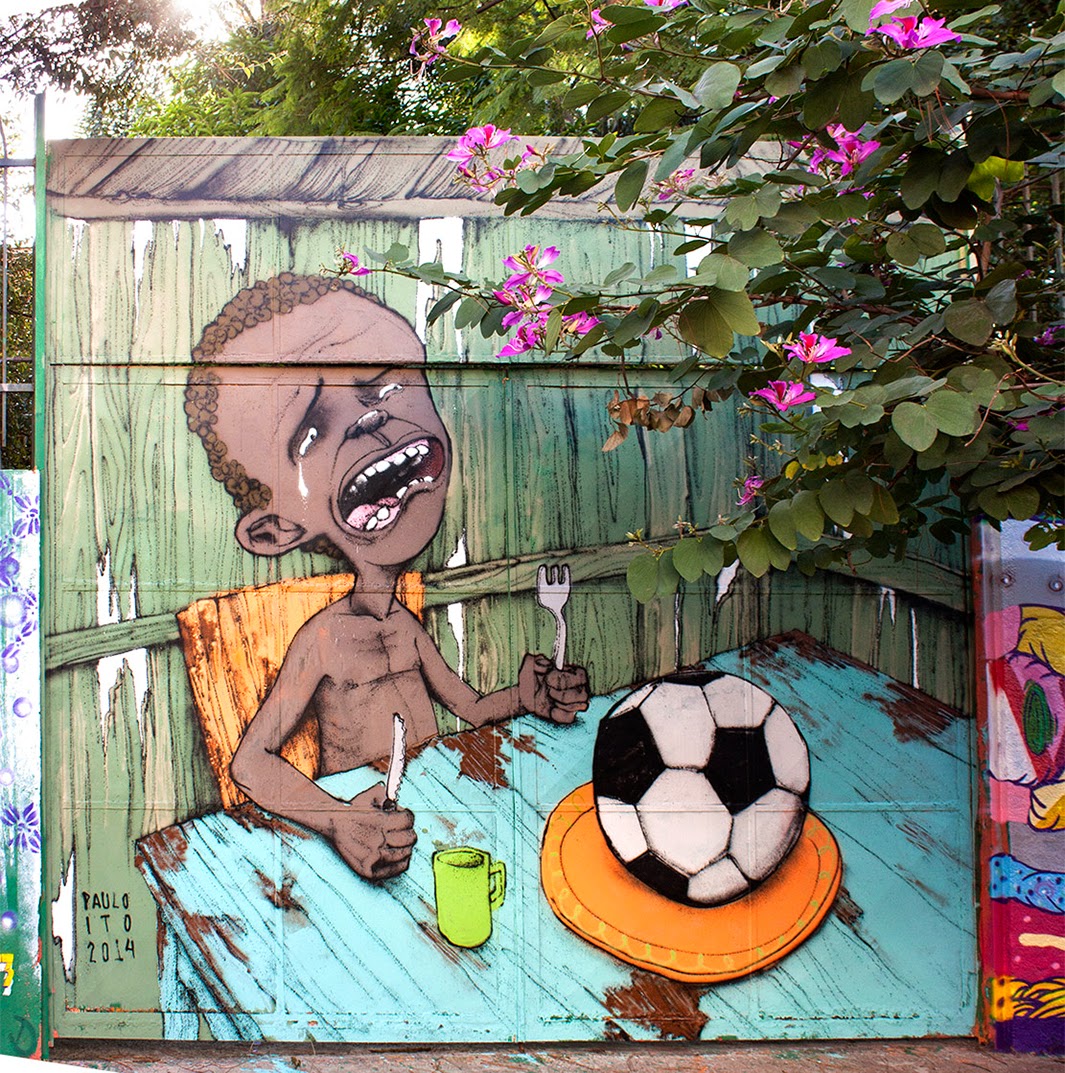
    Mural by Brazilian artist Paulo Ito
    All the contradictions of commercial spectator sport will be on display, in heightened form, in this year’s World Cup. Dave Zirin, in his invaluable new book, Brazil’s Dance with the Devil, shows how this sporting mega-event has become a carnival of state-sponsored neo-liberalism, characterised by mass evictions, gentrification, increased repression and surveillance, vast expenditure on redundant facilities and corporate plundering of public funds. It’s a boon for the construction, property, security and media industries, but a bane for many others, as was demonstrated last year, when huge numbers of Brazilians took to the streets to protest against the World Cup priorities that have skewed the country’s development.
    World Cup boosters claim that once the competition is underway and “the ball is rolling” all the discontents will vanish. What’s certain is that there will be a concerted effort to convince us that this is so. Those who persist in talking about the social cost underlying the festivities will be condemned as killjoys and nay-sayers. We are cast as consumers and nothing but consumers, expected to imbibe the corporate-branded spectacle without qualms or conscience. In that context, engaging critically with sports, seeing them as part of the broader human current, becomes a necessary subversive act. FIFA and its corporate partners have a vested interest in promoting tunnel vision, but the rest of us do not. Enjoyment of the football and critique of its context can and should go hand in hand. The idea that one excludes the other is a myth we need to shed.
    **********
    Mike Marqusee is a political activist and writer who writes on politics, culture and sports. He has authored several books including “Redemption Song: Muhammad Ali and the Spirit of the Sixties”; “Chimes of Freedom: the Politics of Bob Dylan’s Art” ; “If I Am Not for Myself: Journey of an Anti-Zionist Jew”; “Street Music: Poems by Mike Marqusee”.

    This article first appeared on author’s own website www.mikemarqusee.com
  • The disgrace of the Maidan leftists by Dave Stockton

    One of the most striking features of the events in Ukraine, both before and after the February coup, was the disgraceful response of some groups on the British and international left, including Socialist Resistance (British section of the Fourth International).

    First they denied the fundamentally reactionary nature of the Maidan movement. Then, when the far-right and fascist parties seized