Author: New Socialist Initiative Delhi Chapter

  • Is Past a Foreign Country?: Thinking About Adam Ajmeris in Saffron Times

    – Subhash Gatade
    “The past is a foreign country; they do things differently there.” – L.P. Hartley, The Go-Between
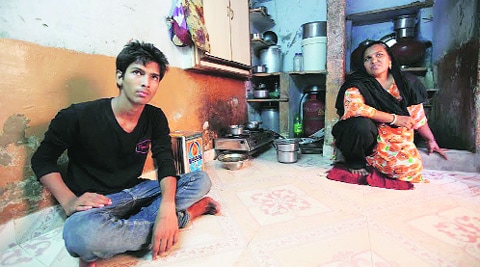
    Sixteen year old Shahwan, from Ahmedabad, who is still waiting for his Class X results, was extremely happy that day, when India’s electorate gave its verdict. He hugged his Ammi and went out in his Mohalla along-with his brother Almas, yelling ‘we have won’, ‘we have won’. And not only Shahwan and his family members but one could witness similar joy in the houses of Mohammad Salim Hanif Sheikh, Abdul Qayyum Mansuri alias Mufti Baba and several others.
    Interestingly Shahwan’s tremendous joy with tears flowing down the eyes of his Ammi Naseem (40) had nothing to do with the fact that Mr Narendra Damodardas Modi, had delivered a ‘historic victory’ to the BJP.
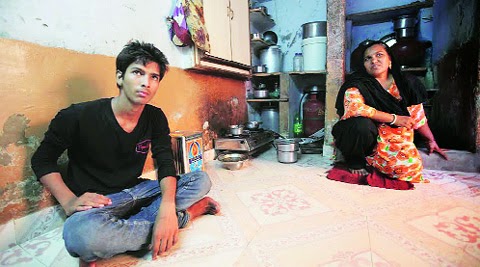
    Shahwan and his mother. File photo: Indian Express
    It was a strange coincidence that the day India’s electorate decided to give a mandate to the Modi led BJP to rule the country for coming five years also happened to be the day when Supreme Court of India in a historic judgment overturned a controversial decision take by him as home minister. It was related to the prosecution of those arrested for Akshardham attack under now lapsed Prevention of Terrorism Act (POTA).
    Perhaps not very many people would remember today how Akshardham Mandir in Ahmedabad was attacked by two terrorists killing 37 people and injuring several others way back in September 2002. It was reported that both the terrorists were killed by commandos on the spot itself. Shahwan’s father Adam Sulaiman Mansuri alias Adam Ajmeri, a poor mechanic along-with four others were arrested from Shahpur and Dariapur areas of Ahmedabad in August 2003 by the anti-terrorism squad of the Ahmedabad police for their alleged role in the attack. The sixth accused was nabbed from Uttar Pradesh a few days later. The lower courts sentenced Adam and another person to death for his ‘heinous role in the conspiracy’ which was later confirmed by the Gujarat high court. Remaining four accused were sentenced to rigorous imprisonment for life.
    Pulling up Gujarat police for framing “innocent” people in the particular case a bench comprising of Justices A K Patnaik and V Gopala Gowda held that the prosecution failed to establish their guilt beyond reasonable doubt and they deserved exoneration from all the charges. The bench nixed their confessional statements being invalid in law and also said that the prosecution could not establish they participated in any conspiracy. After perusing evidence and lower court judgments, the SC bench underlined how the story of prosecution crumbles at every juncture. According to Indian Express ( 17 th May 2014) the bench blamed the home minister for:

    “clear non-application of mind ..in granting sanction,” since it was based neither on an informed decision nor on an independent analysis of facts..The court said the sanction was hence “void” and not a legal and valid sanction under POTA.

    Shahwan remembers his visits to jail on Eid and his father’s breaking down on such visits telling him that he had nothing to give him for the festival. For Naseem, it was rather a torturous journey as her own relatives literally boycotted her for being ‘wife of a terrorist’ and was not even invited on any occasion and had to bring up her two kids by embroidery work and stitching ofburqa. The only saving grace was that her neighbours who had seen Adam grow before their own eyes helping his father in his tiny workshop and always ready to go extra mile in helping others never believed the police’s theory and continued to offer her moral support.
    People who have tried to look beyond the glitter and glitz would recount similar stories of pain and suffering at the hands of a callous administration and a biased civil society. One of the most discussed and rather most tragic case was that of a social worker Maulana Umarji from Godhra who went out of his way to maintain communal harmony in the area and also organised relief and rehabilitation for the needy. He was made to rot in jail for years together under the same draconian law POTA on the basis of a confessional statement of another accused taken under duress. Maulana was similarly acquitted by the courts. Tortured and humiliated by the police in jail, he died few months later. 
    It is matter of days when Adam Ajmeri like other accused in the terror attack case would return home. For one who had lost all hope to meet his family again it would be like rebirth and he would definitely like to forget what travails he went through, and perhaps would like to make a new beginning in his life. It is a different matter that question will keep lingering about the impunity with which the state could frame any innocent and stigmatise one’s family for all their lives and how the state could be turned into a large torture chamber for the marginalised and the vulnerable.
    This strange coincidence about electoral outcome and Supreme Court’s damning remarks which had a bearing on the quality of governance reminds one of another not so glorious chapter in the state’s recent history. It is well reported that it happens to be the only state of the Indian Union where you find so many senior police officers and their juniors still languishing in jail for their alleged role in many of the encounter killings in the state.
    May it be the case of Ishrat Jahan, the student from Bombay or Sameer Khan Pathan or for that matter Mr Soharabuddin, or Sadiq Jamal all these encounters took place at night wherein none from the police force received any injuries, despite the ‘terrorists’ being armed with ‘latest automatic weapons’ (as was announced later) and the rationale provided for these killings was that they had come to kill Mr Modi and his other colleagues from the Hindutva brigade.
    Merely a week before the election results were out, Gujarat government had to face another humiliating moment in the Supreme Court itself about its plea seeking uniform guidelines for dealing with cases of encounter killings. The highest Court dismissed the pleas saying that there cannot be such an advisory in a federal structure. A bench comprising of Chief Justice RM Lodha and justices MB Lokur and Kurian Joseph said that:

    “Guidelines or advisory of such nature are not enforceable,” (read media report here)
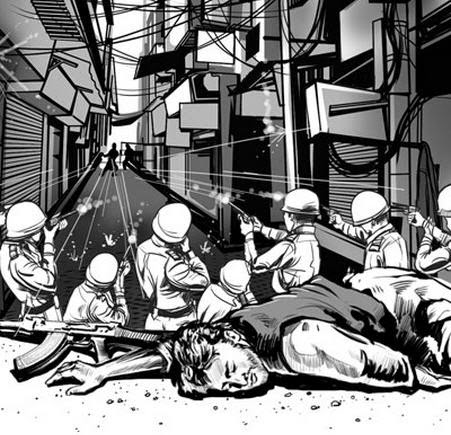
    Creative depiction of fake encounter.
    Courtesy:   DNA
    It may be noted here that the Gujarat government in 2012 had filed this PIL (Public Interest Litigation) for independent probe into all cases of alleged killings by police in past 10 years in the country and had sought direction to deal with all cases of fake encounters in a uniform manner. It had been Gujarat government’s contention that some vested interest groups are selectively targeting its police force over the encounter killings.
    The petition had sought a direction to all state governments and Union Territories to evolve and formulate a uniform nation-wide policy providing for an independent agency like “monitoring authority / special task force” created by the Gujarat government to probe into all cases of alleged fake encounters. An important aspect of this debate was that none of the BJP ruled states’ supported Gujarat government over this move and it found itself isolated.
    May it be the issue of ‘encounter killings’ in the state or for that matter the troubling developments in the year 2002 variously described as Gujarat carnage or Gujarat riots where according to his own party seniors ‘Rajdharma’ was not observed, it is clear that Mr. Modi begins his innings as PM of the country with a past which would keep haunting him.
    History bears witness to the fact that past just cannot be wished away claiming that it is a construct of the adversaries. All those people who tried to brush aside their past under carpet had to pay heavy price for their ‘amnesia’.
    Would Mr. Modi be able to make a radical rupture with the period gone by and turn a new page as far as not only good but just governance is concerned. That would be a moot question.
    Chances look really dim but as of now we have no other option than to wait and watch.
    **********
    Subhash Gatade is a New Socialist Initiative (NSI) activist. He is also the author of ‘Godse’s Children: Hindutva Terror in India’ ; ‘The Saffron Condition: The Politics of Repression and Exclusion in Neoliberal India’ and ‘The Ambedkar Question in 20th Century’ (in Hindi).
  • Isn’t ‘illegal Bangladeshi’ Racist Shorthand for All Bengali Speaking Muslims in Assam?

    – Bonojit Hussain
    Note: A shorter version of this article was published in today’s Calcutta edition of The Telegraph.

    The fragile and unstable peace in Bodoland Territorial Autonomous Districts (BTAD) of Assam has once again been ruptured. The recent massacre of Muslims of East Bengali descent in Kokrajhar and Baksa districts of BTAD on 1st and 2nd May has already taken toll on 46 lives; with many people still missing, the dead count might go up.
    This is not the first time that targeted ethnic violence has occurred in what is today BTAD. Through out the 1990’s armed Bodo groups have indulged in pogroms against Nepalis, Adivasis and Muslims and Hindus of East Bengali descent. But since the creation of BTAD in 2003, increasingly only Muslims of East Bengali descent are being targeted. Worst among all was the so-called ‘riots’ of 2012 where 108 people died. According to sources in Assamgovernment, 79 were Muslims of East Bengali descent, 22 were Bodos and 4 were from other communities.
    A lot has been written about the underlying causes of these recurring targeted killings and we need not dwell upon that here. (for an overview see Sanjib Barua, “Assam: The Politics of Electoral Violence”, Outlook Magazine, May 09, 2014). What should bother us all is how quickly discourse over the recurring massacres in BTAD is transformed into a debate on the question of illegal immigration from Bangladesh, wherein the victims are immediately labeled as ‘illegal Bangladeshis’. Even if the victims were ‘illegal Bangladeshis’, the barbaric act of killing 46 people in a span of 36 hours is a crime against humanity.
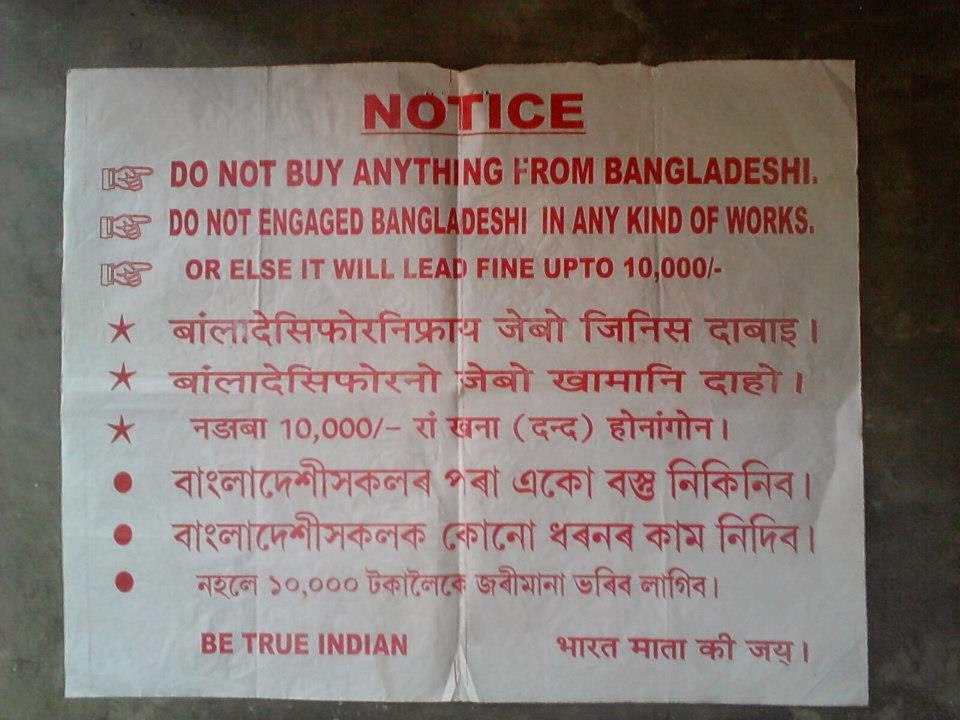
    Poster in Kokrajhar district during 2012 riots. Photo: Bonojit Hussain
    Like in 2012, immediately large section of Assamese society, a section of the national media and the BJP leadership raised the bogey of ‘illegal Bangladeshi’ to justify the killings and divert attention from the real causes of the massacre. Some even went to the extent of likening victims of the massacre with locust. Verbal attacks and abuses are also being launched on social media against anyone who dares question the hypocrisies of Assamese society. Recently an Assamese research scholar at Jawaharlal NehruUniversity was subjected to threats and abuses by Assamese xenophobes, she was also asked to re-locate to Bangladeshowing to her sympathies for these ‘locusts’.
    If one poses the question as to how these xenophobes know that Assam is being swarmed by ‘illegal Bangladeshis’, the answer is always about increasing visibility and numbers of Miyas (slur used to denote Muslim Bangladeshis) in urban clusters, new settlements in peripheries of forest land and settlements near river embankments. I argue this is a racist way of telling.
    It is a difficult question to answer how many undocumented Bangladeshis are there in BTAD area let alone in all of Assam. However, it is impossible to refute that from 1901 to 1941, encouraged by the colonial administration, over 10 lakhs migrated and settled in Assam from East Bengal. The geographical area of present day BTAD would fall under what were Goalpara and Kamrup districts during the colonial era. So, it is worth mentioning that East Bengali Muslim peasants first settled in undivided Goalpara district, before they spanned out to other parts of western and central Assam. The decadal growth of population in Goalpara district had shot up by 30 % as early as 1901-1911 compared to 1.4 % and 2 % in the preceding decades respectively. In 1921-1931, the decadal growth of population of Goalpara dropped to 15.8 % because most of the suitable wasteland in the district had already been occupied by immigrants who poured into the district in 1901-1921, and that the immigrants had found a larger scope for settling in Kamrup and Nagaon districts. During 1921 to 1931 Barpeta subdivision of Kamrup district saw an enormous 69 % increase in population. Between 1901 and 1931, 4.98 lakhs East Bengali Muslim peasants are recorded in Goalpara district alone. Here, then, the question arises – Where are the descendants of the lakhs of Muslim peasants of East Bengali descent who settled in the region before partition? (for a detailed discussion see, Banajit Hussain, “The Bodoland Violence and Politics of Explanation”; Seminar Magazine, No: 640, December, 2012)

     Considering the abysmal level of socio-economic development among Muslims of East Bengali descent in Assam, the reason for increasing numbers and visibility of the so-called Miyas in urban clusters, in the peripheries of forest land and near river embankments could very well be migration from rural areas to urban centres of Assam in search of livelihood. But more importantly it could be because of internal displacement from Char areas of Assam.
    Chars are the extremely braided mid-channel bar of Brahmaputra and its tributaries. These Chars were populated by Muslims of East Bengali descent for cultivation in the later decades of the Colonial era. Due to subsequent neglect and apathy of the Government the socio-economic indicators among Char dwellers have remained extremely depressing. Assam Government’s socio-economic survey in 1992-93 and 2002-03 revealed that Char dwellers constituted 9.35 % of the total population of Assam; the population density in the Chararea was 690 persons per sq. km (Assam’s overall density in 2001 was 340 person per sq. km); between 1992-93 to 2002-03 literacy rate in Char area increased marginally from 15.45 % to 19.31 % (Assam’s overall literacy rate in 2001 was 63.25 %); in 2002-03 67.90 % of Char dwellers lived below the poverty line, an increase of 19% from 1992-93 (34 % of Assam’s population was below poverty line in 2001).
    By their very nature of being integral part of the fluvial process of the river Brahmaputraand its tributaries, Chars are pre-disposed to erosion and Chardwellers pre-disposed to become internally displaced persons. Though hard data on displacement from char areas is hard to come by, some micro-level studies provide adequate insight into flood, erosion and displacement. One such study conducted by Dr. Gorky Chakraborty in the chars of Barpeta district reveals that “during the period (1989-98) when there was no high intensity flood in Assam, 45% of the total households were affected and 51% of the total land was lost by the surveyed char households. Similar study over a period of 25 years (1980-2004) in the Beki River, a tributary of Brahmaputra in Barpeta district reveals that 77% of the surveyed households suffered due to land erosion and 94% of their land was lost.” (Gorky Chakraborty, “Assam’s Hinterland: Society and Economy in the Char Areas”; Akansha Publishers, Delhi, 2009) With such abysmal socio-economic conditions and such high degree of erosion and displacement, lakhs of Chardwellers are left with no option but to migrate to the mainland.
    With such complexities involved in differentiating between an undocumented Bangladeshi migrant and a Muslim citizen of East Bengali descent; how do Assamese xenophobes and leaders of BJP conclusively declare that the villagers of Balapara, Narasinghbari and Narayanguri (3 villages where the massacre occurred) were ‘illegal Bangladeshis’?
    What are the ways of telling the difference? It is most certainly not difference but similarities between an undocumented Bangladeshi migrant and a Muslim citizen of East Bengali descent. It is physical and cultural markers; in this case it is beard, lungi, religion and language. Doesn’t this make ‘illegal Bangladeshi’ racist shorthand for any Muslim of East Bengali descent in Assam?
    Here it is worth looking at the cliché that are too often deployed – “illegal Bangladeshis are behind Rhino poaching, they loot innocent tribal villagers, they breed faster than dogs, rape and murder women in villages of Assam”. These clichés are becoming a part of a new discursive formation under consolidation which represents Muslims of East Bengali descent in Assam as “lesser human” or in its extreme form as “locust”. It hardly needs to be asserted that the construction of the “lesser human” other that is sexually virulent and is naturally prone to criminality has been the hallmark of racist worldview for more than half a century now.

    **********

    Banajit Hussain is a Delhi based researcher from Assam. He is associated with New Socialist Initiative (NSI). 
  • Adieu Comrade Mukul Sinha: Your Struggles Will Be Carried Forward

    New Socialist Initiative (NSI) condoles the untimely demise of Comrade Mukul Sinha, an inspiring Trade Union leader and a leading activist of the anti-communal movement. At a crucial juncture in our country’s history, when the forces of majoritarianism with due support from the corporate capital are on the upswing, the absence of Mukul Sinha would be felt more.

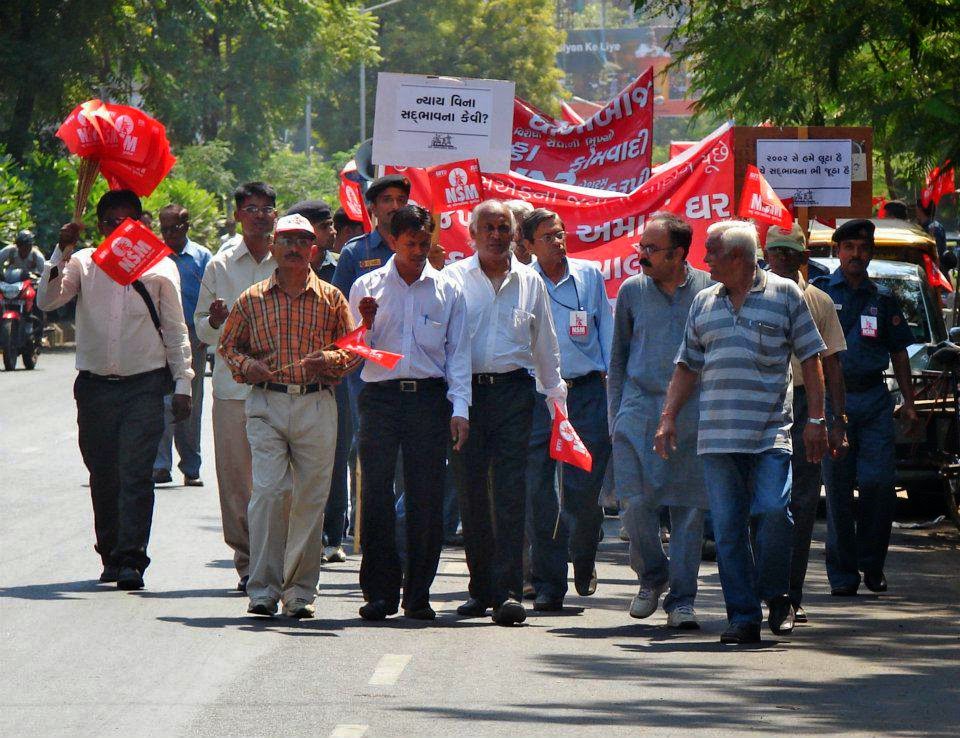
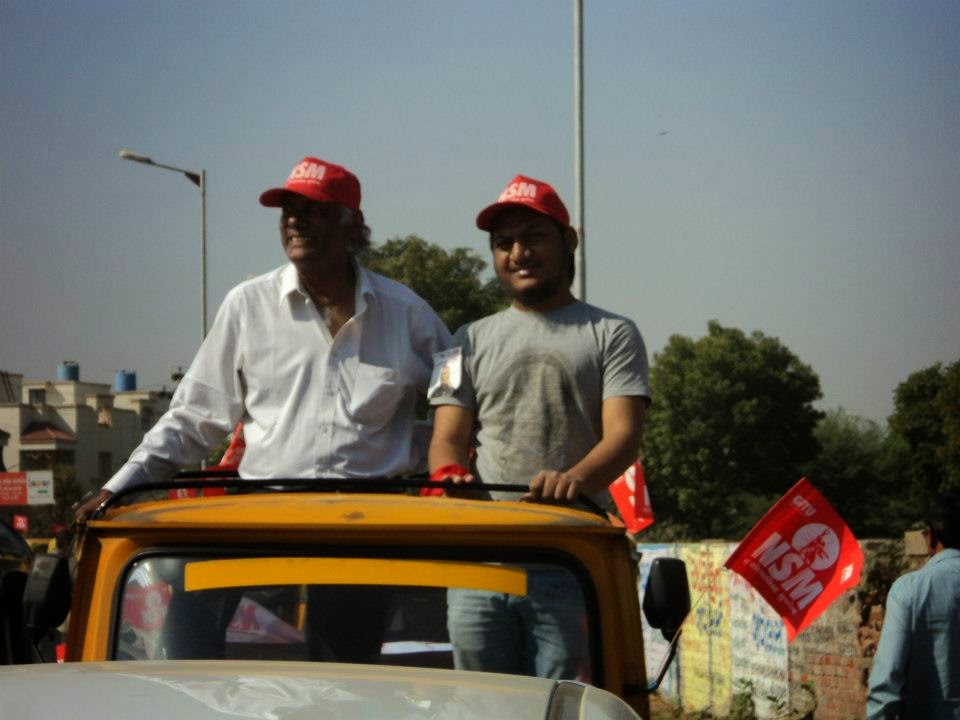
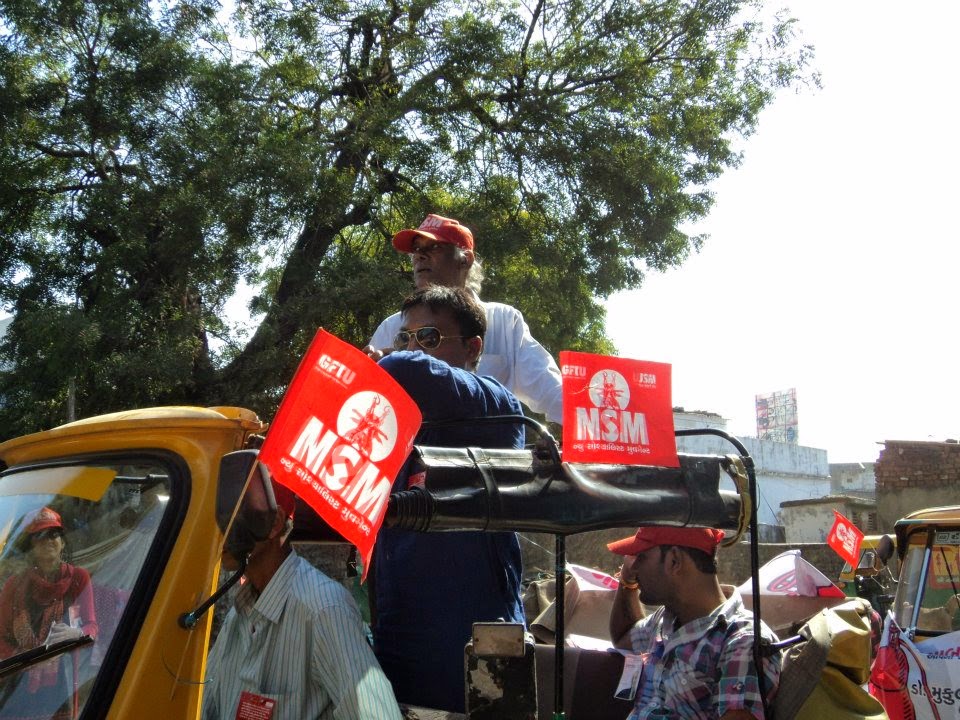
    Founding member of the New Socialist Movement (NSM), Jan Sangharsh Manch and Gujarat Trade Union Federation Comrade Mukul Sinha started his social-political life as an activist of the working class movement and helped organise different sections of the working people in Gujarat. Since last twelve years he had become a leading voice of the anti-communal movement in Gujarat who dared to take up cases of victims of the 2002 carnage at great personal risk to himself.
    Long live the glorious memory of Comrade Mukul Sinha.

    In remembrance sharing below some of his photographs:

  • Selective Symbolism and the Battle for Varanasi

    – Subhash Gatade
    Neelanjan Mukhopadhyay, author of a much discussed book on Modi, made few interesting observations about AAP’s (Aam Aadmi Party ) foray into the electoral politics of Gujarat. Underlining the fact that Kejriwal’s entry into the state – wherein he tried to put the government on the mat for its acts of omission and commission – did raise expectations, he maintains that the momentum did peter away slowly.
    What is more important to note that when the electoral battle started the party did not field a single candidate from the minority community despite the fact that population of Muslims in Gujarat is more than nine percent. According to the state leadership of the party it did not ‘find any suitable candidate from the community’ to contest elections. Questioning this explanation Neelanjan says that it thus did not challenge the prevalent norm that ‘Muslims are not to be given tickets’ by the mainstream parties. (Modi ki Raah Chale Kejriwal, Deshbandhu, 30 April 2014).
    Any neutral observer of the whole situation – who is familiar with the fact that there are places where AAP did field ‘outsiders’ to fight elections – would also be of the opinion that this explanation seems insufficient and perhaps there are deeper reasons involved in this decision. If at the political level it could bracket BJP as well as Congress at the same level by portraying their alleged proximity to the Adanis’ and Ambanis’ why did not it try to make another strong political point by giving ticket(s) to candidate(s) belonging to the minority community. (To put it on record, the BJP did not field a single Muslim candidate and Congress could muster courage to do it in only one constituency).
    Why did it dither to do so?
    Can we say that it was done to appear more ‘accommodating’ towards the ‘concerns’ of the majority community in a state which has been witness to a carnage more than a decade ago and a gradual silencing or marginalisation of minority voices ? Perhaps one can look back at its Delhi experience in fighting elections – where it trounced Congress from many of its safer seats, delivered a humiliating defeat to three term chief minister Sheila Dixit – but was later criticised for not being forthcoming on the menace of communalism. 
    The absence of any candidate from the minority community from AAP (in Gujarat) would not have become a cause of concern if Arvind Kejriwal would not have decided to contest against Narendra Modi himself from Varanasi and the nuanced messages of his own campaign with rich symbolisms would not have become obvious. Media has already given coverage to the fact that the campaign formally started with Arvind’s ‘holy dip’ in the Ganges and is supposedly surging ahead with a bag of promises, the prominent one being to declare Varanasi as a ‘holy city.’ And as we go to the press one finds reports appearing in press that Kejriwal had gone for a ‘Ganga Aarti’.The AAP manifesto for Varanasi elections declares that
    “Varanasi will be developed as the spiritual capital of the world and hence it will get the status of a holy city.”
    Close watchers of the Varanasi situation may tell you that it has been an old demand raised by the conservative forces from time to time but to no avail and AAP’s electoral campaign has definitely added new ‘glamour’ to it.
    Holy City, Unholy People?
    Question arises what is a ‘holy city’?

    Holy city is a term applied to many cities, all of them central to the history or faith of specific religions. Such cities may also contain at least one headquarters complex (often containing a religious edifice, seminary, shrine, residence of the leading cleric of the religion and/or chambers of the religious leadership’s offices) which constitutes a major destination of human traffic, or pilgrimage to the city, especially for major ceremonies and observances. A holy city is a symbolic city, representing attributes beyond its natural characteristics. – Wikipedia 

    To be fair to Mr Kejriwal, he is not alone in promising ‘holy’ status to particular city.
    In the sixty plus year trajectory of independent India there have been occasions where surreptitiously or openly few cities were declared ‘holy ‘ supposedly to cater to demands of different pressure groups or political formations. In fact in a multi-religious, multi-cultural and multi-racial country like India, attempts to declare particular cities ‘holy’ are not limited to the Hindus only.
    Way back in early ’80s when Khalistani terrorism was raising its head the world came to know how Sant Jarnail Singh Bhindranwale – the radical Sikh cleric who died in Operation Bluestar – had demanded a particular code of conduct to be followed in Amritsar, a city which is revered by the Sikhs and which was duly implemented then.
    There have been demands by Hindutva groups to declare Ayodhya holy city from time to time. In fact the focus of the Babri Mosque demolition movement had been to convert Ayodhya into a ‘Vatican City’ of the Hindus. And they have used every occasion to further their agenda. Few years back when Ayodhya witnessed a terrorist attack few of the senior leaders of the Vishwa Hindu Parishad had spewed venom calling for shifting ‘Muslims from the adjoining areas and the localities acquired in Ayodhya reiterating that there will be no guarantee of security of the Ram Lalla till they are not shifted.’
    Few years back Babulal Gaur, Cabinet Minister in M.P government had in a G.O (Governmental Order) circulated instructions about banning of eggs, meat and fish etc from few of the holy cities declared by the erstwhile Uma Bharati government way back in 2003-2004. One can still recall how after the said declaration by Ms Uma Bharati about Amarkantak, Ujjain etc, questions were raised about imposition of a Varna agenda not only on non-Hindus but also on majority of non-vegetarian Hindus.
    When YSR Reddy happened to be Chief Minister of undivided A.P., under an ordinance number three and two related G.O. it was instructed that there would be ban on non-Hindu groups to undertake any religious activities in Tirupati and 19 other ‘holy’ cities. Analysts then had termed the move as emergence of ‘Special Religous Zones’ in 21 st Century India.
    One can just imagine what sort of havoc such declaration under a secular dispensation can play with the life and liberties of people, communities who are considered the ‘other’ in the overall schemata of things. Apart from case studies done by democratic groups about impact of such steps on the livelihood of the people – where they are forced to stop merchandise in these ‘banned’ items – the more dangerous aspect of such declaration becomes the leverage it gives to majoritarian fanatic groups to take law into their hands and deliver ‘instant justice’ with the police becoming a mute spectator.
    It is clear that in their hurry to challenge Narendra Modi and the brand of exclusivist politics he represents neither Mr Kejriwal nor any of his supporters have thought over their proposal to declare Varanasi a ‘holy city’ with all sincerity.
    Varanasi : Question of Composite Heritage
    Whatever might be the claims of the protagonists of this particular demand, even a cursory glance at the history of the city and its surroundings makes it clear that it disregards the rich composite heritage represented by the region. Many knowledgeable people have written about it and interested people may refer to the debates which have taken place already.
    Very briefly, it is important to emphasise that Varanasi is of key importance not only for religious minded Hindus but Buddhists as well as Jains. Sarnath which is located just 13 kms north east of Varanasi happens to be the place where Gautama Buddha first taught the Dharma, and where the Buddhist Sangha came into existence. Isipatana (modern Sarnath) finds mention in Buddha’s preaching as well. According to him it is one of the four places of pilgrimage which his devout followers should visit, if they wanted to visit a place for that reason.
    It is a city where many great Tirthankars of the Jain community – prior to Mahavir – were born and worked among people. Singhpur, a village approximately one km away from Sarnath, was the birthplace of Shreyansanath, the eleventh Tirthankara of Jainism, and a temple dedicated to him, is an important pilgrimage site. On closer scrutiny we also find few important shrines of Islam as well which are revered by Muslims of different shades.
    The cultural importance of Varanasi could be gauged from the fact that it gave birth to the great rebel saint Kabir, Ravidas as well as Tulsidas in the medieval ages. Perhaps the rich cultural tradition of composite heritage found a new voice in the legendary Premchand in the early 20 th century who was born here only- who started his journey as a Urdu litterateur and later shifted to Hindi – but who is still respected by both the streams. Not very many people would know that in the early 50s the city elected a Communist Member of Parliament named Com Rustam Satin – with huge margins. It need be emphasised that Com Satin – belonged to the Parsi community – which had a very nominal presence in the city.
    One can very well understand why RSS and its anointee Narendra Modi would like to obliterate this rich heritage even from the minds of the people as it does not suit their larger weltanshauung (world view) of ushering us into a Hindu Rashtra. Any proof that communities lived in peace with each other and were not always at war is anathema to their long term project of refashioning India. We have before us how they were nearly successful in doing similar thing with the image of Ayodhya which according to scholars also has a long history of composite heritage with elements of Buddhism, Jainism, Islam and Sikhism intermingling with Hinduism in very many ways. Reinventing tradition and myth, they claimed that Ayodhya has always been Hindu, thus tried to promote it to the status of a Hindu Vatican. Yet, as critical historians have pointed out, this claim stands completely unsubstantiated.
    But why Mr Kejriwal wants to do walk in that trap is a moot question.
    Even if one decides to leave the debate about composite heritage of the city here itself, another question still remains which demands greater introspection and contemplation from Mr Kejriwal. How this demand which tries to flow with the public mind to achieve a narrow political goal is qualitatively different from similar demands raised by forces of Hindutva mentioned earlier ? Can it be claimed that the demand to declare Varanasi a ‘holy city’ is qualitatively different from similar demands raised by the proponents of Hindu Rashtra.
    We know very well why the votaries of what is popularly known as Hard Hindutva decided to field NaMo from this particular constituency? They could foresee that if someone with a ‘Hindu Hriday Samrat’ tag can catch the imagination of the people in this ‘religious city’ as well then without raising the communal tempers further it can gain them rich political dividends.
    And a better strategy to counter this blitzkrieg type of politics would have been not to appear a better Hindu or rather a soft Hindu but an uncompromising secular.
    In fact for anyone who is concerned with maintaining communal harmony in this part of South Asia, the bloody history of late eighties and early nineties is a grave reminder that whenever there are attempts to upstage Hard Hindutva by Soft Hindutva – the way Congress under Rajiv and Rao tried to do – the gainer has always been Hard Hindutva.
    By faith Hindu, by choice Secular
    It is said that the relation between religion and politics correlates with the relation between sacred and the secular. And the long journey towards secularisation of society effectively means removal/exit of the ‘sacred’ from the functioning of state and society and its reconstitution on secular foundations. The fact of the matter is that a dangerous cocktail of religion and politics has been a bane of polity and society in this part of South Asia and one does not see an immediate end to it.
    We should never forget that founders of constitution decided to move ahead on these lines in an atmosphere which had seen enough inter-communal bloodletting and killing of innocents. Despite the challenges involved in the process they resolved that unless and until we ensure separation of religion and politics similar bloodletting may occur again.
    Imagine an alternate scenario which could have been followed by Mr Kejriwal.
    Instead of engaging in the public display of his religiosity – by taking a ‘holy dip’ in the Ganges or by participating in the Ganga Aarti (nobody is here questioning his right to do so) – he could have as well declared that by faith he might be a Hindu but for him it is a private matter and by choice and by practice he believes in clear separation of religion and politics.
    This move would have definitely cost him few votes but could have helped him set an alternate agenda in these critical times when the very idea of secularism is being questioned, challenged and derided as never before. Yes as far as NaMo brigade is concerned there would not have been any impact on their brazenness but looking at the fact that Mr Kejriwal has been able to fire imagination of thousands and thousands of people all over the country who have taken the plunge with all sincerity and dedication to ‘cleanse the system’ this move could have sent a different message altogether. It would have placed him in the ranks of a Visionary who is not only adept at flowing with the public mind but is ready to challenge it also on crucial junctures.
    Perhaps he could have remembered the great poet Majaj who has rightly said :
    Masjidon main maulvi khutbe sunate hi rahe,
    Mandiron mein barhaman ashlok gatey hi rahey
    Ik na ik dar par jabeen-i-shouq ghisti hi rahi
    Aadamiyat zulm ki chakki mein pisti hi rahi
    Rahbari jaari rahi, paighambari jaari rahi
    Deen ke parde mein jang-i-zargari jaari rahi.

    (The mullah and the pundit and their ceaseless sermon
    Man bowed before each one of them but did he learn
    The great messiahs came claiming divinity. 
    Their religions, mostly ruses for plunder turn by turn.)

    **********

    Subhash Gatade is a New Socialist Initiative (NSI) activist. He is also the author of ‘Godse’s Children: Hindutva Terror in India’ ; ‘The Saffron Condition: The Politics of Repression and Exclusion in Neoliberal India’ and ‘The Ambedkar Question in 20th Century’ (in Hindi).
  • Protest Held in Delhi Against Gruesome Massacre in Bodoland

    New Delhi: 07/05/2014

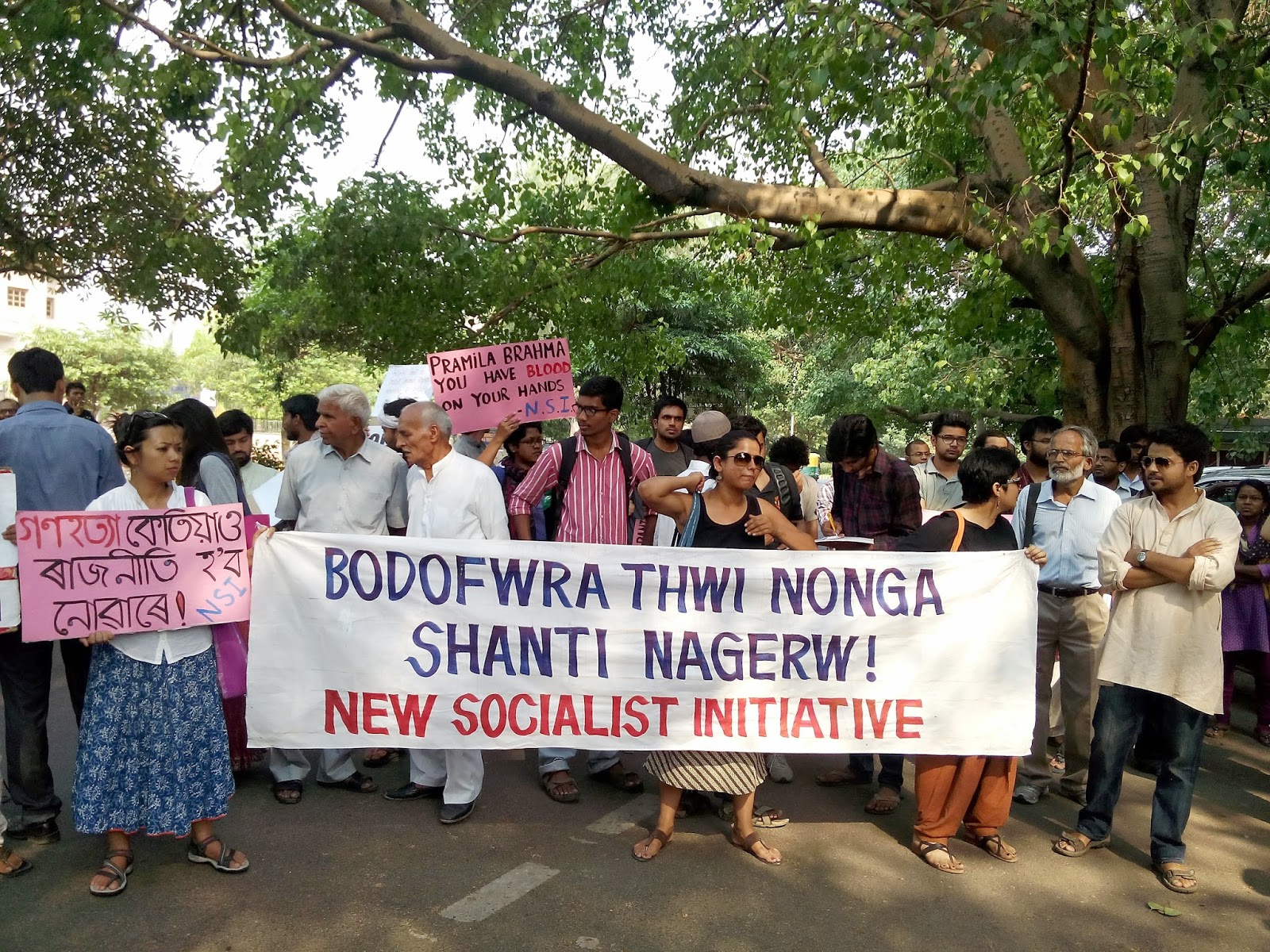
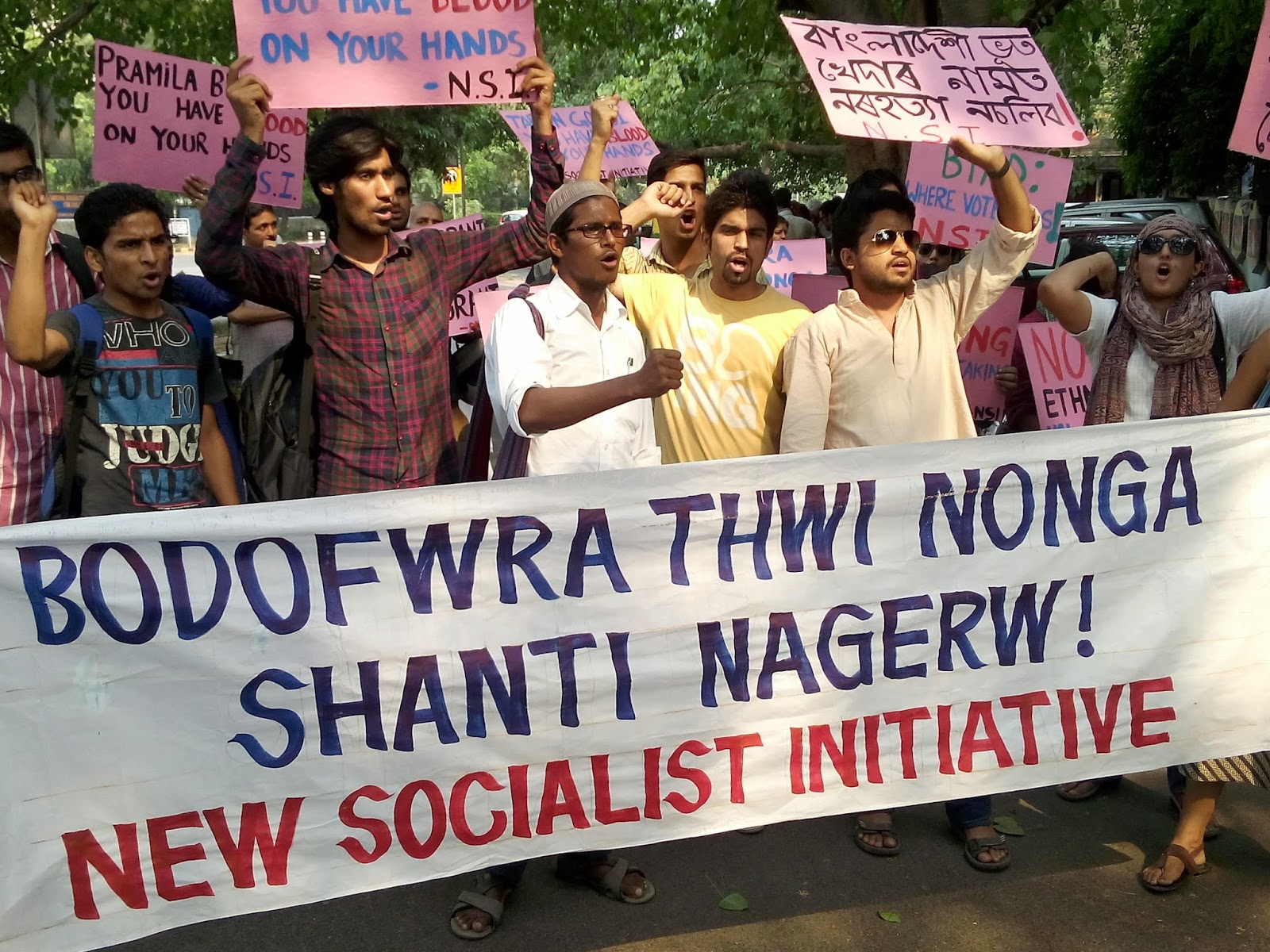
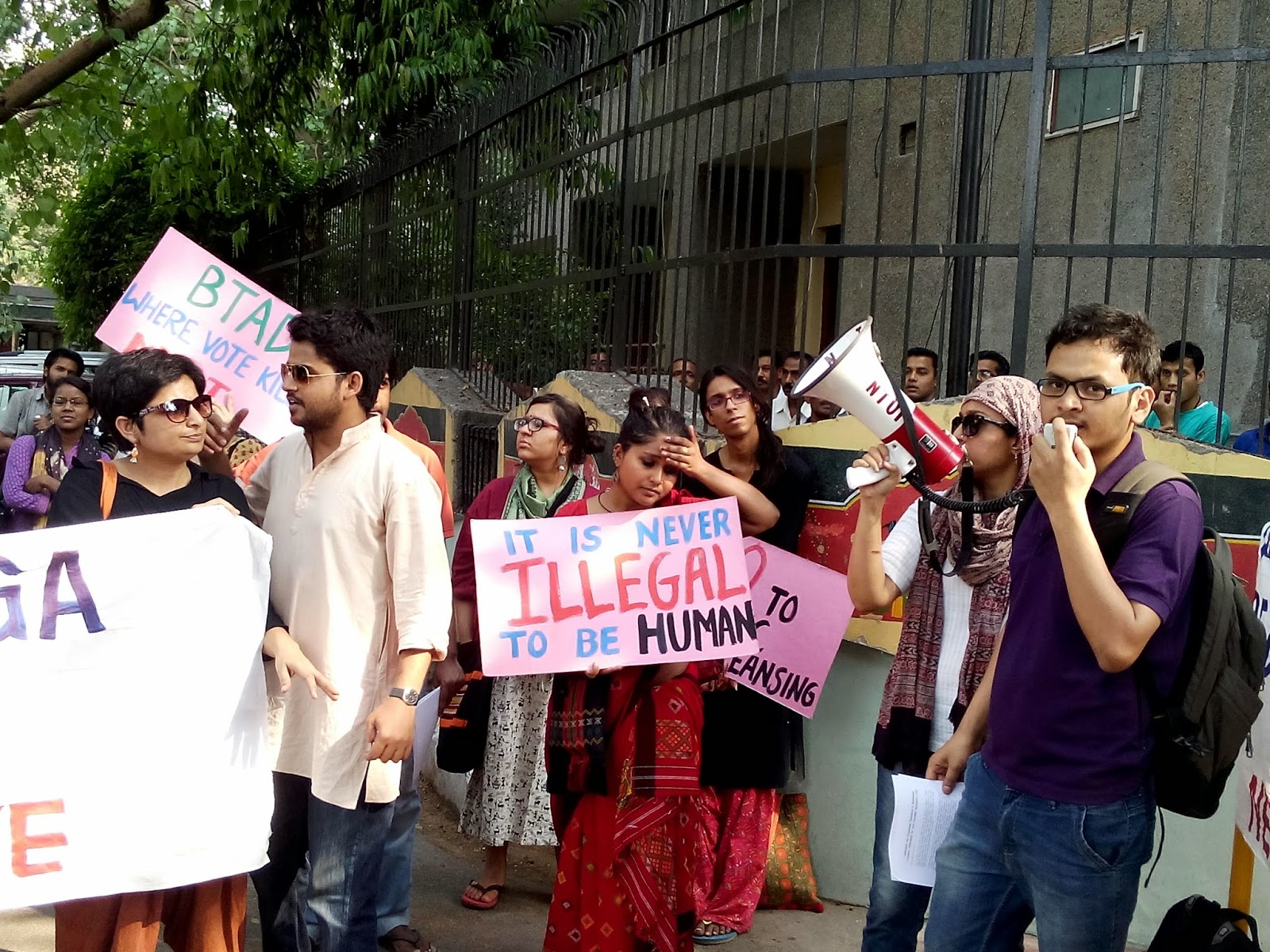
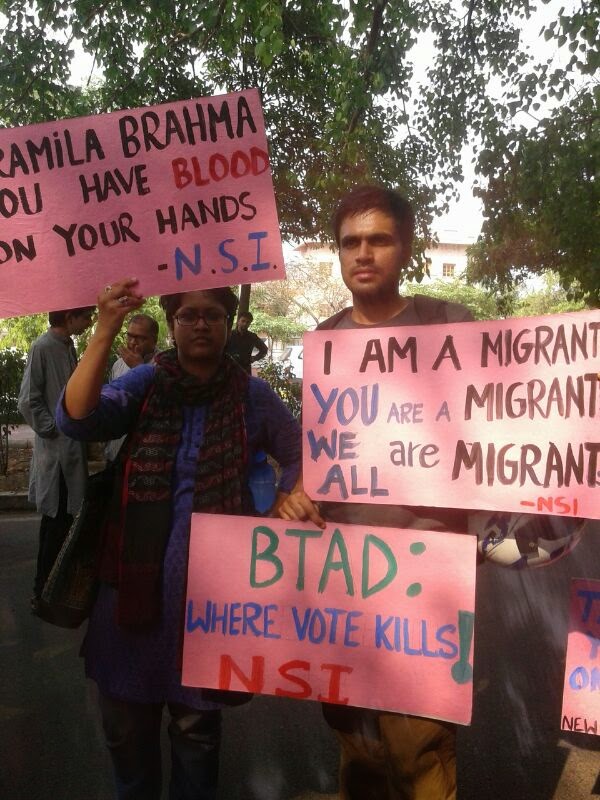
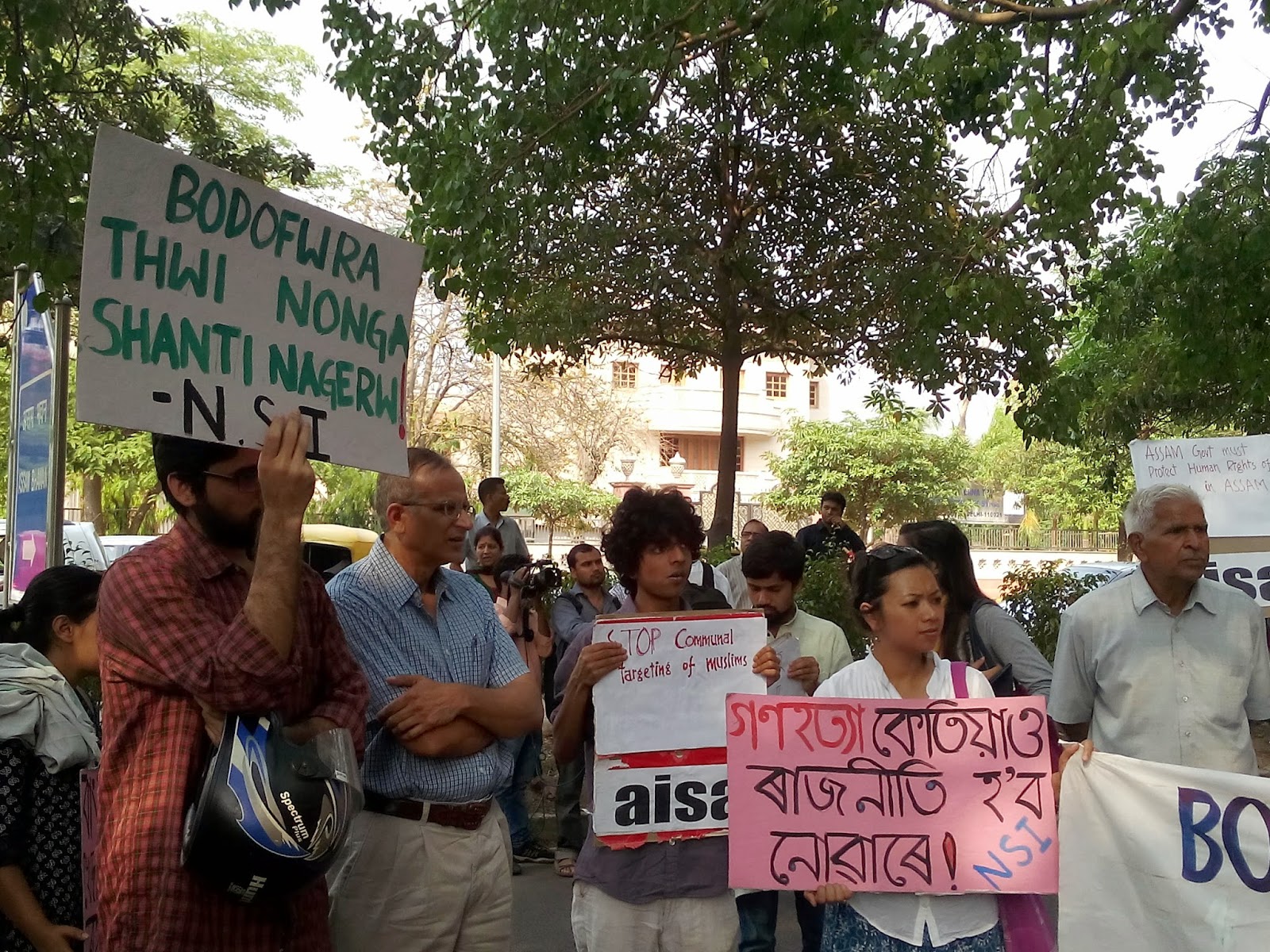
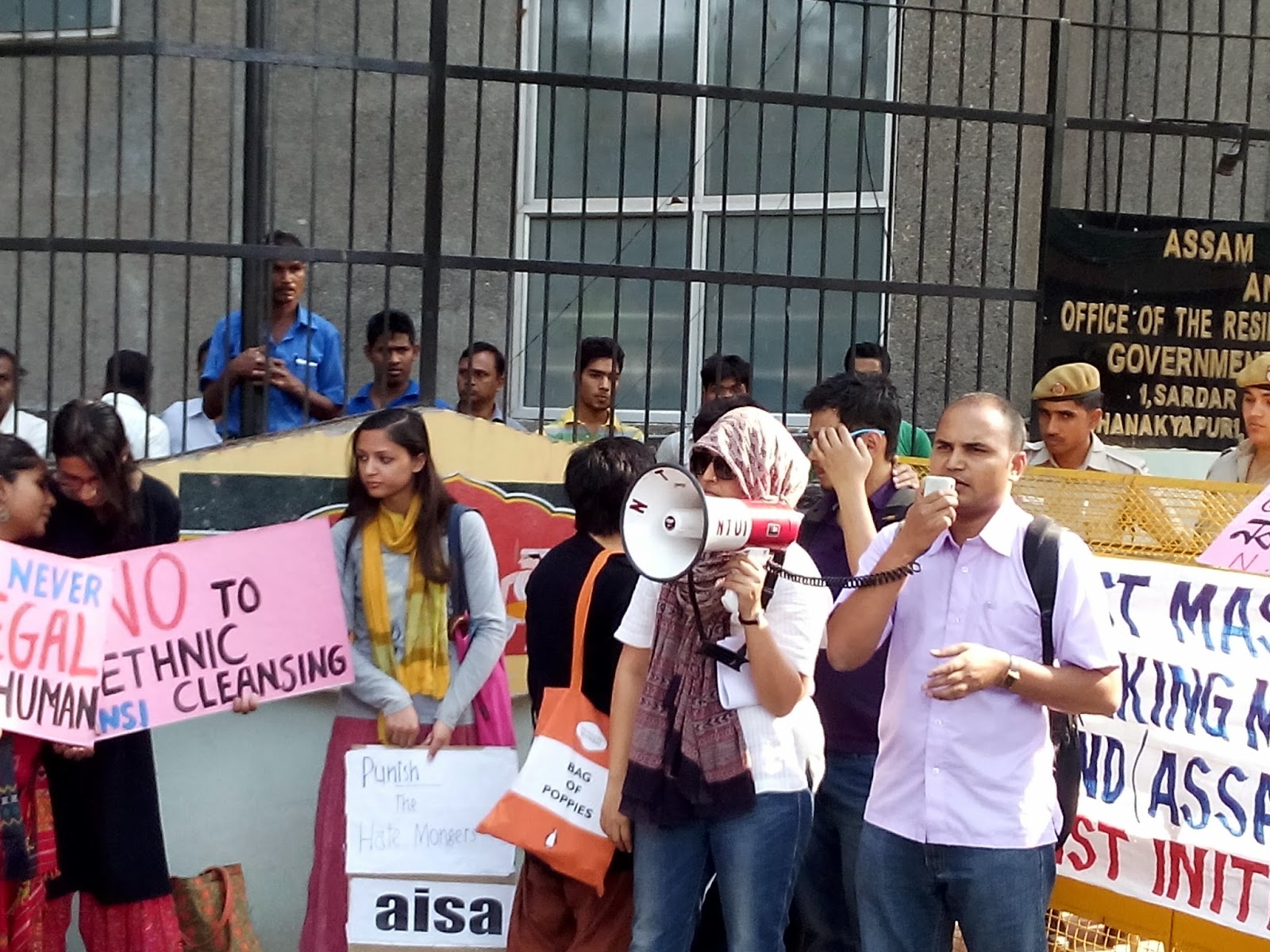
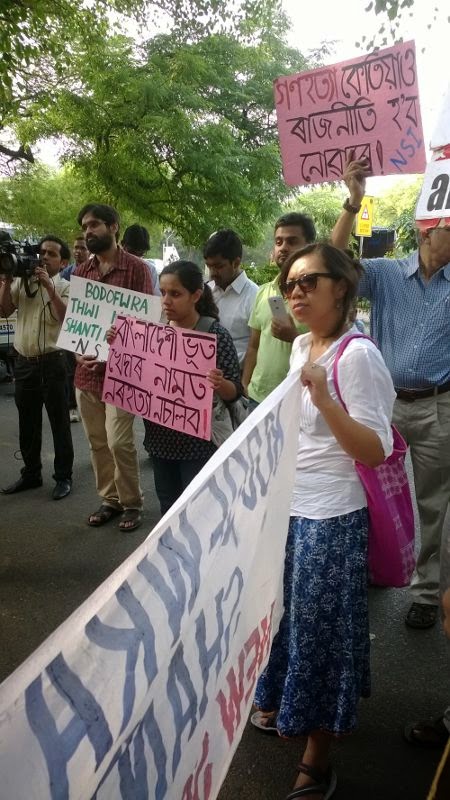
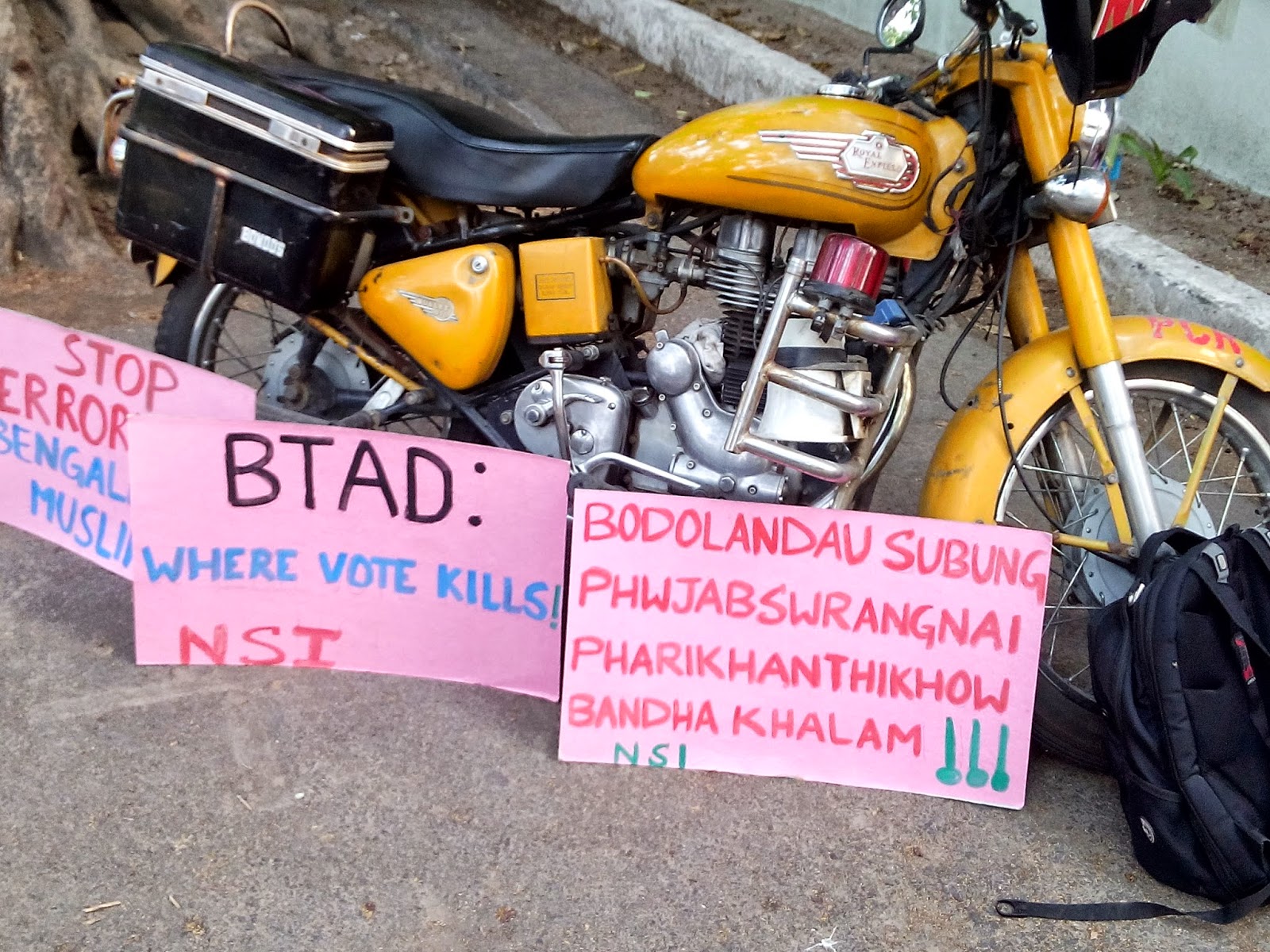
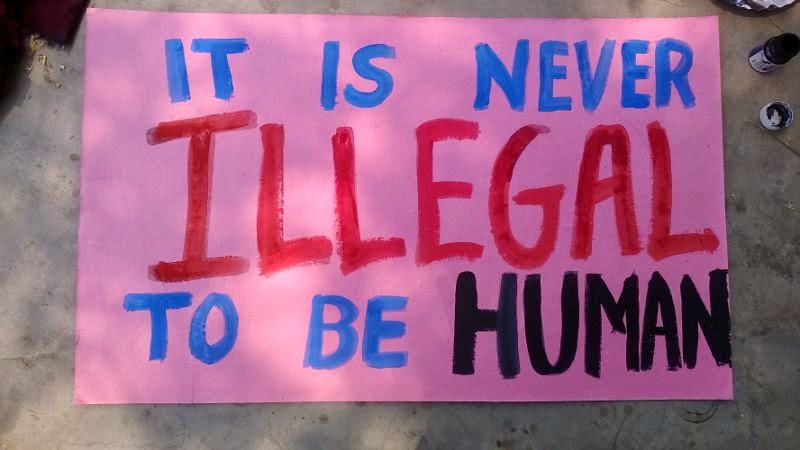
    A protest outside Assam Bhawan in New Delhi was organized today by New Socialist Initiative (NSI) against the gruesome massacre of Bengali speaking Muslims in Bodoland (Assam). According to latest official reports, 44 people have been killed, the majority being children and women. Death toll are further expected to rise considerably. 
    The banner in Bodo language reads “Bodo people want peace not blood”
    Apart from large numbers of student activist and teachers from Delhi University, JNU, Jamia; representatives of National Alliance of People’s Movement (NAPM), Jamia Teachers’ Solidarity Association (JTSA), Coalition for Nuclear disarmament and Peace (CNDP), All India Students’ Association (AISA), Bhumi Bachao Andolan, Kudai-e-Khidmatgar, Focus on Global South, People’s Alliance for Democracy and Secularism (PADS), Jagori, Stree Mukti Sangathan, Association of Students’ for Equitable Access to Knowledge (ASEAK), Jamia Students’ Solidarity Forum (JSSF), Save Democracy and Repeal APFSA Group (SDRAG) and JNU Students’ Union participated in the protest.
    During the 2 hour long demonstration the protesters also submitted a memorandum address to Mr. Tarun Gogoi, Chief Minister of Assam, which was received by Officer on Special Duty (OSD) of the office of Resident Commissioner. While condemning the massacre in strongest possible term, through the memorandum, the protesters demanded the following from Assam government:
    • A high level judicial enquiry be instituted, as state (Assam) security forces have utterly failed to prevent the massacre and can not be relied upon to carry out fair and thorough investigations. 
    • Adequate compensation and rehabilitation package be provided to families of deceased and injured. 
    • Secured relief camps with adequate standards be provided to the victims till they feel confident to return to their villages.
    • FIR be registered against Pramila Rani Brahma for her inflammatory public remarks. 
    • Since it has come to light that guns belonging to forest department have been used in the massacre and involvement of forest guards have been suspected, investigate the possible involvement of official and executive members of the forest department of Bodoland Territorial Council. 
    Through speeches and slogans protesters also highlighted the deplorable fact that while innocent civilians are massacred, certain sections of media and society have twisted the issue and are raising the bogey of illegal Bangladeshi immigrants to cover up the causes of the violence. 
    The protesters also condemn the attempts of Assam government to divert attention from its utter failure in protecting lives of people by declaring that it is mulling to arm Bengali-speaking Muslims in BTAD area with licensed guns and has asked for applications from villagers. Protesters asserted that the need of the hour is to de-arm BTAD completely instead of arming further.
    Speaking to media, New Socialist Initiative (NSI) representatives clarified that NSI does not demand that BTAD be scrapped. They pointed out that historically Bodo community has been one of the most oppressed community in Assam and the genuine democratic aspirations for greater political and economic autonomy of ordinary Bodo people should be respected. However, the genuine aspirations of the Bodo people have been completely hijacked by the politics of power mongering and of vested interests which can further only further it’s interest at the cost of the rights of other ethnic groups as is being done for a decade by pitting ordinary Bodo people against similar non-Bodo people of the region. They stressed that instead of demanding that BTAD be scrapped, the demand should be that of revision and reworking of the Bodoland Territorial Council (BTC) Accord under which BTAD came into existence and is governed; so that democratic aspirations of all section of population in BTAD are upheld and gets realized.
    Several leaders from the ruling Congress Party (both in Assam and outside) have opined that the Bodoland massacre is a direct outcome of Narendra Modi’s never-ending diatribes against “illegal Bangladeshi migrants”; many on the left also thinks that to be the case. When asked by the journalists during the protest, NSI representatives pointed out that to see this massacre to have stemmed out of Modi’s diatribes would amount to gross simplification of otherwise deep-rooted and complex causes behind the massacre. However, they also asserted that Modi’s diatribes have created a political environment where it became easy for a section of the society and media to attempt and justify the massacre along communal lines by raising the bogey of ‘Bangladeshis’.
    Below are few more photographs are the protest:

  • Condemns the Gruesome Massacre in Bodoland (Assam): Statement by New Socialist Initiative (NSI)

    New Delhi; 07/05/2014
    New Socialist Initiative (NSI) strongly condemns the gruesome massacre of Bengali speaking Muslims in the Bodoland Territorial Autonomous Districts (BTAD) in Assam, which has witnessed the resurgence of the ugly head of ethnic violence. As per latest official reports, 44 people have been killed, the majority being women and children, while several have been injured and many are missing.
    On the evening of 1st May at 7.30 pm, 8 armed Bodo youths riding on 4 bicycles entered a house in Narasinghbari village in Baksa District and fired gunshots. The next day (2nd May), allegedly 40 Bodo militants surrounded 77 houses in Narayanguri village in the same district and fired indiscriminately. Until now 36 dead bodies have been found. According to district administration 15 people are still missing, among them 12 children and 3 women. Simultaneously, in Balapara village in Kokrajhar district at around 12.30 am on 2nd May, armed Bodo youths killed 8 people. The survivors in Baksa district told that the death toll will substantially increase as the militants killed and threw the dead bodies into the Beki River that flows through the area.
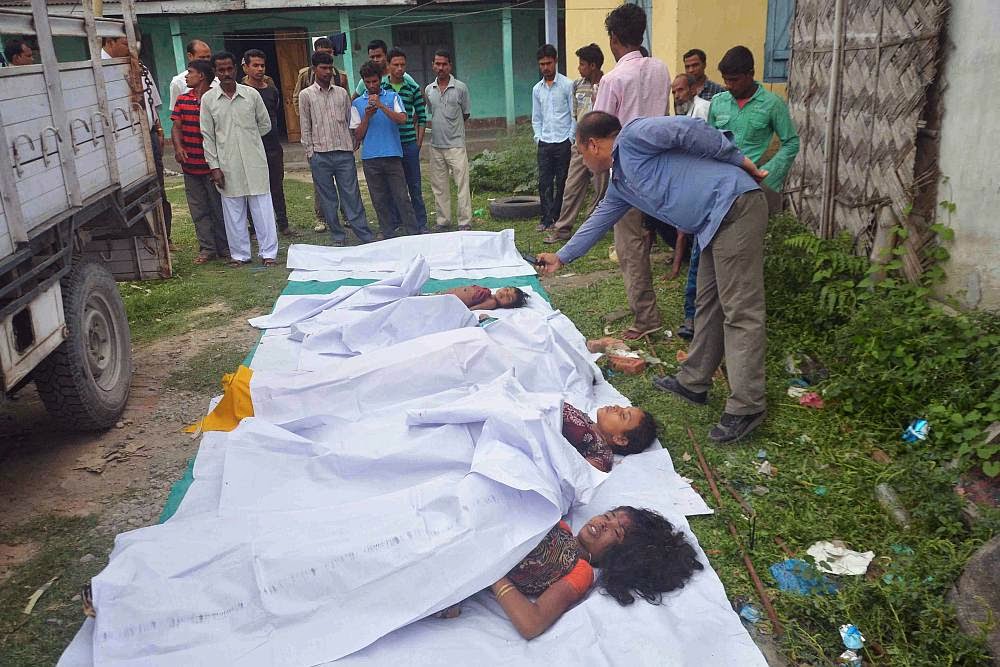
    Bodies of victims outside Kokrajhar Police Station
    Even though the Assam government and BTAD administration blame National Democratic Front of Bodoland’s Songbijit faction for the carnage, survivors and people from the affected communities have refuted the government’s claim and asserted that former cadres of Bodo Liberation Tigers (BLT) were involved in the massacre. They strongly feel that the ‘planned’ massacre was a reprisal for not voting for the Bodo People’s Front (BPF) candidate Chandan Brahma, who is a powerful minister in the Assam State government, in the Lok Sabha election for Kokrajhar constituency held on 24th of April. Chandan Brahma is in the fray against, among others, sitting BPF MP Sansuma Khungur Bwismwithiary who is contesting as an independent candidate this time. The media statement given by Pramila Rani Brahma, former Minister in the Assam Government and present BPF MLA from the Kokrajhar East constituency, on 30th of April in which she accused the Muslims of not voting for Chandan Brahma, reasserts the survivors’ claims. Ms. Brahma’s speculation amounted to dividing the populace on the basis of religion and is in violation of the law as it amounts to promoting hatred, ill-will or animosity on the basis of religion. Survivors have also intimated that the attack was carried out under the leadership of Amiya Brahma, Ranger of Basbari Forest Range, and that the assaulters used .303 rifles belonging to the Forest Department. Since the massacre, Amiya Brahma along with several forest guards and former militants were arrested for involvement in the massacre. 
    Naba Saraniya, a former commander of United Liberation Front of Assam (ULFA) and the non-Bodo consensus candidate of Sanmilita Janagosthiya Aikkyamancha (SJA) which is an amalgamation of at least 20 ethnic and linguistic groups that form 74% of the total population in the BTAD areas, is widely tipped by poll analysts to win the election. People from the affected communities have also affirmed that they voted en masse for Mr. Saraniya. Despite perceived threats of violence, voting amongst non-Bodos is reported to be about 65% and in certain pockets where non-Bodos are a majority, voting percentage even crossed the 90% mark. The likely victory of a non-Bodo candidate is a significant change in the politics of the region in which the BPF and its predecessors had strongly dominated for the last couple of decades.
    It should also be noted that before the violence on the 1st and 2nd of May, tensions had begun to strongly manifest in the region. Since the 25th of April, hundreds of Muslim people from the villages under the Harbhanga polling booth had been harassed by the police. This was done in allegations over the death of police personnel on election duty the day before, owing to a rumor of an Electronic Voting Machine (EVM) being rigged. 
    The tensions that were evidently building up since the polling day (14th April) culminated in the massacre of 1st and 2nd May where perpetrators resorted to extreme violence, entering into indiscriminate killings including women, children and the elderly. The worsening of the situation in the region was either not comprehended or left to chance by the state administration. Despite tensions building up, the inability to prevent the massacre brings to fore the utter failure and short-sightedness on part of the Assam Government. It is condemnable that to divert attention from its failure Assam government is mulling arming Bengali-speaking Muslims in BTAD area with licensed guns and has asked for applications from villagers. Forest minister Rockybul Hussain told media on Sunday that for their self-defense, Bengali speaking Muslims villagers should be given licensed arms by the state government. He has been quoted to have said that, “Since the home department in Bodoland area is under the state government, the government can provide licensed arms if anyone applies for it.” The minister and the Assam government should know better than others that the need of the hour is to de-arm BTAD completely rather than arming it further.
    While innocent civilians are massacred, certain sections of media and society have twisted the issue and are raising the bogey of illegal Bangladeshi immigrants to cover up the causes of the violence. This is done to gain political mileage out of a tragedy as the Bengali speaking Muslims living in Assam have historically been easy to victimize and made scapegoats out of. Various political parties and ethnic groups have time and again played the game of discrimination and accusation solely targeting the Bengali speaking Muslims, the most recent example being Bharatiya Janata Party’s Prime Ministerial candidate, Narendra Modi.
    Also one should be very careful not to fall into the trap of equating the whole of the Bodo community with militancy and terror. No community is homogeneous to the extent it is made out to be. Within the Bodo community there are divergent voices, beliefs, ideologies and aspirations. The fact that there were five Bodo candidates, including the two mentioned above, contesting from the same constituency affirms the same. What one needs to question and fight against is the economic and political hegemony of the people in power. It is the nexus between the tiny Bodo ruling elite and the ruling dispensation in Assam which pits ordinary Bodo people against similar non-Bodo people. It should also be remembered that historically Bodos have been an oppressed community in Assam, and hence the genuine aspirations of Bodo people should be respected. However, the genuine aspirations of the Bodo people have been completely hijacked by the politics of power mongering and of vested interests. This ruling elite can further it’s interest only at the cost of the rights of other ethnic groups as is being done for a decade by pitting ordinary Bodo people against similar non-Bodo people of the region. Further the genuine economic and social interests of the larger Bodo community remain neglected and throttled in this play of power and privilege. It is time to re-imagine the idea of Bodoland for a better future. It is time to demand that BTC Accord be re-worked and revised so that the genuine democratic aspirations of all sections of population are upheld and realised.
    We therefore demand that:
    • A high level judicial enquiry be instituted, as state (Assam) security forces have utterly failed to prevent the massacre and can not be relied upon to carry out fair and thorough investigations.
    • Adequate compensation and rehabilitation package be provided to families of deceased and injured. 
      Secured relief camps with adequate standards be provided to the victims till they feel confident to return to their villages.
    • Instead of arming further, de-arm BTAD immediately by seizing all arms and ammunition. 
    • FIR be registered against Pramila Rani Brahma for her inflammatory public remarks. 
    • Since it has come to light that guns belonging to forest department have been used in the massacre and involvement of forest guards have been suspected, investigate the possible involvement of official and executive members of the forest department of Bodoland Territorial Council. 
    • Rework and revise the BTC accord so that the genuine democratic aspirations of all sections of population are upheld and realized.
    • Protest Against Massacre of Bengali Speaking Muslims in Bodoland (Assam)

      New Socialist Initiative (NSI) calls upon all progressive and democratic minded individuals and organisations to join us and raise our voice against the massacre of Bengali-speaking Muslims that it still unfolding in Bodoland (Assam). The death toll has already reached 32 and still counting.
      Protest against Massacre of Bengali-Speaking Muslims in Bodoland (Assam)
      3 pm, 7th May (Wednesday), 
      Assam Bhawan, Sardar Patel Marg, Chanakyapuri, New Delhi
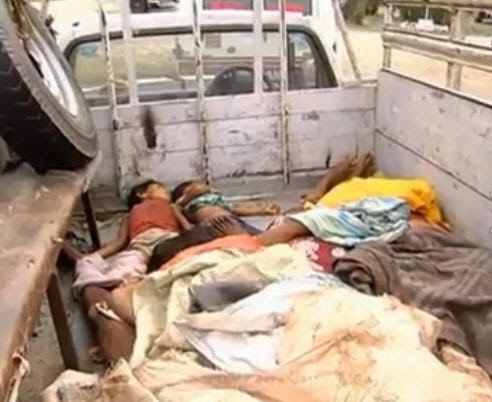
      2nd May: Bodies lying in a vehicle outside
       Kokrajhar Police Station
      In what seems to be a post-poll revenge killings in all probability, on 1st May at 7.30 p.m., 8 Bodo youth armed with fire arms riding on 4 bicycles entered a house in Narasinghbari village in Baksa Dist. inhabited by Muslims and asked, whom did you vote for, and before getting any answer they fired shots and killed 3 persons and injured two. At 12.30 a.m. on 2nd May (night of 1st May) in Balapara village part I, 20 armed militants entered and fired indiscriminately on 5 houses and killed 8 people which include 3 women, two old persons and 3 children (aged: 3, 8 and 12 years), who had obviously not even voted. On the same day (2nd May), 40 militants surrounded 77 houses in Narayanguri village (the last village before Manas National Park) and fired indiscriminately. 20 dead bodies have been found so far, 8 had to be hospitalised and 31 are still not accounted for. This has led to exodus of Muslims to safer places.
      It is worth noting that a day before the massacre, Pramila Rani Brahma, Minister for Agriculture in Assam from Bodo People’s front (BPF) who represents Kokrajhar East Constituency gave an interview to media on 30th April claiming even before the results of Lok Sabha elections are out that this time Muslims did not vote for the BPF and therefore their candidate Chandan Brahma was not likely to win.
      It is further worth noting that he 16th General election for Lok Sabha concluded in Assam on 24th April. From Kokrajhar constituency, the candidate of Bodo People’s Front, a party of former militants, was Chandan Brahma and was opposed by a non-Bodo candidate Naba Saraniya, a former commander of ULFA, backed by the Sanmilita Janagostiya Aikkyamancha (SJA), an amalgamation of at least 20 ethnic and linguistic groups based in Bodoland. The Bengali speaking Muslims of Bodoland apparently voted enmasse in favour of Naba Saraniya.
      For facebook event page click here
      Contact: 8860304908, 9999773268, 9013074979, 9911078111
    • Tsundur Massacre: Normalising Injustice the Judicial Way

      – Subhash Gatade
      Tsundur, Guntur, A.P. which had made headlines way back in 1991 when eight dalits were lynched by a 400 strong armed mob of Reddys is again in the news. The recent judgment of the A.P high court has overturned the judgment of the Special courts and has acquitted all the accused involved in the case for ‘want of evidence’.
      As rightly noted by Human Rights Forum (HRF) the judgment is ‘brazen injustice’ and is ‘reflective of upper caste anti-dalit bias’ and ‘betrays insensitivity in the judiciary to an inhuman caste atrocity.’ It is expected that the state does not waste time in moving the Supreme Court to get this retrograde judgment overturned and render justice to the families of dalits.
      What is more disturbing and shocking is the fact that when the Special Court formed to deliberate on the case had finally given its verdict seven years back, it was considered a ‘historic’ in very many ways. The conviction of the perpetrators – twenty one of the accused were life imprisonment and 35 of the accused were asked to serve one year rigorous imprisonment – was considered a significant milestone in the ongoing dalit emancipation movement.
      II
      The judgment by the special court had demonstrated the immense possibilities inherent in the SC and ST Prevention of Atrocities Act (1989) which till date remain on paper. As rightly noted it was the first time in the nearly twenty year old trajectory of this act that special courts had to be set up at the scene of offence.
      It is noteworthy that Dalits in Tsundur were so united that they neither accepted any summons from the courts nor they ever went to court which was situated at some distant place from the village. They demanded in unison that the courts should come to them and the government had to concede to their demand and set up special courts in a school premises.
      They had also demanded that they be provided with a Public Prosecutor and a judge who has a positive track record while dealing with cases of dalit atrocities. After lot of dilly-dallying the government had complied with this demand also.
      It has been normal in all such cases of dalit atrocities that as time passes, people including victims and their families loose interest in continuing their fight for justice. They come under pressure or are coerced into changing their statement in the courts etc. The significance of the Tsundur struggle was that the people leading the campaign were successful in keeping the people mobilised all these years. Tsundur became a rallying point for different left and democratic forces in the state and it was harbinger of a new turn in the left politics also which resolved to take up the issue of caste oppression.
      III
      D Dhanraj was a crucial witness to the whole case. He did not falter for a moment despite tremendous pressure brought upon him by the powerful Reddys. One could see that Tsundur, the small village in Guntur, had created many such ‘unsung heroes’ – ordinary looking people who faced heavy odds so that they get justice. Merukonda Subbarao, a fifty six year old daily wage-worker, who had served as the first president of the ‘Tsundur Victims Association’ was another such ‘hero’ who identified and named forty of the accused standing in the court room, from among the one hundred and eighty three accused. It was clear that the whole incident was etched in his memory so strongly that he did not falter despite the judges requests to repeat the identification. And who can forget Martyr Anil Kumar, a young man in his twenties who was in the forefront of the struggle so that the perpetrators of the massacre are punished without delay. Anil was killed in a police firing during one of those struggles.
      As is clear in every other atrocity against the dalits, the Reddys who have dominated the state politics since independence, tried with all their might so that they are allowed to go scot free. Utilising their contacts in the Judiciary, bureaucracy or police administration they tried to delay the process of justice as long as they could do it.
      Attempts were made to buy or coerce the dalits in very many ways and the state also tried to play second fiddle to the Reddy’s. It felt that by distributing largesse to the dalits, giving jobs to few of them, awarding compensation to the victims’ families they could calm down their yearning for justice. But dalits in Tsundur wanted nothing less than severe punishment for the perpetrators.Unitedly they raised a slogan ‘Justice not Welfare’. It was worth emphasising that with their continued resistance they were able to make Tsundur a key issue in state politics.

      IV
      A brief recap of the events in this ‘historic case’ tells us that the upper caste (namely the Reddys’ ) used the pretext of of alleged harassment of a Reddy girl by a dalit youth in a cinema hall to attack the dalits. The planned nature of the attack was evident also from the fact that within no time a few hundred strong mob of Reddys wielding traditional weapons (and few of them carrying modern firearms) descended on the dalit hamlet and unleashed their fury against the innocents. In fact, sensing an imminent attack, most of the menfolk had already left the village. Once the marauders came to know of this they literally chased the dalits on the road adjoining the Tungabhadra canal and lynched them one by one.
      Looking back it is clear that the preplanned attack against the dalits was another futile attempt by the Reddys to reassert their age-old authority which had seen fissures with the growing assertion of dalits. The changed atmosphere in the village was for everyone to see. Not only many of the dalits boys and girls had benefitted from the affirmative action programmes in education, a few among them had even surpassed the Reddys in many respects. Many of the dalits from the village were working with Indian Railways. Overall the situation was such that the Dalits had refused to follow the medieval dictats reserved for them under the Varna system.
      V
      All that is passe now. The judgment of the high court which has overturned the verdict of the Special Courts reminds us that the journey to achieve justice is going to be a long one.
      Any cursory glance at the cases of mass crimes against dalits tells us that the high court judgement is no exception rather it is the norm.
      It was only last year that Patna highcourt acquitted nine out of 10 accused in the Miyapur massacre for ‘lack of evidence,’ overturning a lower court’s order. (July 2013) The Aurangabad Scheduled Castes and Scheduled Tribes (SC and ST) special court judge, Krishna Kant Tripathi, had earlier awarded life imprisonment to 10 persons on September 20, 2007. The Miyapur massacre was a major carnage in which the Ranvir Sena killed 32 people, mostly Dalits, supposedly to avenge an earlier Naxal attack in Senari village of Jehanabad. A 400-500 people had entered the village and began firing at the villagers. (16 th June 2000).
      The same year one witnessed Patna high-court overturning another judgment by the lower court where 11 accused involved in the killings of ten activists of CPI (ML) in November 1998 had been convicted. One had witnessed similar reversals in the Bathani Tola massacre – which involved 23 accused – and Laxmanpur Bathe massacre – which saw 58 deaths. In all the above cases Ranveer Sena was said to be involved but it was allowed to go ‘scot free’.
      No doubt that the lower courts had convicted the accused – which the high court later reversed – but a close reading of the cases would make it clear that loopholes were deliberately left which could facilitate the accused. e.g. the police had pronounced Ranvir Sena supremo Brahmeshwar Singh “Mukhiya” the prime accused, an “absconder”. It is a different matter that this dangerous criminal was languishing in Ara jail since 2002. It may be added here that when Nitish Kumar, assumed reins of power in 2004, one of the first thing he did was to disband Justice Amir Das Commission when it was nearly ready with its report. This commission was appointed in the immediate aftermath of the Bathe massacre and had gone into great details about the political patronage, which Ranvir Sena received, from different mainstream political formations.
      VI
      It is possible that all this details where the state and its different organs comes out in rather unflattering terms could be brushed aside as a story repeated ad nauseam. All the talk of dalit atrocities could be presented as another extension of the way in which ‘state in the third world’ unfolds itself. But the key point worth emphasising is that caste atrocities much like gender oppression or racial atrocities have a specificity which transcends the binary of ‘state as perpetrator’ and ‘people as victims’ . In fact they implicate the partisan role played by the people themselves.
      The ‘Report on Prevention of Atrocities against SCs ‘ prepared by NHRC ( 2004) presents details of the way in which the civil society presents itself . Here civil society itself becomes a distinct beneficiary of caste based order and helps perpetuate the existing unequal social reactions and frustrates attempts to democratize the society because through the customary arrangements the dominant classes are assured of social control over people who can continue to abide by their commands without any protest.
      Of course the uncivil nature of the civil society presents before us a unique challenge where the need then becomes to rise above a mere discourse on civil and constitutional rigths and address the failure of the largest democracy of the world to go beyond mere form. We have to appreciate that it concerns the greater hiatus that exists between constitutional principles and practice and corresponding ethical ones based on a diametrically opposed ideal.
      Everyone has to see that under the purity and pollution based paradigm which is the cornerstone of our caste system, inequality receives not only legitimisation as well as sanctification. As inequality is accepted both in theory and practice, a legal constitution has no bearing on the ethical foundation of caste-based societies. In fact Dr Ambedkar, the legendary leader of the oppressed had this very reality in his minds, when he emphasised the difference between what he called ‘political democracy’ and ’social democracy’, the difference between ‘one person having one vote’ and ‘one person having one value’.
      VII
      To conclude, one can go on enumerating cases of dalit oppression and explain the manner in which perpetrators of atrocities against dalits are ‘saved’ judicially.
      Protest against the judgement by Dalit Adivasi Bahujan Minority Students Association
      Perhaps one can make a beginning with the first massacre of dalits in independent India when 42 dalits – mainly children and women – were burnt alive by a gang of marauders belonging to the local upper castes (1969) in Kizzhevanamani, Thanjavur, Tamil Nadu. Dalits and other exploited people in that area of Thanjavur had launched an agitation under the leadership of Communist Party on the question of wages which had infuriated the dominant caste people.
      Here also the judgment by the Courts was disturbing to say the least. The courts had acquitted all the accused with the specious argument that ‘it appears unbelievable that all these members of the upper caste’ would have gone walking to the dalit hamlet/basti.’
      It is said that shadows of Kizzhevanamani have continuously hovered around atrocities against Dalits and adivasis in post independent India. Question arises how long it is going to continue?
      **********
      Subhash Gatade is a New Socialist Initiative (NSI) activist. He is also the author of Godse’s Children: Hindutva Terror in India, and The Saffron Condition: The Politics of Repression and Exclusion in Neoliberal India.
    • 9 Mythbusters: Lest We Forget the Genocide of 2002

      – Shehzad Poonawala

      [Note: DNA newspaper buckling under pressure from Team Modi: This article was published yesterday in the web edition of DNA at 1 pm under the headline “Mamata Banerjee calls Narendra Modi ‘Butcher of Gujarat’: Here are 9 Mythbusters on 2002 Riots”. Within couple of hours of publication the article went viral with more than 1000 shares on facebook and twitter. DNA itself tweeted it thrice so did senior journalist like Siddharth Varadarajan (link here). But this morning, without any explanation, the piece was pulled down by DNA from its website. If you click on the link it says “The requested page cannot be found”. Here, we are reproducing the article so that it remains in public domain.]

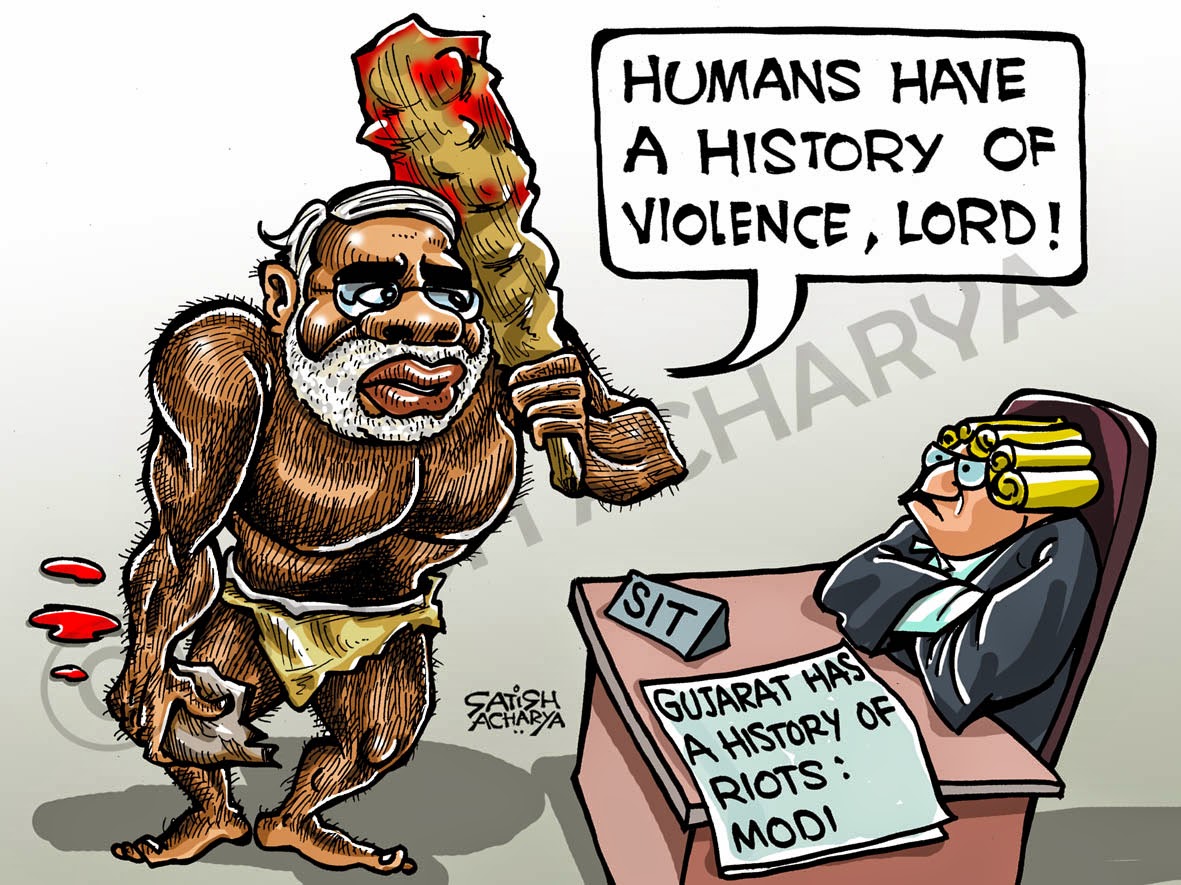
      Cartoon: Satish Acharya

      For those who have developed “selective and motivated” amnesia about the Truth of 2002 riots in Gujarat and are suddenly buying into the myths being perpetrated by the PR machinery of Mr. Narendra Modi, here are a few myth-busters to refresh your memory and perhaps your conscience.

      Myth No. 1: Post-Godhra Violence was brought under control within 2-3 days by Narendra Modi’s Government…
      Truth: “The violence in the State, which was initially claimed to have been brought under control in seventy two hours, persisted in varying degree for over two months, the toll in death and destruction rising with the passage of time.” 
      Source: Final Order of the National human Rights Commission chaired by the very respected Justice J.S Verma. Available here 
      Myth No. 2: Gujarat Police acted fairly by taking action against rioters from every side…
      Truth: “We women thought of going to police and telling the police as in the presence of police, the houses of Muslims were burnt, but the police told us ‘to go inside, it is doom’s day for Muslims” 
      Source: PW219 testimony which was admitted as part of Naroda Patya judgment that led to conviction of Mayaben Kodnani, Narendra Modi’s cabinet minister who led murderous mobs during 2002 riots! Available here
      Myth No.3: No conspiracy by the Gujarat government, Post-Godhra violence was a spontaneous reaction…
      Truth: “A key state minister is reported to have taken over a police control room in Ahmedabad on the first day of the carnage, issuing directions not to rescue Muslims in danger of being killed. Voter lists were also reportedly used to identify and target Muslim community members” 
      Source: Report of Human Rights Watch- April 2002, Vol. 14, No. 3(C). Available here
      Myth no. 4: Modi allowed a fair prosecution of those accused in rioting and hence even his cabinet colleague Mayaben Kodnani was convicted…

      Truth: “The modern day ‘Neros’ were looking elsewhere when Best Bakery and innocent children and helpless women were burning, and were probably deliberating how the perpetrators of the crime can be saved or protected.”

      “Law and justice become flies in the hands of these “wanton boys”. When fences start to swallow the crops, no scope will be left for survival of law and order or truth and justice. Public order as well as public interest become martyrs and monuments.”

      “From the facts stated above, it appears that accused wants to frustrate the prosecution by unjustified means and it appears that by one way or the other the Addl. Sessions Judge as well as the APP (Shri Raghuvir Pandya, the public prosecutor in this case at the time was a member of the ruling Bharatiya Janata Party (BJP) and contested elections from Ward 20, Vadodara in the 1996 Corporation Elections on a BJP ticket!) have not taken any interest in discharge of their duties.”

      Source: Supreme Court in Zahira Habibulla H Sheikh And Anr vs State Of Gujarat And Ors on 12 April, 2004 CASE NO.: Appeal (crl.) 446-449 of 2004 . Available here
      Myth No.5: Narendra Modi never justified post-Godhra killings…

      Truth: “Responding to queries regarding various statements attributed to him by the media, Mr Modi denied citing Newton’s law. Nor had he spoken of “action-reaction”; he had wanted neither the action (at Godhra) nor the subsequent reaction. When we cited footage in Zee to the contrary (Annexure 4A), there was no reaction from Mr Modi.”
      Source: Editors Guild Fact Finding Mission Report dated 2002. Available here
      Myth No.6: Narendra Modi speaks only about development in his speeches. Even after 2002 riots, his speeches were never laced with communal poison..

      Truth: Narendra Modi’s reported speech: “For several months, the opposition has been after me to resign. When I did, they did not know what to do and started running to Delhi to seek Madam’s help. They realised that James Michael Lyngdoh, the Election Commissioner of India, is their only saviour.Some journalists asked me recently, ”Has James Michael Lyngdoh come from Italy?” I said I don’t have hisjanam patri, I will have to ask Rajiv Gandhi. Then the journalists said, ”Do they meet in church?”. I replied, ”Maybe they do.” James Michael Lyngdoh came and visited Ahmedabad and Vadodara. And then he used asabhya basha (indecent language) with the officials. Gujaratis can never use such language because our rich cultural heritage does not permit it. Then he gave a fatwa ordering that the elections can’t be held. I want to ask him: he has come to this conclusion after meeting only members of the minority community. Are only minority community members citizens of India? Are majority community members not citizens of this country? Is the constitutional body meant only for the minority community? Did he ever bother to meet the relatives of those killed in the Godhra carnage? Why didn’t he meet them? Why didn’t he ask them whether the situation was conducive for polls? Why? James Michael Lyngdoh ( says it slowly with emphasis on Michael), the people of Gujarat are posing a question to you.”

      Source: Reported speech of Narendra Modi, 30th September 2002. Available here
      Myth No. 7: Narendra Modi never applied for a US Visa (when it came to light that he was denied one)..
      Truth: “The Chief Minister of Gujarat state, Mr. Narendra Modi, applied for a diplomatic visa to visit the United States. On March 18, 2005, the United States Department of State denied Mr. Modi this visa under section 214 (b) of the Immigration and Nationality Act because he was not coming for a purpose that qualified for a diplomatic visa. 
      Mr. Modi’s existing tourist/business visa was also revoked under section 212 (a) (2) (g) of the Immigration and Nationality Act. Section 212 (a) (2) (g) makes any foreign government official who “was responsible for or directly carried out, at any time, particularly severe violations of religious freedom” ineligible for a visa to the United States. 
      The Ministry of External Affairs requested that the Department of State review the decision to revoke his tourist/business visa. Upon review, the State Department re-affirmed the original decision.”

      This decision applies to Mr. Narendra Modi only. It is based on the fact that, as head of the State government in Gujarat between February 2002 and May 2002, he was responsible for the performance of state institutions at that time. The State Department’s detailed views on this matter are included in its annual Country Reports on Human Rights Practices and the International Religious Freedom Report. Both reports document the violence in Gujarat from February 2002 to May 2002 and cite the Indian National Human Rights Commission report, which states there was “a comprehensive failure on the part of the state government to control the persistent violation of rights of life, liberty, equality, and dignity of the people of the state.”
      Source: Statement by David C. Mulford, U.S. Ambassador to India, March 21, 2005. Available here 
      Myth No. 8: Vajpayee never asked Modi to observe “Rajdharma”, did not rap him for 2002 riots..

      Truth: “In comments which appeared to back criticism of the state authorities, Mr Vajpayee said he would speak to political leaders about allegations that they had failed to do their job. “Government officials, political leaders, need to respond to the task. The constitution guarantees equal rights for all,” he said.The state government is controlled by the BJP, and the Chief Minister, Narendra Modi, has come in for particular attack over the way the authorities reacted to the violence.

      At the Shah Alam camp in Gujarat’s commercial capital, Ahmedabad, Mr Vajpayee said that the Godhra attack was “condemnable” but what followed was “madness”. “The answer to madness is not madness,” he said in an emotional speech.”The duty of our government is to protect the property, life and honour of everybody… there is no scope for discrimination,” he said in an apparent reference to allegations that local officials had turned a blind eye to the killings.”
      Source: Vajpayee says riots “shameful” – BBC News report April 4th 2002. Available here
      Myth No.9: It’s not sheer opportunism that well-known Modi-baiters like Smriti Irani, have today become his cheerleaders..
      Truth: “Smriti Irani who unsuccessfully contested from Delhi’s Muslim-dominated Chandni Chowk constituency in the April-May parliamentary elections, blamed Modi for BJP’s recent electoral reverses. “Whenever people mention Gujarat they only talk about the riots and try to corner the Gujaratis on the issue. So, in order to maintain the respect that I have for Atalji and the BJP, I won’t hesitate to take this step( of going on a fast to seek Modi’s removal) ,” she said.”
      Source: Times of India report dated 12th December 2004. Available here 
      These myth-busters took me just one hour to compile. So it’s quite surprising that none of the stalwarts who interviewed Modi, (some of whom saw the events of 2002 unfold in front of their very own eyes), never counter-questioned him further and exposed the glaring gaps in his “rebuffed” narrative.

      **********
      Shehzad Poonawala is a Delhi based columnist.

    • Increasingly Newer forms of Labour Militancy in NCR Region: A Brief Report

      – Faridabad Mazdoor Samachar (New Series 310, April, 2014)
      Mar-Apr 2014: Plot 7, Sec 3, IMT Manesar, Napino Auto & Electronics Factory. On 24 March, workers of A, B and general shift stopped work and stayed on the shop floor. The same day, in the factory in Plot 31, Sec 8 of the same company, workers from three shifts also stopped work and stayed on the shop floor. And workers in the factory of this same company at 753-754 Udyog Vihar, Phase 5, Gurgaon, also stopped work and stayed on the shop floor. In all three factories, the women workers didn’t leave the shop floor at night. This is an expression of a radical transformation of the relations between women and men. In February 2014, in Baxter Pharma’s factory, 110 women and 140 men stopped work and stayed on the shop floor, refusing to buckle under the pressure of the management, labour department and police.
      Starting from 24 March, 2014, in all the three Napino Auto and Electronics factories, men and women workers stopped work and stayed on the shop floor round the clock, and continued to do so on 25, 26, 27, 28, 29, 30, 31 March and 1 and 2 April. The misanthropic company stopped the canteens of all three factories. Workers of the C shift of all three factories, who were outside the factories, brought food. Workers of many other factories remained in constant touch with the workers inside these three factories, carrying on discussions with them, circulating word in other factories about what was going on, and helping out with food.
      Similar happenings have occurred in the recent past in Maruti Suzuki Manesar, Suzuki Powertrain, Suzuki Motrocycle, Satyam Auto, Bajaj Motor, Endurance, Hailax, Lumex, Dighania, Hero Honda, Honda Motorcycle and Scooter, Harsurya Healthcare, Ametip Machine Tools.
      Friday, 28 March, 2014, 10.30 AM. Orient Craft Factory, Sec 18, Gurgaon. A tailor dies of electric

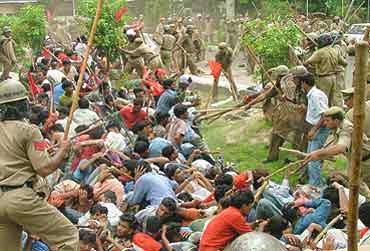
      Police crackdown on Workers, gurgaon. Photo: HotGurgaon

      shock from a machine in the factory. The company calls the police and declares heart attack as the cause of death. 1200 women and men workers of the factory rebel – first inside the factory, then out on the streets. Workers from other factories join them. 2.30 PM onwards, 3 ACPs, 1 DCP and police from half a dozen police stations from Sector 18 and from Gurgaon West Zone, Udyog Vihar, set up a barricade against the assembling workers. By 4 PM, stone pelting, lathi-charge, tear gas, firing starts. 1 ASP and and 10 policemen are injured, and 40 vehicles damaged. Many workers and hawkers injured. Police registers case against thousands of workers. By now, many workers have been arrested, and countless others are being chased. According to the workers, a woman worker had similarly died of a sudden burst of current in a machine, on 26 March.

      Two years ago, workers of the same company from the factory located in Sec 37, Gurgaon, had pitched battle with the management and police. Recently, workers in Ghaziabad (Gragiano), in Faridabad (Lakhani Shoes), in IMT Manesar (Maruti Suzuki), in Noida, in Okhla Industrial Area, in the Prithla-Baghola area of Palwal (Shivani Locks, Bio Medical, Haryana Wire, Mahindra, Vamani Overseas, SKH, Auto Ignition) have clashed with and battled managers, factory buildings and police. These clashes are against and bring into view the dominant social relations that govern life today, of which managers, buildings and police are expressions.
      **********
      This English version of the report was excerpted and sent to us by Jeebesh Bagchi.