Author: New Socialist Initiative Delhi Chapter
-
[Statement] Condemn the Killing of Shaikh Mohsin by Hindu Rashtra Sena in Pune! Resist Communal Fascism!
Statement by concerned IT professionals from PuneWe, the undersigned express our deep shock at the gruesome incident of hate crime reported in the city of Pune earlier this week. A 28 year old IT professional Shaikh Mohsin Sadiq was thrashed to death by a group of people suspected to be connected with a radical Hindu outfit called Hindu Rashtra Sena.Mohsin was reportedly returning home after offering namaz at a mosque on Monday night when he found himself caught by the mob. As is the case in every hate crime, a skull cap on head and beard were enough for the killers to pounce on him with deadly intentions. The city was witnessing bandh and violent street protests by Shiv Sena, BJP and other radical Hindu organizations in the wake of Facebook post(s) with allegedly derogatory references to Shivaji and former Shiva Sena Chief Bal Thackeray. The assailants were apparently involved in similar protests when they spotted Mohsin on Monday night in Bankar colony in Hadapsar area of Pune.One cannot help seeing this incident vis-à-vis forthcoming assembly elections in Maharashtra. As a run-up to the elections which are due in a few months, an attempt to polarize the masses on communal lines with the sheer intention of electoral gains, as we have seen elsewhere, seems to be on the cards. We appeal to the state government to thwart any such attempts with alacrity while ensuring safety to every citizen; we also appeal to the people of Maharashtra to not fall prey to such hideous designs and uphold the progressive tradition of the state that has seen peaceful co-existence of various sects, religions and cultural groups with no place for hatred.While offering our deepest condolences to the bereaved family members and friends of Mohsin, we extend our heartfelt solidarity to each and every member of minorities/disadvantaged communities in struggle to preserve the values of democracy, secularism and justice.Sd/—Neeraj Kholiya, Dhanesh Birajdar, Bharatbhooshan Tiwari, Nitin Agarwal, Vinod Pillai, Kamesh, Gokul Panigrahi, Rajat Johari, Ujjwal Barapatre, Kshitij Patil, Sanind Shaikh, Akbar Ali, Prince Shelley, Mohamed Shazad, Shaikh Asfaque Hossain. -
Demonstration held against State Crackdown on Bhagana Rape Survivors and other Protesting Villagers at Jantar Mantar
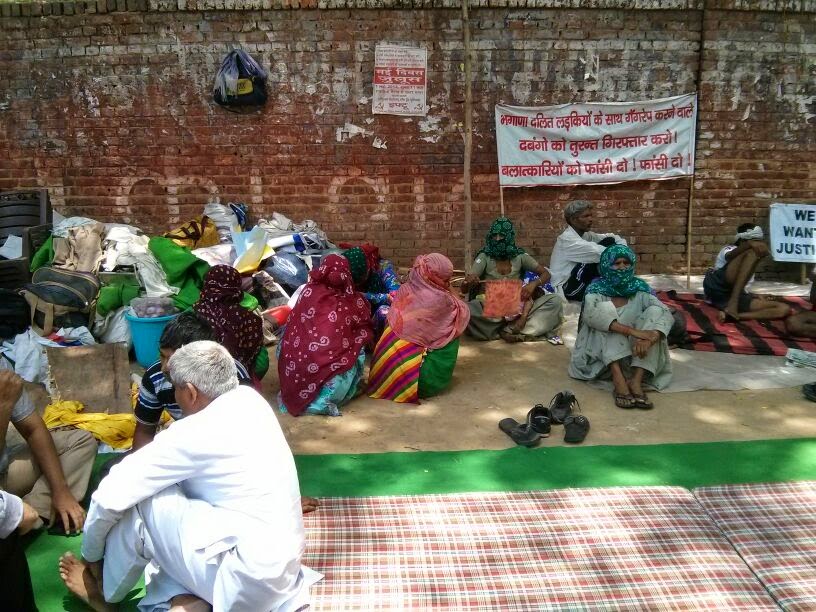
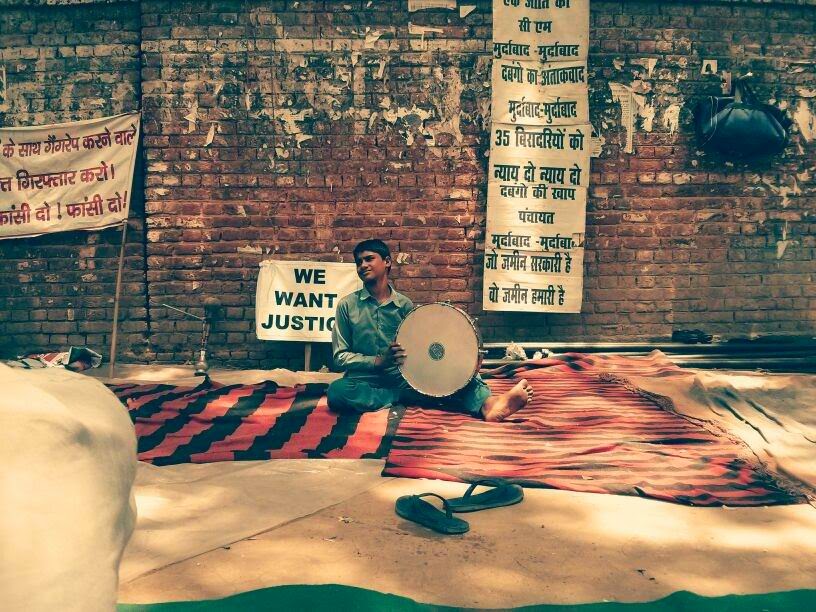
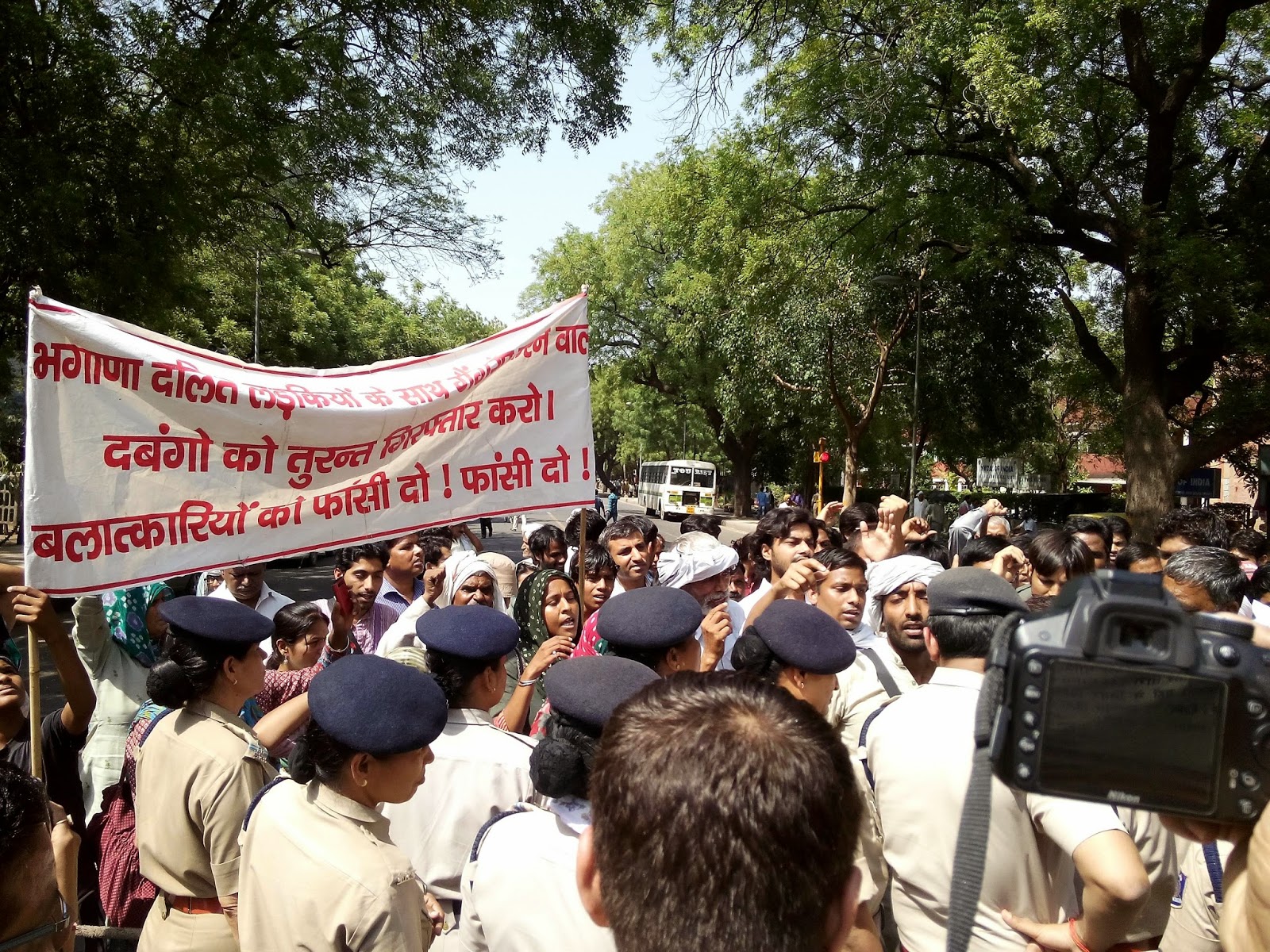
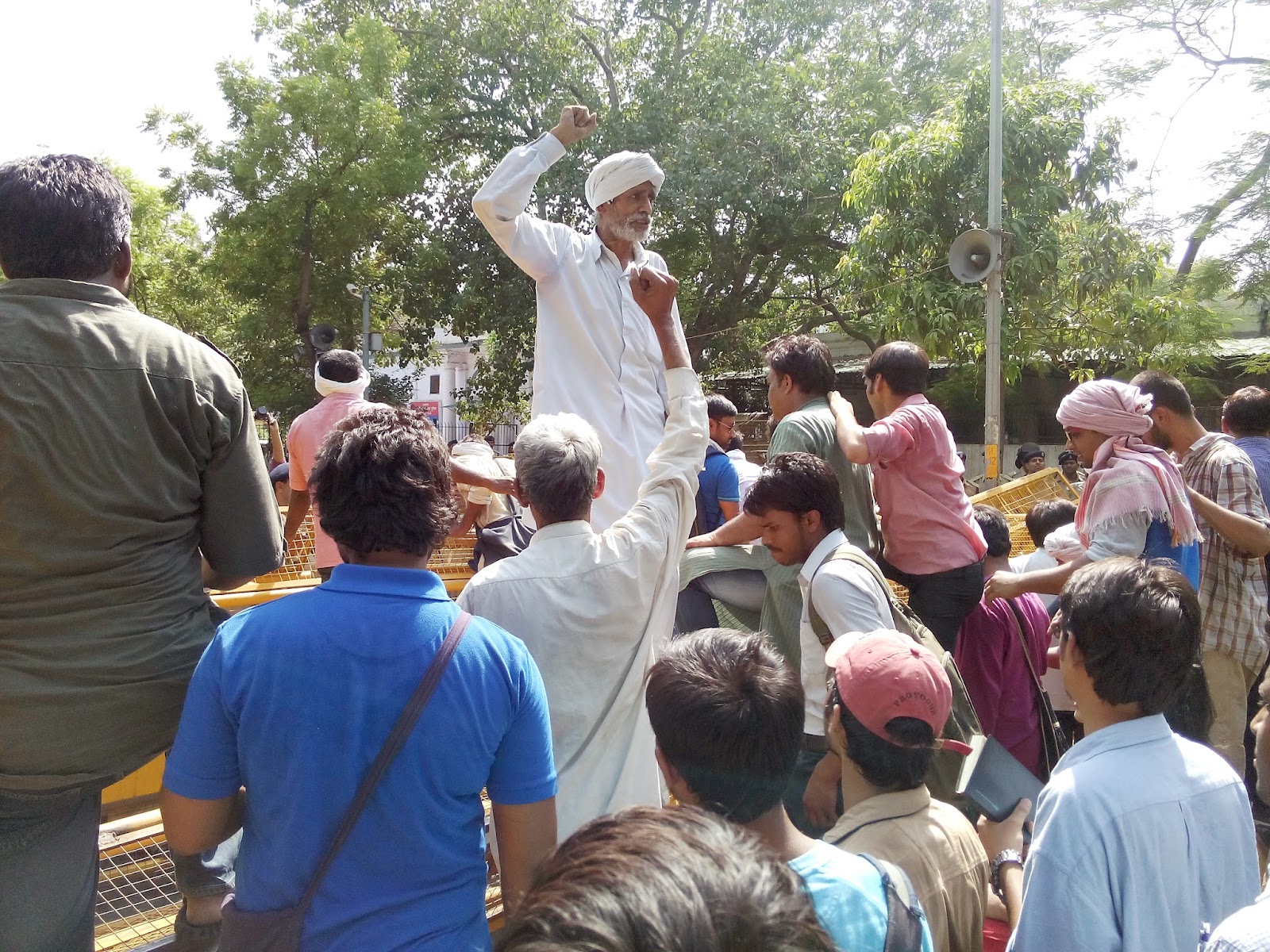
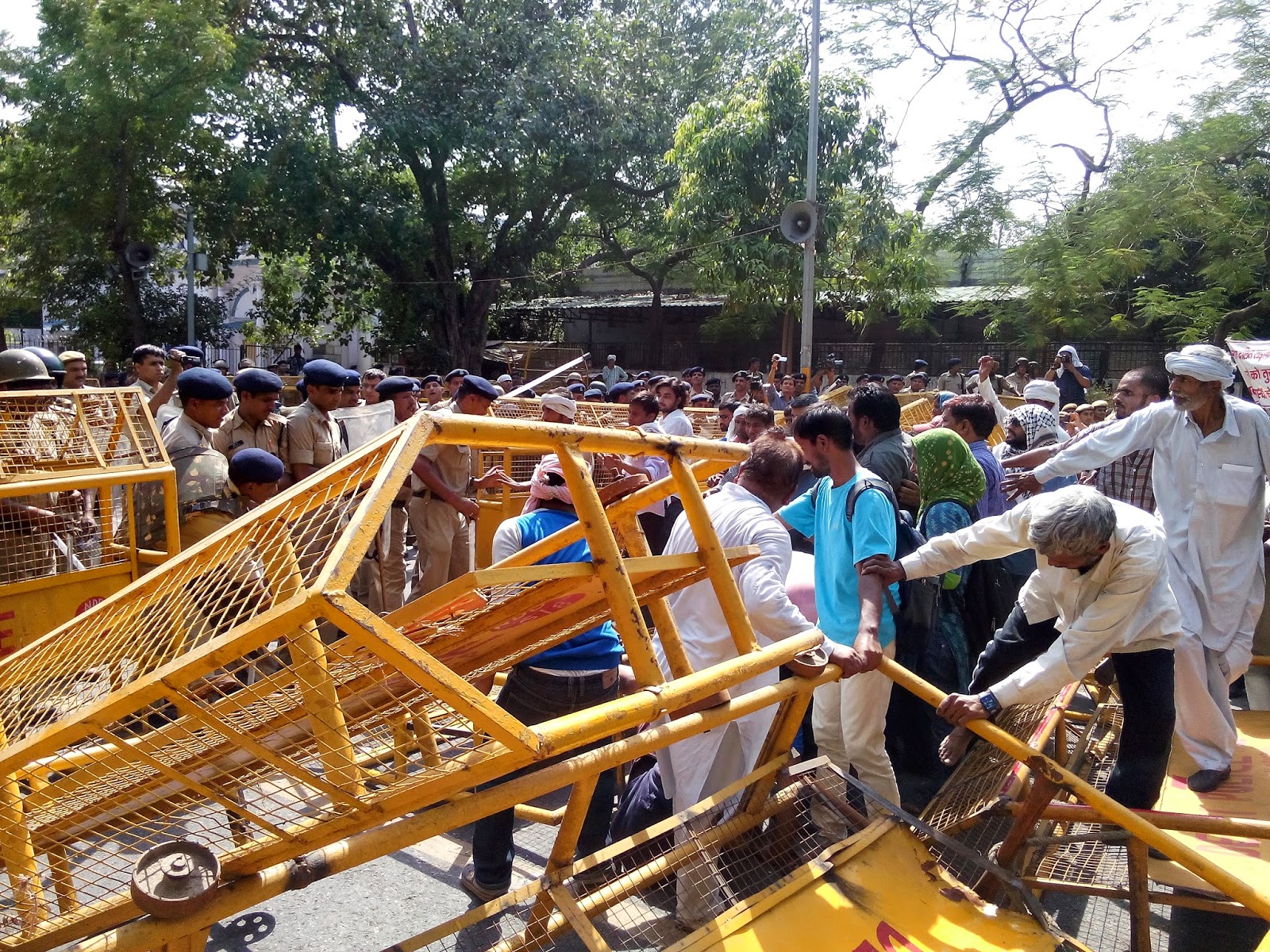
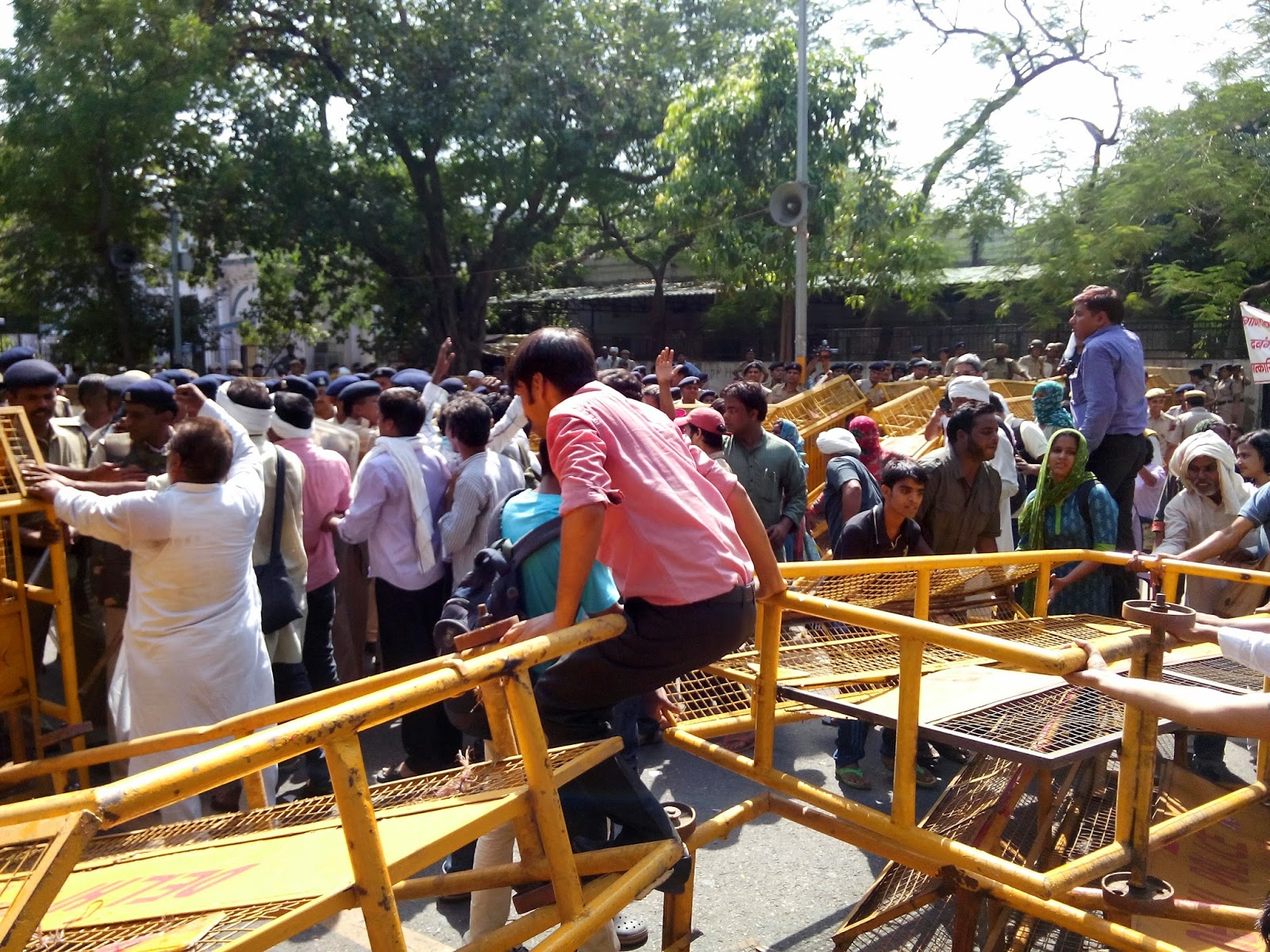
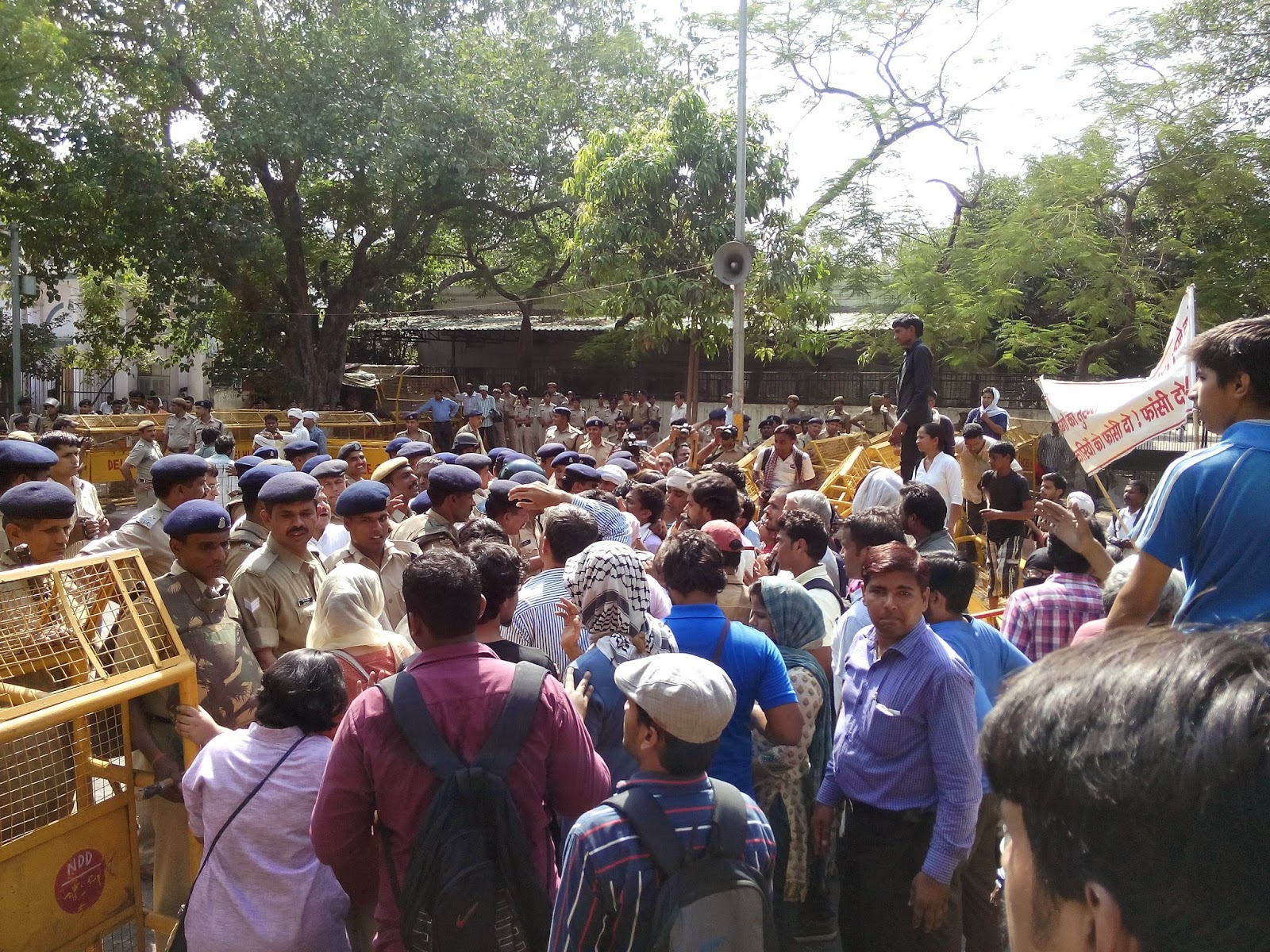
Condemned the police brutality against Bhagana Kand Sangharsh Samiti!Uphold the struggle for right to protest!On 23 March four Dalit girls of Bhagana village in Hisar, Haryana were abducted and gang raped by five young men of the dominant caste – Jats – recently included in the Central list of Other Backward Classes or OBCs. Two days later, on 25 March the girls were found in an unconscious state at the railway station in Bathinda, Punjab. They were then taken back home by their respective families. After several attempts in Haryana at bringing the guilty to justice, where their voices were ignored by the state administration they were forced to move the struggle to the capital city. For more than a month they have been sitting on a dharna at Jantar Mantar under the banner of Bhagana Kand Sangharsh Samiti. This case of Dalit atrocity in Haryana has, however, failed to become national news in the sold out corporate media.They, along with other left and progressive groups and members of civil society, have all the right to protest against atrocities on Dalits and other marginal groups. However, that is not how the State wishes to see it.
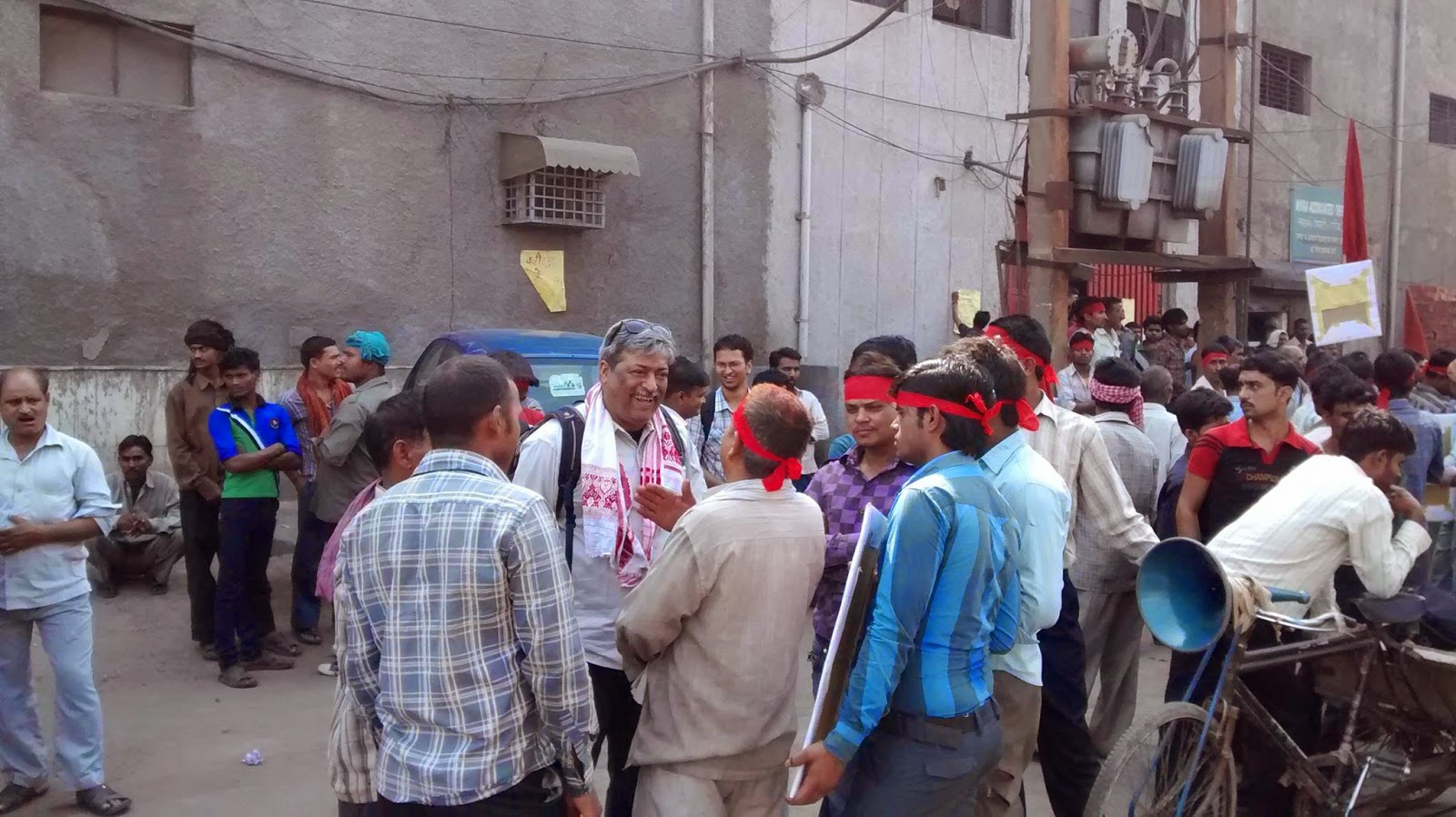
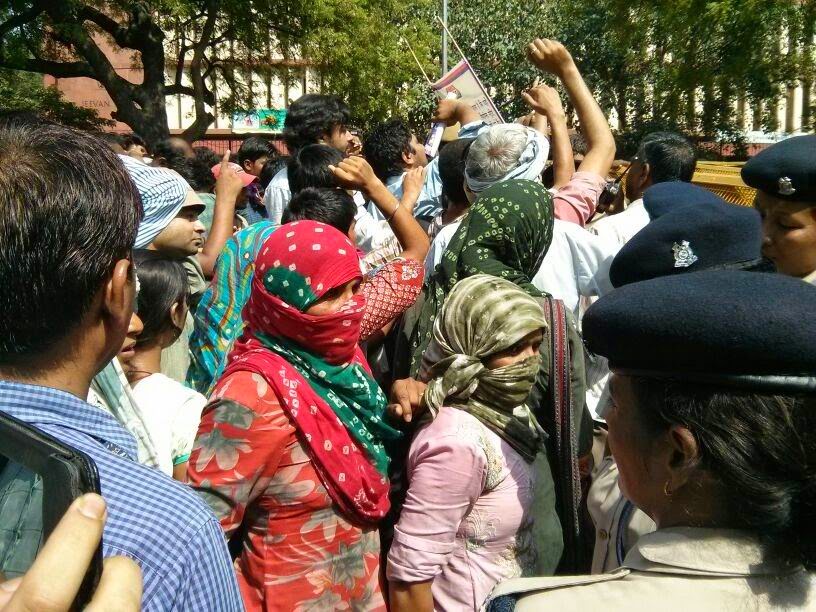
After Delhi Police demolished tents at the dharna site As if the trauma of abduction and gang rape was not enough, police brutality against the very rape survivors in the wee hours of the morning of 4 June added fuel to the fire. At about 5 am, 6-700 police personnel arrived at the dharna site at Jantar Mantar, forcefully evicted the protesters, uprooted their tents and took away their minimal belongings. The police informed protesters that they had orders ‘upar se’ (‘from above’) to vacate the dharna site immediately. When protesters refused, they were given time till 12 noon to vacate the place. Meanwhile, as this news spread amongst Left and progressive groups in the city, they began gathering at the dharna site and held a protest demonstration in front of the Parliament Street police station. The station in-charge, in a response that smacks of an arrogance so typical of police forces, attempted to get away with an explanation for the police brutality of that morning by saying that it was the NDMC that told the police to vacate Jantar Mantar so that they could clean the place!We all know that this is not the first time when the State machinery has attacked people’s right to protest and nor will it be the last. The need of the hour is to unite and gather against this in the coming days. Though, under pressure from the spontaneous demonstration against this action, while the police has assured the protesters that they would not remove anyone from the dharna site now, there is no reason to have any faith in this assurance.In this light, a planning meeting has been called tomorrow, 5 June at 6 PM at the dharna site at Jantar Mantar to chart out the plan of action for the future.Do join us in large numbers.Below are few photographs of today’s protest: -
A Level Playing Field? Global Sport in the Neoliberal Age
– Mike MarquseeOne of the hallmarks of the neo-liberal age has been the exponential expansion of commercial spectator sport – in its economic value, political role and cultural presence. All of which will be thrown into high relief during the coming World Cup.In recent years, the industry has grown in all regions above the local GDP rate, and is estimated to have generated $135 billion in direct revenues in 2013. These revenues derive from four elements: gate receipts, corporate sponsorship, media rights and merchandising. Revenues from sponsorship and media rights have grown fastest and together now make up over half of total revenue. But whereas in North America and Europe, gate receipts remain the single biggest source of revenue, in the BRIC counties and in Asia as a whole sponsorship is now the biggest money-spinner, accounting in China for 48% of total sports revenues. Meanwhile, though merchandising is marginal in most of the world, it is significant in north America, where it accounts for 25% of revenues.Despite its growth, the sports industry, narrowly defined, is still dwarfed by the pharmaceutical ($1.1 trillion a year) and automotive ($1.8 trillion) sectors. But direct revenues tell only a part of the story. Sport is interwoven with other industries: footwear, sportswear, soft drinks, advertising, among others. It’s a central driver in media industries – print, broadcast and digital. And it’s critical to the gambling industry, legal and illegal, with betting on sports estimated to be worth between $700bn and $1tn a year.Sport has become a fertile zone of capitalist intersection and mutual aggrandisement. It should therefore not be surprising that it has also become a major carrier of neo-liberal ideology, used to promote a competitive individualism in which the pursuit of victory and success is presented as the purest form of personal self-expression. Nike is the obvious example, with its injunctions to “just do it” and “risk everything” and its strategic linkage to sports superstars. What is celebrated is a “triumph of the will” – in which adverse circumstances are made to bow to individual desire. It’s a version of what has been described as “magical voluntarism”, identified by Mark Fisher as a key component of today’s dominant ideology.It needs to be said that this ethos of egocentric assertion is by no means inherent in sport, which is not about ‘the law of the jungle’ or a ‘war of all against all’. On the contrary, it’s a competitive activity built on a cooperative basis, requiring mutual agreement among competitors and between competitors and spectators. And it is intensely regulated; in fact, without the regulation, the sport vanishes. Team sports, of course, set a premium on interdependence and a willingness to sacrifice individual priorities for the good of the collective. But even the most successful individual competitors are what they are only because they enjoy a network of personal and social support. No one can ever “just do it” on their own.One of the favourite metaphors of advocates of capitalist globalisation is borrowed directly from sports. They hunger for a world-wide “level playing field” in which competition flourishes freely and fairly. However, as in so many spheres, the impact of neo-liberal globalisation on sport itself has been to create an increasingly uneven playing field, marked by widening inequalities.As the major male sports swallow an ever increasing share of sports revenues and investment, other sports are pushed to the margin. In south Asia, cricket is so dominant that it has rendered hockey, at which India and Pakistan excelled for decades, nearly invisible. While women’s sports have enjoyed increased revenues in absolute terms, the growth of male sports means that women still receive only 0.5% of corporate sports sponsorship.Elite male European football now accounts for more than 35% of global sports revenues; a similar share goes to the Big Four North American team sports (baseball, basketball, ice hockey and American football). Within European football, the five biggest leagues comprise half the total market and the top 20 teams one-quarter of that market.The English Premier League breakaway in the early 90s has proved to be a watershed. The big clubs’ main motive was to maximise their share of broadcasting revenues. Since then, the tendency has been for the rich teams to get richer, while the rest face perpetual insecurity. In effect, the billionaire backed clubs are now hoarding the best players, making it even harder for others to compete with them. UEFA has introduced its Financial Fair Play rules in an attempt to restrain the growing inequality, but they are unlikely to affect the overall imbalance.Meanwhile, European football recruits extensively from Latin America and Africa, whose domestic competitions are thereby weakened. Compounding the talent drain, globalised broadcasting has in many regions made Europe’s big clubs more famous and more widely followed than local teams.The general trend towards a concentration of wealth and power is neatly illustrated by recent events in world cricket. Earlier this year, the three richest cricket boards – India, England and Australia – combined forces to impose a new order on the ICC, the game’s governing boy. From now on the Big Three will take home a larger share of the game’s global revenues, dictate unilaterally which other teams they’ll play and how often, and wield an effective veto on all ICC decisions. There’s also a plan to introduce a two division structure for Test cricket, with a telling wrinkle in the scheme: none of the Big Three are ever to be relegated to the second division. So their standing in the competition will be guaranteed not by the quality of their cricket but by their financial clout.Unpredictability and spontaneity are at the heart of sports, and they are at odds with the capitalist drive to maximise profits and eliminate variables. An extreme example is bookmakers who seek to fix results, thus guaranteeing the return on their investment. But sponsors too would prefer some WWE-like scripted entertainment: no annoying upsets or injuries or mysterious losses of form to compromise their projections. The problem for them is that their property would forfeit all value should it be seen to be scripted.So there’s a tension between capitalist imperatives and sporting imperatives. In fact, the whole idea of sports competition as a mirror or metaphor for capitalist competition is misconceived. The ‘level playing field’ in sport is constituted by a rigid scaffolding of rules without which the competition dissolves. Capitalism’s version is a deregulated arena of limitless accumulation. The aim of capitalist competition is to eliminate (or acquire) the competitor. In sport, you need the opponent to survive and return for the next match or season, which always begins the contest afresh. And of course, what’s at stake in the two types of competition is fundamentally different. The penalties for coming second do not compare.
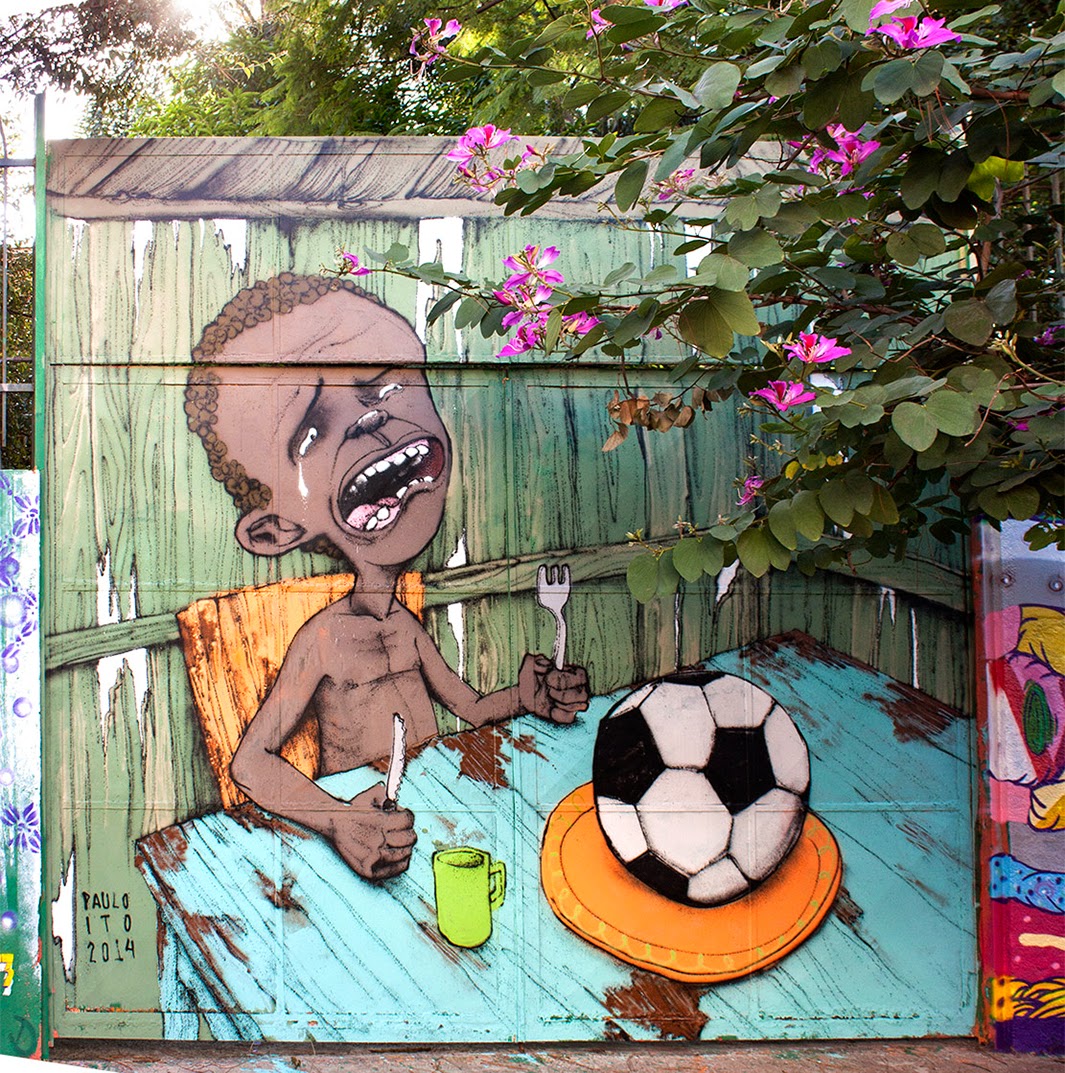
Mural by Brazilian artist Paulo Ito All the contradictions of commercial spectator sport will be on display, in heightened form, in this year’s World Cup. Dave Zirin, in his invaluable new book, Brazil’s Dance with the Devil, shows how this sporting mega-event has become a carnival of state-sponsored neo-liberalism, characterised by mass evictions, gentrification, increased repression and surveillance, vast expenditure on redundant facilities and corporate plundering of public funds. It’s a boon for the construction, property, security and media industries, but a bane for many others, as was demonstrated last year, when huge numbers of Brazilians took to the streets to protest against the World Cup priorities that have skewed the country’s development.World Cup boosters claim that once the competition is underway and “the ball is rolling” all the discontents will vanish. What’s certain is that there will be a concerted effort to convince us that this is so. Those who persist in talking about the social cost underlying the festivities will be condemned as killjoys and nay-sayers. We are cast as consumers and nothing but consumers, expected to imbibe the corporate-branded spectacle without qualms or conscience. In that context, engaging critically with sports, seeing them as part of the broader human current, becomes a necessary subversive act. FIFA and its corporate partners have a vested interest in promoting tunnel vision, but the rest of us do not. Enjoyment of the football and critique of its context can and should go hand in hand. The idea that one excludes the other is a myth we need to shed.**********Mike Marqusee is a political activist and writer who writes on politics, culture and sports. He has authored several books including “Redemption Song: Muhammad Ali and the Spirit of the Sixties”; “Chimes of Freedom: the Politics of Bob Dylan’s Art” ; “If I Am Not for Myself: Journey of an Anti-Zionist Jew”; “Street Music: Poems by Mike Marqusee”.This article first appeared on author’s own website www.mikemarqusee.com -
Foot Soldiers of Hindutva in Search of an Icon
– Subhash Gatade“The epitah for the RSS volunteer will be that he was born, he joined the RSS and died without accomplishing anything.”-V. D. Savarkar
(D.V.Kelkar, “The R.S.S.” Economic Weekly ( 4 Feb 1950: 132) Page 36, The Brotherhood in Saffron,The RSS and The Hindu Revivalism, Andersen and Damle,Vistaar, 1986, Delhi)
Veer Savarkar was a Veer Purush who was not scared of death. He was a Shastra Upasak and Shaasrta Upasak: Shri Narendra Modi. May 29, 2013 Author: admin (www.narendramodi.in)
ICelebrations at the central hall of Parliament are a marker of the political ambiance in the country.The change of guard at the centre was very much visible at the place recently where the entire top brass of BJP including PM Narendra Modi were present to celebrate the birth anniversary of Savarkar. Modi described Savarkar as a prolific writer, poet and social reformer. “Tributes to Veer Savarkar on his birth anniversary. We remember and salute his tireless efforts towards the regeneration of our motherland.”People would recall that normally it used to be a low-key event. Last year, the celebrations were further muted. Only few prominent leaders of the BJP were present there. The ascendance of BJP led government had clearly made the difference.A trip down memory lane would tell us that even for the Sangh Parivar and its affiliated organisations this has not been the case always. The iconisation of Savarkar in the Parivar is not very old. Late nineties when Shiv Sena-BJP ran a coalition government in Maharashtra they did not even think of putting his portrait in the state the assembly. For them this discovery of Savarkar happened during the BJP led NDA regime at the centre (1998-2004).Perhaps neither Modi nor any of his cabinet colleagues, most of whom started their social political life in the RSS or Rashtra Sevika Samity ( which is meant for women of the Hindutva brigade), would like to remember today that they are singing paens to the man who when alive had castigated the Hedgewars-Gurujis’ – founders and pioneers of RSS – and their Swaymsevaks umpteen times ( Sample the quote above) and the Hedgewars’-Golwalkars’ had also returned the compliment in the same vein.
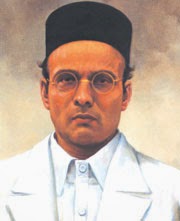
Savarkar Even a cursory glance at the trajectory of Hindu Mahasabha under the leadership of Savarkar or the way in which RSS unfolded itself during those days makes it quite clear that the differences in priorities between the two organisations was already visible from the day Savarkar was elected president of the Hindu Mahasabha after his release from jail ( 1937).In a sympathetic study of RSS “The Brotherhood in Saffron,The RSS and The Hindu Revivalism,” the authors Andersen and Damle clearly explain (Page 40, Vistaar, 1986, Delhi) that in fact Savarkar’s emphasis was on turning Mahasabha into a political party in opposition to the Congress when Hedgewars’ had already decided to insulate RSS from any active politics and concentrate on ‘cultural work’. Hedgewar and later Golwalkar also neither wanted to be associated with a formation whose confrontational activities would place the RSS in direct opposition to the Congress. According to him there were apprehensions regarding each other’s role in the Hindu Unification Movement. The souring of relations between the two organisations is visible in a angry letter issued by Savarkar’s office in 1940 advising that:
“… When there is such a serious conflict at a particular locality between any of the branches of the Sangh RSS and the Hindu Sabhaites that actual preaching is carried out against the Hindu Mahasabha …, then the Hindu Sabhaites should better leave the Sangh …and start their own Hindu Sabha volunteer corps.( Letter from V.D.Savarkar to S.L.Mishra, 3 March 1943, Savarkar files, Bombay)”
Definitely the fact that this ‘Veer Patriot’ (to quote title of a write-up which appeared in ‘Panchajanya’ sometime back discussing Savarkar) died a lonely man abhorred especially by the thriving ‘Parivar’ then, which made special efforts to maintain distance from him in those days, did not bother these ‘legatees’ then. It did not perturb their conscience a bit that it took more than thirty four long years after his death that they ultimately decided to claim their lineage from this pioneer of the Hindutva project.Just to recapitulate, a decade back, when the Vajpayi led NDA was ousted out and UPA I led by Congress, had assumed reins of power a controversy had erupted about removal of Savarkar’s plaque from Port Blair’s cellular jail where Savarkar was jailed, Vikram Savarkar, Savarkar’s own nephew in an interview to a national daily exposed BJP’s lack of interest in him and castigated them for their sudden love for him. (Savarkar nephew hits out at BJP, August 30, 2004, Indian Express)It may be noted that he had accused the senior leaders of the BJP for ‘keeping mum despite noticing the removal of his uncle’s quotations from Port Blair’s Cellular Jail’. According to him Ram Kapse, the then incumbent Lt. governor of Andaman and Nicobar and former M.P Ram Naik ( both BJP workers) “..did not utter a word when the plaque was removed.” The report further says that ,’ ..he is not surprised at BJP’s lack of interest in Savarkar. “We know very well that the BJP and RSS did not appreciate his (Savarkar’s) philosophy.”..’ ..The report further says that ‘ (Vikram- author) Savarkar insists BJP’s sudden love for the legend is an eyewash.’ “It is an effort to woo voters for the Assembly elections in Maharashtra.”II“Many people worked with the inspiration to free the country by throwing the British out.After formal departure of the British this inspiration slackened.In fact there was no need to have this much inspiration.We should remember that in our pledge we have talked of the freedom of the country through defending religion and culture. There is no mention of departure of the British in that”. – M.S. Golwalkar alias Golwalkar Guruji ( Sri Guruji Samgra Darshan,Volume IV, p.2 )
“ In 1942 also there was a strong sentiment in the hearts of many. At that time too the routine work of Sangh continued. Sangh decided not to do anything directly”. – M.S. Golwalkar alias Golwalkar Guruji ( Sri Guruji Samgra Darshan, p.41)
Ofcourse even a layperson can understand that this ‘discovery of Savarkar’ which happened in late 90s or or the first decade of the 21 st century and the memory recall experienced by the R/SS brigade vis-a-vis Savarkar did not have spiritual but purely temporal considerations. As an aside it need be mentioned here that Savarkar’s portrait was unveiled in the Parliament in the year 2003 – exactly five years after they BJP came to power at the centre. It is clear that apart from the immediate task on hand this complete claim over Savarkar’ serves a larger purpose for them and it relates to their utter compromising role during the anti-colonial struggle.Everybody knows that the RSS came into being in the mid twenties when the anti-colonial struggle was surging ahead but preferred to keep itself aloof from this upsurge and concentrate on its supposedly ‘cultural work’. Not even once during this twenty plus year journey till we reached independence did it give any call specifically opposing the Britishers, rather it penalised those activists who wanted to participate in the people’s movement for freedom. Even its founder Mr Hedgewar went to jail only once after the founding of RSS and that also under the Congress banner. It has been well documented how sheepish their behaviour was during those days when even the secret reports of the Britishers did not write anything averse about them. The Britishers even ‘appreciated’ their immediate compliance when they were ordered to stop military type training in the late 1930s. Not content with their opposition / non participation in the independence movement they even made special efforts to break the broad anti imperialist unity of the Indian people by dividing them on communal lines.Anybody can vouch that this ‘controversial past’ of theirs cannot be erased from public memory. The ‘iconisation’ and the ‘glorification’ of Savarkar thus serves a dual purpose.The projection of Savarkar as a great freedom fighter and claiming lineage from him whitewashes the ‘Parivar’s’ silence during those stormy days then and Savarkar’s later transformation from a nationalist into a Hindutva Supremacist serves them equally well.It is also evident that there are many aspects of Savarkar’s life which they find rather discomforting.In fact, it would not be incorrect to state that they find themselves in catch 22 situation while defending him e.g. The controversy surrounding the clemency petitions sent by Savarkar to the Britishers for his release while he was in the Andamans still simmers. While his detractors have been able to show his clear cut surrender before the Britishers by presenting documentary proofs which includes Savarkar’s own petitions his die hard supporters have rather adopted a more ‘flexible’ strategy to buttress their case. Initially they challenged the veracity of his clemency petitions themselves but when that could not be sustained they have portrayed the whole exercise as a tactical move on his part to get out of jails so that he could join the struggle outside. In fact this whole exercise to discover ‘tactics’ behind Savarkar’s petitions for clemency are a great insult to the memory of those known and unknown revolutionaries who braved heavy odds to persist in their struggle many of which embraced death rather than seek amnesty.Definitely there are many loopholes in this defense. One is surprised to find that a leader of his stature whose heroic deeds in the prime of his youth for the cause of freedom struggle had electrified the nation had started sending letters of apology and demanding amnesty immediately after being sent to Andamans as part of his punishment for life imprisonment. He even disregarded the fact that an All India Defense Committee had already come up for his release and the Congress Party then had urgently taken up his case before the British regime.But as the book ‘Penal Settlement in Andamans’ by Mr R.C. Mazumdar ( Gazettees Unit, Department of Culture, Ministry of Education and Social Welfare, Govt of India, 1975, P.221) vividly demonstrates he was really so demoralised with the tough conditions existing there that he promised to serve the government in any capacity in exchange of his release.Sample this concluding part of a mercy petition which Savarkar personally presented to Sir Reginald Craddock, Home Member of the Government of India when he came to visit Cellular Jail in 1913 (November 14, 1913). The mercy petition concluded with the following words :I am ready to serve the Government in any capacity they like, for as my conversion is conscientious so I hope my future conduct would be. The Mighty alone can afford to be merciful and therefore where else can the prodigal son return but to the parental doors of the Government. (R.C. Mazumdar, op cit. Page 213)
The assassination of one of the noblest sons of the Indian people namely Mahatma Gandhi and the role played by Savarkar in it has also been a major controversy revolving about it. Despite enough evidence to show that he had a hand in the conspiracy to kill the Mahatma, his supporters have glossed over all the facts on mere technical grounds.Kapur commission also examined Savarkar’s role in the assassination. As things had unfolded in the trial court of Atma Charan, Godse had claimed full responsibility for planning and carrying out the attack, in absence of an independent corroboration of the prosecution witness. Here Badge’s testimony was not accepted as it lacked lacked independent corroboration. This was later corroborated by the testimony of two of Savarkar’s close aides – Appa Ramachandra Kasar, his bodyguard, and Gajanan Vishnu Damle, his secretary, who had not testified in the original trial but later testified before the Justice Kapur commission set up in 1965. Kasar told the Kapur Commission that they visited him on or about January 23 or 24, which was when they returned from Delhi after the bomb incident. Damle deposed that Godse and Apte saw Savarkar in the middle of January and sat with him (Savarkar) in his garden.
Justice Kapur concluded: “All these facts taken together were destructive of any theory other than the conspiracy to murder by Savarkar and his group.”. “First Terrorist of Independent India” – Subhash Gatade.
A few other crucial aspects of his personality which could help us in reaching a balanced conclusion have either not been considered or have been dropped as irrelevant for the debate. It is time one revisits some of these aspects and also take a fresh look at his weltanshaung (world view) through which many of the tragic as well as bloody events in the history of Independent India can be foretold.In fact the myth makers engaged in building a ‘halo’ around Savarkar about his ‘bravery’ do not want to uncover that he preceded Jinnah in propounding the ‘two nation theory’.If Jinnah is portrayed as a ‘villain’ in the popular imagery supposedly for demanding partition how it is proper to wrap Savarkar in the garb of hero if he was the one who forcefully laid down the principle much before him. The presidential address delivered by him in Ahmedabad at the 19 th session of the Hindu Mahasabha in 1937 not only explained his understanding of Hindutva but also declared that India comprises of two nations. According to him:there are two antagonistic nations living side by side in India, several infantile politicians commit the serious mistake in supposing that India is already welded into a harmonious nation, or that it could be welded thus for the mere wish to do so.These our well meaning but unthinking friends take their dreams for realities.That is why they are impatient of communal tangles and attribute them to communal organizations. But the solid fact is that the so-called communal questions are but a legacy handed down to us by centuries of cultural, religious and national antagonism between the Hindus and Moslems … India can not be assumed today to be a Unitarian and homogeneous nation, but on the contrary there are two nations in the main : the Hindus and the Moslems, in India.
( V.D.Savarkar, Samagra Savarkar Wangmaya Hindu Rasthra Darshan ( Collected works of V.D.Savarkar) Vol VI, Maharashtra Prantik Hindusabha, Poona, 1963, p 296
It is now history how in 1942 when the Britishers were engaged in the World War II and the Congress’s call for ‘Quit India’ reverberated throughout India, thousands of people engaged in government jobs including police and military left their jobs to protest continuation of British regime. It is worth noting that while the RSS preferred to keep itself aloof from the ‘Quit India Movement’ and concentrate on its divisive agenda when the broad masses of the Indian people were fighting the Britishers the pioneer theoretician of the project of Hindu Rashtra went one step further. At that time ‘Veer’ Savarkar preferred to tour India asking Hindu youth to join the military with a call ‘Militarise the Hindus, Hinduise the nation’ . While on one hand Subhash Chandra Bose was engaged in building Indian National Army to fight the Britishers and on the other hand this ‘Veer of a different kind’ was unashamedly strengthening British efforts to suppress the rising tide of people’s movement. It is interesting that the myth makers of Hindu Rashtra never forget to talk about Subhash Bose’s alleged meeting with Savarkar before he proceeded for Germany communicating a sense that Bose’s effort had Savarkar’s blessing. But they never try to wriggle themselves out of this contradiction that while Savarkar ‘blessed’ the formation of Indian National Army, he himself was helping the Britishers to find recruits for their army. The rationale provided to justify Savarkar’s help in this war effort is convoluted.It was during the same period that when anti imperialist forces led by Congress and other radical sections of society were waging a ‘Do or Die’ struggle against the Britishers, Hindu Mahasabha under Savarkar’s leadership was running coalition governments in Sind and Bengal sharing power with Muslim league. And while at the level of rhetoric Savarkar had unleashed an attack against the composite, inclusive nationalism of such forces and had no qualms in categorising them for their ‘appeasement of Muslims’, at the practical level he was busy unashamedly defending this power sharing:in practical politics also the Mahasabha knows that we must advance through reasonable compromises.Witness the fact that only recently in Sind, the Sind Hindu Sabha on invitation had taken the responsibility of joining hands with the League itself in running coalition government.The case of Bengal is well known. Wild Leaguers whom even the Congress with all its submissiveness could not placate grew quite reasonably compromising and socialble as soon as they came in contact with the Hindu Mahasabha and the Coalition government , under the premiership of Mr Fazlul Haq and the able lead of our esteemed Mahasabha leader Dr. Shyama Prasad Mookerji, functioned successfully for a year or so to the benefit of both the communities.
( V.D.Savarkar, Samagra Savarkar Wangmaya Hindu Rasthra Darshan ( Collected works of V.D.Savarkar) Vol VI, Maharashtra Prantik Hindusabha, Poona, 1963, p 479-480
Is it not surprising that despite many such acts which by any stretch of imagination could be called ‘patriotic’ Savarkar is still being portrayed as a ‘patriot’ by the Hindutva Brigade. One fails to understand what was ‘patriotic’ about this when the Indian masses were shedding their blood at the hands of the Britishers this ‘Veer’ was engaged in not only providing legitimacy to their regime but was also engaged in winning over a section of Hindu masses to join the British forces.Ofcourse the ‘Veerhood’ of this Patriot of a different kind did not end here. Neither could he hide his glee over the ‘banning of Congress’ and ‘its removal from political field.’ He did not mind hurriedly applauding Aiyar, the Dewan of Travancore, when he had exhibited the audacity of declaring the state independent. Qutoed in Frontline, A.G.Noorani, (in his review of two biographies of C.P. Ramaswami Aiyar in -) says that:Sir C.P.Ramaswamy Aiyar, the Dewan of Travancore, had declared the state independent of India! The perfidy did not stop there. He gallantly and speedily appointed an ambassador from Travancore to Jinnah’s Pakistan, thus affirming once more his credentials as an inveterate enemy of India free and whole.And, for this treason, who lustily applauded Aiyar in all of India? Who else but “Veer” Savarkar?
Savarkar should have been tried for treason. They let him go in those days of national euphoria. It only whetted his passion for more treason and grosser crime, culminating in Gandhi’s assassination.
IIIThe epic of bravery of this ‘Veer of a Different Kind’ would remain incomplete if one does not take into account the way he propagated politics of revenge in general and even went to the extent of propagating rape as a political weapon to further the cause of Hindu Rashtra. The way Savarkar justifies violence against innocents, the way he castigates the greatest Maratha king Shivaji for his chivalry towards women is reprehensible.Dhanjay Keer in his biography of Savarkar narrates an incident of Savarkar’s childhood when as a 12 year old child he had gone to stone a local mosque. Savarkar’s own description of the incident is noteworthy:“We vandalised the mosque to our heart’s content and raised the flag of our bravery on it. We followed the war strategy of Shivaji completely and ran away from the site after accomplishing our task.”
As expected when the Muslim boys in the village reacted to this incident, Savarkar and his buddies from the village did not hesitate to retaliate violently with knives, pins etc. Savarkar cannot hide his glee over the victory of their side in this ‘religious war’.In fact Savarkar’s valorisation of violence against English women and children is also problematic.Mr Jyotirmaya Sharma in one of his articles ‘Invented Enemy : Savarkar’s Politics of Revenge’ published in Times of India also gives an example about the way Savarkar narrates the event of 1857 in Kanpur. Discussing the 1857 siege of Kanpur Savarkar tells the reader in an unemotional comment the way:‘butchers were called by the Begum Saheb of Bibigarh, the chief officer of Bibigarh when the prison guards refused to massacre the English.’
According to Savarkar:‘…As soon as they entered with their swords and knives, they butchered 150 women and children. While going in, the butchers walked on the ground and while coming out they had to journey through blood.’
Ofcourse Savarkar’s ‘magnum opus’ Bhartiya Itihasatil Saha Soneri Paane (‘Six Golden Epochs in Indian History)’ can be considered to be a representative of his new weltanshauung where he carefully departs from his earlier nationalist philosophy and focuses his attention on the project of Hindu Rashtra. Ajit Karnik in his comment ‘Savarkar’s Hindutva’ (Economic and Political Weekly, April 12,2003) tells us how Savarkar condemns Marathas for not taking revenge on Muslims. According to him:“…On pages 390-391 of the above-mentioned book, Savarkar takes to task the Marathas for not taking revenge on Muslims in response to the atrocities committed around the year 1757 by Abdalli. Savarkar would have liked the Marathas to not just take revenge, but to annihilate Muslim religion (Mussalmani Dharma) and exterminate the Muslim people and make India “Muslim-free”. He reports with great approval how Spain, Portugal, Greece and Bulgaria had done a similar thing in the past and ensured the safety of Christianity. Presumably, Savarkar would have liked India to be rid of Muslims to make the country safe for Hindutva. Clearly, the India he wanted to create had no place for Muslims: the country had to be cleansed of Islam and the followers of Islam.”
It is worth noting that in this much discussed book Savarkar propounds the thesis of the ‘collective guilt of Muslims’. He lays down the thesis that Muslims need to be punished not only what they themselves have done but what their coreligionists had done. In a way he presents himself as the father of the language of Pratishodh, Pratikaar, all synonyms for revenge, retribution and retaliation and a pioneer thinker who inspired a wide spectrum of individuals and organisations ranging from the Sangh Parivar, Shiv Sena and Hindu Mahasabha to the Hedgewars, Golwalkars to the Thakres, Togadias.Karnik further adds :Further (page 392), Savarkar is unrelenting in his criticism of the Marathas for failing to exact revenge, not only on Abdalli and his forces for their atrocities on Hindus, but on those ordinary Muslims who continued to live in Mathura, Gokul, etc. According to Savarkar, the Maratha army should have killed ordinary Muslims (i e, not soldiers), destroyed their mosques and raped Muslim women. The revenge was to be taken, not on the perpetrators of the earlier atrocities, but on those who had nothing to do with the earlier episodes, on those who were ordinary residents of these places and whose only crime was that they shared their religion with the perpetrators of the earlier atrocities.
The act of ethnic cleansing has come in lot of criticism in the civilized world of late. The way ultra-nationalists of Serbia engaged in such campaign in Bosnia has not only been well documented but for such acts against humanity its ‘architect’ Slobodan Milosevic faced trial before the world court. The events in Gujarat when the Hindutva fascists enacted one of the worst genocides of the minorities have also received lot of condemnation and even the Supreme Court of the country has categorically stated that it was ‘terrorism’ which was spearheaded by ‘Modern Day Neroes’.While Savarkar was long dead when these events occurred but it is not difficult to surmise how he would have reacted to such incidents if one compares his approach towards similar incidents in the past.One knows that the advent of Pushyamitra Shung in the early part of the first millennium had lead to ethnic cleansing of Buddhists on a mass scale. It is the same period when Brahminical revival took place and Manusmriti was codified. In his book Savarkar had no qualms in justifying the large scale massacre of Buddhists by Pushyamitra Shung (Veer Savarkar Prakashan, Kurla, Mumbai,1997, 9th edition, Chapter 2, P 51-74).But one of the most reprehensible but also the least known part of Savarkar’s life is the way he criticised Shivaji for his chivalry towards the daughter in law of Nawab of Kalyan who was captured and brought before him by his army. He calls this act perverted virtue. (Bhartiya Itihasatil Saha Soneri Paane, Chapter 4 and 5, P. 147-74). The legend goes that when one of his enthusiastic assistants presented before him the daughter in law of Nawab expecting to get some special favour, Shivaji not only reprimanded him for such act but also punished him and sent back the women to her place with full honour. But Savarkar condemns this act by Shivaji and says that he was wrong as this cultured and human treatment could not evoke in those fanatics the same feelings about Hindu women. It may be shocking to note that thus Savarkar gives a theoretical justification for the innumerable rapes of the ‘other’ women by the terrorists of the Hindutva brigade ranging from Bhagalpur to Gujarat. In fact like Shivaji, Chimaji Appa another Maratha warrior had also dealt with a similar situation in a similar manner to the wife of the Portugese governor of Bassein. Savarkar is quite unambiguous when he discussed the import of these chivalrous acts and not only condemns Chimaji Appa as well as Shivaji. He sees a problem with the fact that why people in general have been favourably inclined towards these noble acts. According to him :Even now we proudly refer to the noble acts of Chhatrapati Shivaji and Chimaji Appa, when they honourably sent back the daughter in law of the Muslim governor of Kalyan and the wife of the Portugese governor of Bassein respectively. But is it not strange that when they did so, neither Shivaji nor Chimaji Appa should ever remember the atrocities and the rapes and the molestation perpetrated by Mahmud of Gazni, Muhammad Ghori, Alla-uddin Khilji and others on thousands of Hindu ladies and girls like the princess of Dahir, Kamaladevi, the wife of Karnaraj or Karnawati and her extremely beautiful daughter, Devaladevi…
But because of the then prevalent perverted religious ideas about chivalry to women, which ultimately proved highly detrimental to the Hindu community, neither Shivaji Maharaj nor Chimaji Appa could do such wrongs to the Muslim women. ( Six Glorious Epochs of Indian History, P. 461, Delhi, Rajdhani Granthagar, 1971.)
Ofcourse Savarkar does not stop in the medieval period. For him all these incidents have a contemporary import which needs to be properly looked into. And while discussing the Indo-Pak conflict Savarkar remarks :He said that Pakistan’s inhuman and barbarous acts such as kidnapping and raping Indian women would not be stopped unless Pakistan was given tit for tat. Two years earlier Savarkar had expressed his opinion that the liberal policy adopted by Shivaji in case of Muslim women was wrong as this cultured and human treatment could not evoke in those fanatics the same feelings about Hindu women. They should have been given tit for tat, he observed frankly, so that they might have realised that the horrors of these brutalities.
( Dhanjay Keer, Veer Savarkar, Bombay, Popular Prakashan, 1966, p. 539)
IVAs already stated the search of the foot soldiers of the Hindutva brigade is finally over with the ‘discovery’ of Savarkar. Definitely they can have the liberty of having an icon who after playing a heroic role in his youth metamorphosed himself into a fanatic who preferred to become a theoretician and practitioner of hate. But they have no right to impose such an icon on the Indian people as a freedom fighter par excellence. It is pure insult to the memories of the martyrs of India’s freedom struggle.The cohorts of the Hindutva Brigade can derive solace from the fact that this ‘Veer’ systematically turned virtue itself into perversion a la Shivaji and Chimaji Appa but for all those persons who are committed to gender sensitivity and gender equality it signifies sheer exhortation to rape and nothing else.Prime Minister Modi and his cabinet members have every right to iconise or glorify whom they consider their own, especially within the confines of the ‘Shakha’ (basic unit of RSS), but as leaders of a country of more than 1.2 billion people who have taken oath to abide by the constitution, they cannot wish away the fact that their every idea and action – in the public domain – would be put to scrutiny.And they will have to explain to the people why they consider a man who sent mercy petitions to the Britishers, a man who according to Justice Kapoor commission was part of the ‘conspiracy to assassinate the Mahatma’ , a man who opposed preparation of a new constitution then at the time of independence under the stewardship of Dr Ambedkar and instead proposed ‘Manusmriti’ as newly independent India’s constitution , a man who justified sexual violence against innocents to teach them a lesson, as their Hero, as their icon.The sixty plus year old experiment in democracy which is being practised here – with all its limitations – has unleashed the last wo/man’s capacity to question, debate and argue and seek answers. It does not fear history rather draws strength from it. And it can no more be silenced.
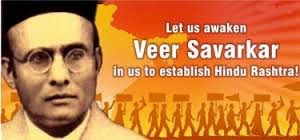
An online poster circulated on 28th May (Veer Savarkar Jayanti) **********Subhash Gatade is a New Socialist Initiative (NSI) activist. He is also the author of ‘Godse’s Children: Hindutva Terror in India’ ; ‘The Saffron Condition: The Politics of Repression and Exclusion in Neoliberal India’ and ‘The Ambedkar Question in 20th Century’ (in Hindi). -
New Issue of Critique Magazine: Fascism Now and Here
New Issue of Critique “Fascism Now and Here” is out. Critique Magazine, August, 2014, Volume: 3 Issue: 1. Pg. 56. Rs. 30 /-. To order your copies write to delhi.nsi@gmail.com Sharing below the cover of this issue and the content list.Contents1. Editorial: Fascism: Now and Here
2. सम्पादकीय : हमारे समय का फासीवाद
3. फासीवाद की राजनितिक संस्कृति – जयरस बानाजी4. Majoritarian Victimhood and the Muzaffarnagar Riots – Usman Javed
5. 1933 of 2014!: challenging Communal Fascism: Making New Beginnings – Subhash Gatade6. और भी कारण हैं श्री मोदी की मुख़ालफ़त के – प्रभात
7. ठोकर मारकर अपनी बात कहना : एक लोकतांत्रिक अधिकार के रूप में धर्म परिवर्तन – निवेदिता मेनन
8. A Death Sentence and an Anointment: Popular Ideological Beses of Growth of Fascism in Contemporary India – Sanjay Kumar
9. Burma: Lest We Don’t See, A Genocide is in the Making – Bonojit Hussain
10. Anti-POSCO Movement: A Visit to Jagatsinghpur District – Misha Maitreyi
11. Delhi University Photocopy Law Suite and the Curious Case of IRRO – Apoorva Gautam
12. Film Review: Red Ant Dream – Kislay Gonzalvez
13. Dalit Cultural Resistance in Maharastra – Prem Ayyathurai
14. लैटिन अमरीका का एकान्त – गेब्रियल गार्सिया मार्खेज
15. सांझी शहादत सांझी विरासत – किशोर झा
16. अंग्रेज़ी जूते में हिंदी को फिट करने वाले ये भाषाई रहनुमा – मुक्ति बोध
17. निर्देशक की नज़र से – मनोज कुमार सुमन
18. Statement: Condemn the Gruesome Massacre in Bodoland – New Socialist Initiative
19. ‘बंगलादेशी घुसपैठिये’ या बंगलादेशी भारतीय मुसलमान? – बॉनोजीत हुसैन
20. A Half-Widow’s Lament – Soibam Haripriya
21. From the Registers of the ‘Temoporary’: State of Affairs of a Women’s Hostel in Delhi University – RaaidaEditorial Collective: Aashima Subberwal, Amrapali Basumatary, Bonojit Hussain, Devika Narayan, Kavya Murthy, Lokesh, Malay Firoz, Mayur Chetia, Misha Maitreyi, Naveen Chander, Pravin Kumar, Praveen Verma, Sanjay Kumar, Subhash Gatade, Sudha Vasan, Vasundhara Jairath, Urmi Ninad.
Front Cover: Painting by John Heartfield “The Old Motto of New Empire: Blood and Iron”.
Back Cover: Sketch by Bhagwati Prasad “The Wave”.
-
हाशिये पर पड़े समझदारों के लिए कुछ सबक
यह लेख समकालीन तीसरी दुनिया के जून 2014 अंक में प्रकाशित होगा। अनुवादक: अभिषेक श्रीवास्तव। अंग्रेजी में इस लेख को पढ़ने के लिए यहाँ क्लिक करें।– रवि सिन्हा
हाशिया अभी-अभी कुछ ज्यादा चौड़ा हुआ है। अकसर केंद्र तक टहल मार आने वाले तमाम लोगों में से कई परिधि पर धकेल दिए गए हैं। मेरी चिंता उन्हें लेकर नहीं है। उनके बारे में तो तमाम विश्लेषण भरे पड़े हैं कि ऐसा क्यों और कैसे हो गया। मैं उनकी संख्या नहीं बढ़ाना चाहता। हाशिया हर ओर है। बाएं से, दाएं से, यह हाशिया मुख्यधारा की सियासी जमीन को घेरे हुए है। कुछ लोग शायद कहें कि दाहिनी तरफ कोई हाशिया नहीं है। उस ओर हर कुछ मुख्यधारा का ही हिस्सा है। चाहे जो हो, मेरे पास दाहिनी ओर के हाशिये पर कहने को बहुत कुछ नहीं है।मेरा सरोकार बाईं ओर के हाशियों से है जिसमें समूचा वाम घुसा पड़ा है, हालांकि यह स्वीकार कर पाना परंपरागत वाम के अधिकतर हिस्सों के लिए शायद बहुत जल्दबाज़ी होगी। वे किसी भी कीमत पर हम जैसों की नहीं सुनेंगे, जिन्होंने अपना समूचा जीवन ही हाशिये पर गुज़ारा है- कुछ तो इसमें अपनी बेवकूफि़यां और कमज़ोरियां जिम्मेदार रहीं और कुछ इसलिए भी कि हमने समय की मांग के आगे झुकने से इनकार कर दिया। यह वास्तव में हमारी गलती तो है नहीं कि हम ऐतिहासिक कालखंड की उस घाटी में पैदा हुए जहां भव्यतापूर्ण अतीत की ढलान पर उतरना तो पूरा हो चुका है जबकि भविष्य की चोटी पर चढ़ाई शुरू होना अब भी बाकी है।इस लेख के शीर्षक में ”समझदार” वाला विशेषण मूल्यांकन के योग्य है इसलिए आदेशात्मक व दंभी होने का मुझ पर आरोप लग सकता है। या तो इस मूल्यांकन का कोई मानक हमें बताना होगा या फिर यह स्वीकार करना होगा कि यह प्रयोग आत्मपरक है। मैं दूसरे वाले विकल्प से शुरू करूंगा क्योंकि मैं जो कहना चाह रहा हूं उसमें गणना के किसी मानक पर अपना पांडित्य नहीं दिखाना चाहता। ज़ाहिर है, हमें किनारे बैठे उन उन्मादियों की ओर इशारा करने की भी कोई ज़रूरत नहीं होनी चाहिए जो बाकी सब पर संशोधनवाद, विश्वासघात और दुष्टता के पत्थर उछालकर खुद को जिंदा रखे हुए हैं। आपको पसंद हो या नहीं, लेकिन वे भी वाम का ही हिस्सा हैं। मैं यह नहीं कह सकता कि वे मेरी चिंता का विषय नहीं हैं, लेकिन दुनिया जैसी है उसे वैसा नहीं समझने को लेकर वे तकरीबन यांत्रिक हैं और आत्मचिंतन व आत्मावलोकन में वे पूरी तरह असमर्थ हैं। मैं उनसे यह उम्मीद नहीं करता कि वे किसी भी चीज़ से कोई भी सबक लेंगे सिवाय इसके कि वे अपने टुच्चे स्वार्थपरक उद्देश्यों को पूरा करें या एक-दूसरे को नुकसान पहुंचाने वाले झगड़ों को अंजाम दें।सोलह मई के बाद की स्थिति में हमें क्या अपेक्षा करनी चाहिए, मैं अपनी बात को यहां से शुरू करना चाहूंगा। तमाम बातें की जा रही हैं कि आने वाला वक्त बहुत बुरा रहने वाला है। बेशक वह बुरा ही होगा, लेकिन अनिवार्यत: अपेक्षित तरीकों से नहीं, हालांकि वह भी हो ही सकता है। इसमें कोई संदेह नहीं होना चाहिए कि भारत के लोगों ने अपने विवेक से एक ऐसे व्यक्ति और परिवार को भारी जनादेश दिया है जो क्रूरताएं करने में सक्षम है। अपनी सुविधानुसार ”जनादेश” के अर्थ को बदल देना और अत्याचारियों की विजय के बाद कह देना कि दो-तिहाई भारतीयों ने उन्हें वोट ही नहीं दिया, इससे हमें कोई मदद नहीं मिलने वाली है। खुद को यह कह कर सांत्वना देने का कोई मतलब नहीं होगा कि वे चुनाव में जीते नहीं हैं बल्कि जो सत्ता में था उसकी हार हुई है। न ही हमें इस तथ्य से कोई राहत मिलने वाली है कि अश्वमेध का घोड़ा पूरब और दक्षिण के उन राज्यों में नाथ दिया गया जहां स्थानीय क्षत्रपों के पास कोई दैवीय ताकत थी। इस जीत का श्रेय धनबल और कॉरपोरेट नियंत्रित मीडिया को देते हुए हम कुछ गलत नहीं करते, लेकिन तब, हमें जनता के विवेक में अपने भरोसे के साथ इस बात का मिलान करना होगा क्योंकि हमारे कहने का एक अर्थ यह निकलता है कि जनता उनकी ताकत के असर में बह गई थी।इस बात को सहज रूप से मान लिया जाना चाहिए कि यह एक जबरदस्त जीत है। जैसा कि विजेता ने खुद अपने भाषण में कहा है, यह जीत साठ साल की मेहनत का नतीजा है जिसने चार पीढि़यों के ”श्रम” और ”बलिदान” को परखा है। आज के विेजेताओं ने पिछले साठ साल में जो लंबा मार्च किया है, उसने अपने पीछे दंगों और फसादों का एक लंबा सिलसिला भी छोड़ा है तथा सैकड़ों हज़ारों पुरुषों व स्त्रियों को मध्ययुगीन बर्बरता करने के लिए तैयार किया है। सवाल है- क्या वे इस निर्णायक विजय के बाद भी ऐसा ही करना जारी रखेंगे?इसका जवाब ना में ही होना चाहिए। एकाध छिटपुट दंगे यहां-वहां तो हमेशा ही होंगे। हमारा समाज जैसा है, उसमें इसे नकारा नहीं जा सकता लेकिन विजेताओं को वह काम जारी नहीं रखना होगा जो वे विजय से पहले करते आ रहे थे। गुजरात में 2002 के बाद दंगे न होना इसका एक उदाहरण है। वास्तव में, उन्हें गुजरात वाला प्रयोग बाकी देश में दुहराने की कोई ज़रूरत ही नहीं पड़ेगी, जहां- अगर उनकी एक उपलब्धि का उदाहरण इस तरह से गिनवाया जाए, कि- हिंदू और मुसलमान अब कभी भी पड़ोसी नहीं हो सकते।हमारा पहला सबक हालांकि इससे नहीं निकलना चाहिए कि वे सामाजिक ताने-बाने के साथ क्या और क्या नहीं कर सकते हैं। इसके बजाय सबक यहां से निकलना चाहिए कि वे राज्य और उसकी संरचनाओं के साथ क्या और क्या नहीं कर सकते हैं। यहां से जो सबक निकल रहा है, वह किसी आदतन वामपंथी के सहज बोध का निषेध करता है। विजेता की पाशविक ताकत का स्रोत बुनियादी तौर पर हमारे समाज में मौजूद है, लेकिन यह ताकत अपनी सामाजिक विचारधारा के अनुरूप राज्य की संरचनाओं को ढाल नहीं सकती। कुछ लोग कह सकते हैं कि आखिर वे ऐसा कोई काम करने का प्रयास करेंगे ही क्यों? आखिर को, यह एक पूंजीवादी राज्य है। इसका नियंत्रण अर्जित करने के बाद तो वे बड़ी आसानी से उन कॉरपोरेट ताकतों के हितों की पूर्ति कर सकेंगे जिनके बल पर वे सत्ता में आए हैं। यह बात जहां तक खींच कर ले जाई जाए, सही ही बैठेगी। यह बड़ी सहज बात है, लेकिन यहां एक निर्णायक बिंदु छूट रहा है। पूंजीवादी हितों को हिटलर जैसी फासीवादी तानाशाही भी पूरा कर सकती है और एक बुर्जुआ-जनतांत्रिक कल्याणकारी राज्य भी, जैसा कि हम स्वीडन या कनाडा में पाते हैं। तो क्या हम यह कह सकते हैं कि फिर इन दोनों के बीच के अंतर से किसी वामपंथी को कोई फ़र्क नहीं पड़ता, जो कि समाजवाद लाने का संघर्ष कर रहा है या फिर उन लोगों को जो समाजवाद का कथित तौर पर इंतज़ार कर रहे हैं? भारतीय राज्यतंत्र एक ऐसे समाज की गोद में बैठा है जो कभी-कभार फासीवादी तानाशाही की राह पर चलने वालों को भी सत्ता सौंप सकता है। खुशकिस्मती बस इतनी है कि अपनी विचारधारा और चाहतों के मुताबिक वे ऐसा कर नहीं पाएंगे। वे ऐसा करने की कोशिश भी शायद नहीं करेंगे क्योंकि दीवार पर लिखी इबारत वे बखूबी पढ़ सकते हैं। एक वामपंथी ऐसे में भारतीय हिटलर के उभार को रोकने का श्रेय यहां की जनता को ही देगा। वह पूरी तरह गलत भी नहीं होगा। आखिरकार दुनिया में जो कुछ होता है, वह अंतत: अपने विश्लेषण में जनता का ही किया हुआ होता है। लेकिन ऐसा दीर्घकालिक और व्यापक विश्लेषण अकसर पुनरुक्ति का शिकार होता है जो हमारी समझदारी में कोई योगदान नहीं दे पाता।तो यहां हमारे लिए जो सबक है, वह भारतीय राज्यतंत्र के बारे में और उसके भारतीय समाज के साथ अबूझ रिश्ते से जुड़ा है। यह बात ध्यान देने लायक है कि समाज ही पाशविक ताकतों को उभारता है और उनके हाथ में राज्यसत्ता सौपता है, लेकिन राज्य खुद ही पाशविक ताकतों को सभ्य होने के लिए बाध्य कर देता है ताकि वे संवैधानिक दायरे के अनुकूल ही आचरण करें। इतिहास ने एक ऐसे समाज के भीतर से आधुनिक राजनीति को गढ़ा है जिसका खुद आधुनिक बनना अभी बाकी है। इस समाज को बनाने वाली संस्कृतियों व आचरणों के कई हिस्से अब भी हमारी आधुनिक राजनीतिक संरचना के साथ खुद को असहज महसूस करता पाते हैं। इसके बावजूद यह राजनीतिक संरचना पर्याप्त सुरक्षित है। यह इसी तरह हुआ जैसे कि एक बच्चा अपनी मां की गोद में बैठा हो और उसकी मां रह-रह कर बच्चे से खीझ रही हो, विरक्त महसूस कर रही हो, फिर भी उसे गोद में थामे हुए है।इस सबक के व्यावहारिक निहितार्थ भी हैं: मसलन, यदि नया शासक वामपंथियों के पीछे पड़ ही गया, तो वे उसका मुकाबला कैसे करेंगे? संभावना यही है कि वे इस बात पर ज़ोर देंगे कि हमें जनता के बीच वापस जाना चाहिए और उसकी ताकत के आधार पर संघर्ष छेड़ना चाहिए। वे पूरी तरह गलत नहीं सोच रहे, लेकिन हमें यह नहीं भूलना चाहिए कि नया शासक तो जनता के और ज्यादा बड़े हिस्से को संबोधित कर सकता है। जब पश्चिम बंगाल की सड़कों और खेतों में तृणमूल के खिलाफ वाम कोई संघर्ष नहीं छेड पाया, तो फिर समूचे देश के शहरों, कस्बों, गांवों और जंगलों में कायम अंधेरे की नई सत्ता के खिलाफ ऐसा कुछ भी कैसे हो पाएगा, जबकि यह संभावना कम ही है कि देश के बाकी सारे वामपंथी इस संघर्ष में साथ आ पाएंगे। यह जो नई सत्ता आई है, वह बिल्कुल ग्रीक देवों की तरह जनता की प्रशंसा, भय और उसकी प्रार्थनाओं पर फिलहाल कायम है, जो हमारी चुनौती को और कड़ा बनाता है। इसीलिए किसी भी राजनीतिक संघर्ष में इस सत्ता और उसकी ताकत को सड़कों पर ललकारने से पहले कई बार ज़रूर सोचा जाना चाहिए। यह काम बाद के लिए भी छोड़ा जा सकता है। फिलहाल, सबसे ज्यादा गुंजाइश इस बात की है, और यही समझदारी भी होगी, कि वामपंथी खुद को मौजदा राजनीतिक ढांचे के भीतर बचाकर रखें- ढांचा यानी संसद, विधानसभाओं, अदालतों और अन्य संस्थानों में और ऐसा करने के लिए वे संविधान और उसके कानूनों की मदद लें। हमें यह नहीं भूलना चाहिए कि गुजरात-2002 के पीडि़तों की ओर से मुकुल सिन्हा या तीस्ता सीतलवाड़ जैसों की साहसिक लड़ाई अहमदाबाद या गांधीनगर की सड़कों पर नहीं बल्कि ज्यादातर अदालतों में लड़ी गई थी।यहां एक बात जोड़ी जानी ज़रूरी है। पाशविक ताकतों को सभ्य बनाने की आधुनिक राजनीति की ताकत को लेकर हमें गाफि़ल नहीं रहना चाहिए। जो लोग पदों पर आकर बैठते हैं, उनसे राज्य की संरचना अवश्य कुछ न कुछ प्रभावित होती है। वे अपने साथ बेशक अपने ही तईं संस्कृति, आचरण और विश्वदृष्टि के ऐसे तत्व भी लेकर आते हैं जो एक आधुनिक बुर्जुआ राज्यतंत्र की बुनावट और प्रकृति के साथ बेमेल बैठते हैं। वे अपने-अपने स्तर पर इस बुनावट को मोड़ने के तरीके भी खोज लेते हैं। ऊपर जो तर्क का मुख्य बिंदु हमने दिया है, वह हालांकि वैध बना रहता है।यही बात हमें दूसरे सबक तक ले आती है। यह पहले सबक से काफी करीब से जुड़ा है। यह लोकतंत्र के रूपों और प्रक्रियाओं के बारे में है। विचारधारात्मक हलकों में मज़बूत भागीदारी वाले ज़मीनी लोकतंत्र की चाहत को लेकर एक आम सहमति व्याप्त है। नए युग के उपदेशक और दार्शनिक, एनजीओ, मैगसेसे पुरस्कार विजेता आदि, जो आजकल तमाम किस्म के सामाजिक आंदोलनों की प्रेरणा बने हुए हैं, इन्होंने लंबे समय से ऐसे सघन लोकतंत्र के गुणों का प्रचार किया है जिसमें राज्यसत्ता विकेंद्रीकृत होती हो और स्वशासन के माध्यम से एक बेहद सक्रिय नागरिकता खुद पर राज करती हो।भारत के राजनीतिक परिदृश्य पर चमकदार हथियारों से लैस कुछ नए सूरमा इधर बीच आ उभरे हैं जिनके स्वराज के बारे में अपने खयालात हैं। दूर से ही सही, लेकिन कई लोगों ने इनकी सराहना की जब दिल्ली की संक्षिप्त सरकार रातों में सड़कों की गश्त लगाकर ”सिस्टम को हिलाने में जुटी हुई थी”। सघन लोकतंत्र के कई अन्य अभिजात पैरोकार इस निगरानीवाद और नए मंत्रियों के अत्यधिक सतही संभाषणों पर लहालोट भी हो गए होंगे। उन्होंने शायद यह भी कामना की रही हो कि खिड़की एक्सटेंशन जैसे खालिस मोहल्लों में रह रही खालिस जनता अगर सांस्कृतिक विविधता को लेकर ज्यादा सहिष्णु होती तो क्या ही अच्छा होता। उनकी नज़र में हालांकि यह सब कुछ ज़मीनी स्तर पर हुए उग्र बदलावों के लिहाज़ से आंख की किरकिरी से ज्यादा कुछ नहीं था। इन पैरोकारों में से कुछ ज्यादा पढ़े-लिखे लोगों के बीच शायद ही कोई खिड़की एक्सटेंशन गणतंत्र की नागरिकता को स्वीकार करने को तैयार हों, खाप पंचायत द्वारा किसी गांव में चलाए जा रहे गणतंत्र को तो छोड़ ही दें। लेकिन इनमें से सभी इस बात की सराहना ज़रूर कर रहे होंगे कि भागीदारीपूर्ण लोकतंत्र के साथ यह प्रयोग कितने दुस्साहस के साथ किया गया, जहां हर मोहल्ला खुद अपना घोषणापत्र लिख सकेगा, अपने राजकाज और विकास का काम खुद अपने हाथों में ले सकेगा तथा सामुदायिक जीवन में स्वाभाविक रूप से निबद्ध नैतिक और सांस्कृतिक मूल्यों को सजा-संवार सकेगा।जहां तक वामपंथ की बात है, तो सघन लोकतंत्र की हिमायत वह इस छोर से नहीं बल्कि दूसरे छोर से करता है। यहां हमारी समझदारी इस बिंदु से शुरू होती है कि बुर्जुआ लोकतंत्र कुछ नहीं बल्कि पूंजी की चेरी है। प्रातिनिधिक चुनावी लोकतंत्र एक बुर्जुआ राज्यतंत्र के लिए लोकप्रिय वैधता हासिल करने का महज़ एक माध्यम है। इसीलिए जब समाजवाद आएगा, तो बुर्जुआ लोकतंत्र का कोई भी तत्व- उसका एक भी संस्थान या आचरण- टिकने नहीं दिया जाएगा। यही वजह है कि पूंजीवाद के अंतर्गत भी वाम का संघर्ष लोकतंत्र को ज्यादा प्रत्यक्ष बनाने, ज्यादा भागीदारीपूर्ण बनाने और ज्यादा विकेंद्रीकृत बनाने की ओर उद्देश्यरत होना चाहिए।लोगों को सशक्त करने के उद्देश्य पर शायद ही कोई असहमति हो, लेकिन सघन लोकतंत्र के पक्ष में सारी दलीलें कई मायनों में व्यापक परिदृश्य को अपनी नज़र से भुला देती हैं। एक सघन लोकतंत्र अपनी सर्वश्रेष्ठ अवस्था में ज्यादा से ज्यादा एक संवैधानिक प्रतिनिधित्व वाले उदार लोकतंत्र के व्यापक ढांचे में पूरक भूमिका ही निभा सकता है। ऐसे किसी भी ढांचे और लोकतांत्रिक परंपरा के अभाव में यह कारगर नहीं हो सकता। अपने सबसे बुरे स्वरूप में एक सघन लोकतंत्र खुद लोकतंत्र के लिए विनाशकारी साबित हो सकता है। ऐसे उदाहरण समूची दुनिया में बिखरे मिल जाएंगे। इस सवाल पर सोचने वाले लोगों के लिए हमारी खाप पंचायतें, दुनिया भर की जनजातीय परिषदें खासकर अफ्रीका, अफगानिस्तान और उत्तर-पश्चिमी पाकिस्तान में, तथा चीन में महान सर्वहारा सांस्कृतिक क्रांति के दौरान आया भीड़ का लोकतंत्र (मॉब डेमोक्रेसी) ऐसे कुछ प्रामाणिक उदाहरण हो सकते हैं।यह सहज वामपंथी समझदारी, कि समाजवाद में बुर्जुआ लोकतंत्र का कोई भी घटक नहीं बचा रहेगा, इस नज़रिये से पैदा होती है कि लोकतंत्र का विकास ही पूरी तरह पूंजी के हितों और योजनाओं से संचालित हुआ है। इस लोकतंत्र को लाने के लिए जनता ने कुछ नहीं किया है और इसमें उसके लिए कुछ है भी नहीं। यह हालांकि एक गलत नज़रिया है। आधुनिक लोकतंत्र का इतिहास पूंजीवाद के इतिहास से भले ही साम्यता रखता हो, लेकिन इसका अर्थ यह नहीं है कि दोनों एक-दूसरे के पर्याय हैं। समाजवादी लोकतंत्र इस आधुनिक युग की अधिकतर लोकतांत्रिक भवनाओं और परंपराओं को अपने में समाहित करेगा और वह समाजवाद के केंद्रीय सिद्धांतों व मूल्यों के हिसाब से संशोधित उसके तमाम आचरणों व संस्थानों को बचाए भी रखेगा। यहां मुख्य बिंदु यह है कि लोकतंत्र, चाहे वह बुर्जुआ श्रेणी का ही क्यों न हो, वह सिर्फ राज्यतंत्र और सत्ता के दूसरे ढांचों को निर्मित करने का एक माध्यम भर नहीं हैा इसमें अधिकारों, चुनावों और नागरिकों की निजी स्वतंत्रताओं का दायरा भी तय होता है।इसके साथ ही यह तथ्य भी रह जाता है कि लोकतंत्र प्राथमिक तौर पर राज्य और उसकी सत्ता संरचना के संघटन का एक माध्यम है। अंतिम विश्लेषण में सारी सत्ता संरचनाएं स्वतंत्रता के लिए बाधक ही होती हैं। इंसानी तरक्की का उद्देश्य इन्हें ज्यादा से ज्यादा हलका और पारदर्शी बनाना होना चाहिए जिससे अंतत: वे छीज कर खत्म हो जाएं। लंबी दौड़ में ऐसे ही राज्यतंत्र के लोप की परिकल्पना की जाती है। ऐसा वास्तव में हो या नहीं, लेकिन यह लोकतंत्र व सत्ता संरचना के इच्छित स्वरूपों की ओर तो इशारा करता ही है। राज्य को धीरे-धीरे संकुचित होते जाना चाहिए और अपनी जकड़ से जिंदगी के व्यापकतम दायरों को मुक्त करते जाना चाहिए। पूंजीवाद के अंतर्गत ऐसा वास्तव में संभव नहीं है क्योंकि राज्य जिस किसी को भी मुक्त करेगा, उस पर बाज़ार कब्ज़ा जमा लेगा और मुनाफाखोरी के सघन जंगल में खींचकर उसे निगल जाएगा। लेकिन पूंजीवाद के तहत भी, राज्य को पारदर्शी होना चाहिए, जो कितभी संभव है जब वह नियमों से बंधा हो, संवैधानिक हो और मनमौजी न हो। जिन्हें ऐसा लगता है कि सघन लोकतंत्र के माध्यम से राज्य को पारदर्शी बनाया जा सकता है, वे गलत सोचते हैं। सघन लोकतंत्र राजनीतिक प्रक्रिया को दोहरा और गाढ़ा बना देता है। यह नीतियों के नियोजन व क्रियान्वयन को कीचड़ सा अपारदर्शी बना देता है। इससे कहीं ज्यादा अहम यह है कि एक सघन लोकतंत्र के लिए यह संभव ही नहीं होगा कि वह आधुनिक युग की लोकतांत्रिक भावनाओं को समरूपता से खुद में समाहित कर सके। यदि किसी को इस बात पर शक है, तो वह एक बार फिर खाप पंचायतों और जनजातीय परिषदों का उदाहरण उठाकर देख सकता है।उम्मीद की जानी चाहिए कि इस दलील को इस रूप में नहीं लिया जाएगा कि बात जनता को अशक्त करने और उसे लोकतांत्रिक प्रक्रिया से काटने की हो रही है। एक पारदर्शी, संवैधानिक और नियमबद्ध राज्य जनता के द्वारा उतना ही निर्मित हो सकता है जितना कोई और, तथा ऐसा करने की प्रक्रिया उतनी ही लोकतांत्रिक हो सकती है जितना कि एक सघन लोकतंत्र, बल्कि यूं कहें कि ऐसे राज्य में जनता की हिस्सेदारी ज्यादा होती है क्योंकि नीतियों और प्रस्तावों पर व्यापक स्तर पर पारदर्शी व तार्किक तरीकों से बहस की जा सकती है। सभी चुनावों की तरह ही इस बार के चुनावों की भी त्रासदी यह रही है कि इसमें सामाजिक-मनोवैज्ञानिक तथा अन्य अपारदर्शी किस्म के पहलू ही छाए रहे। ये पहलू विचारधारा, कार्यक्रम और नीतियों पर बहस को नामुमकिन बनाते हैं। इस बार जो मसीहा जीत कर सामने आया है, वह एक साथ तमाम लोगों के लिए तमाम चीज़ों का पर्याय था- मसलन, कई उसके कट्टर हिंदू व्यक्तित्व को लेकर आश्वस्त थे, दूसरे कुछ लोग उसकी दबंग शख्सियत को लेकर खुश थे और कुछ अन्य लोग वृद्धि, रोज़गारों व राष्ट्रीय गौरव पर उसके चमत्कारिक वादों के कायल थे। उसके वादों और नीतियों की पड़ताल करने की कोई ज़रूरत समझी ही नहीं गई। वे ही कारक जो एक सघन लोकतंत्र को बरबाद किए दे सकते हैं, संवैधानिक व प्रातिनिधिक उदार लोकतंत्र को भी संक्रमित करने की क्षमता रखते हैं, सिवाय इसके कि लंबी दौड़ में एक संवैधानिक व प्रातिनिधिक उदार लोकतंत्र ही इन परिस्थितियों से निपटने में बेहतर सक्षम होता है।तीसरा बड़ा सबक बुर्जुआ राज्यतंत्र के कार्यक्रमों और नीतियों के संदर्भ में हमारे अप्रोच से जुड़ा है। इसे समाजवाद लाने के रणनीतिक उद्देश्य के साथ दिग्भ्रमित नहीं किया जाना चाहिए क्योंकि समाजवाद का उद्देश्य तो एक बुर्जुआ राज्य की जगह समाजवादी राज्य लाकर ही हासिल किया जा सकता है। बहरहाल, मौजूदा राज्य के कार्यक्रमों व नीतियों के इर्द-गिर्द संघर्ष बहुत निर्णायक महत्व का मसला है क्योंकि वह वर्तमान में तो लोगों की जिंदगियों पर असर डालता ही है, साथ ही समाजवाद के लिए संघर्ष की राह में भी रोड़े अटकाता है।भारतीय पूंजीवाद फिलहाल बहुत भूखा है। यहां पूंजी एक ऐसे भूखे जानवर की तरह है जिसकी निगाह एक शिकार पर है जिसे एक छलांग में वह पकड़ लेना चाहता है। ऐसे चरण में पूंजीवादी वृद्धि दो अहम कारकों के चलते तीव्र होती है- एक, प्रचुर मात्रा में उपलब्ध सस्ता श्रम और दूसरे, यह तथ्य कि अधिकतर कुदरती संसाधन जैसे जंगल, खदान तथा समूची अर्थव्यवस्था में व्याप्त छोटी-छोटी परिसंपत्तियां जैसे कि छोटे किसानों की काश्त आदि को अब भी पूंजी में तब्दील किया जाना बाकी है। सस्ता श्रम तो हमेशा ही तगड़े मुनाफे के लिए अनुकूल होता है लेकिन संसाधनों और परिसंपत्तियों को कौडि़यों के दाम में कब्ज़ा लेना असल मसला है। यही गुंजाइश पूंजी के पिशाच को जबरदस्त भूखा और अधीर बनाती है। पूंजी हमेशा ही बुर्जुआ चुनावों में बड़ी भूमिका निभाती है, लेकिन इस बार पहले के मुकाबले कहीं ज्यादा आक्रामकता से अपनी यह भूमिका निभाने के लिए उसके पास मौजूद वजह कहीं ज्यादा बड़ी है।इस लूट का प्रतिरोध करने का सबसे असरकारी तरीका- यदि यह प्रतिरोध बुर्जुआ लोकतंत्र के दायरों में किया जाना है तो- दो चीज़ों के लिए लड़ना होगा। पहला, हम एक ऐसे कल्याणकारी राज्य के लिए संघर्ष करें जो उच्च आय और मुनाफे पर कर अभिवृद्धि से पर्याप्त राजस्व एकत्रित करे तथा हर नागरिक के लिए भोजन, आश्रय, स्वास्थ्य, शिक्षा, नागरिक सेवाओं व अन्य बुनियादी जरूरतों व सेवाओं की संपूर्ण जिम्मेदारी ले। दूसरी लड़ाई एक ऐसे कानूनी ढांचे के लिए होनी चाहिए जो कुदरती संसाधनों के पूंजीकरण और छोटे काश्तकारों के वंचितीकरण को इस शर्त पर रोके कि लगाए जाने वाले उद्यम में पहले राज्य और फिर काश्तकार को स्थायी शेयरधारक बनाया जाए। यह कदम परिसंपत्तियों और संसाधनों के अधिग्रहण के बाद वाले बाजार मूल्य व मौजूदा मूल्य के सम्मिश्रण के आधार पर एक उपयुक्त व परस्पर समझाइश से तय मौद्रिक मुआवजे भुगतान के बाद और अलग से उठाया जाए।इस किस्म का प्रतिरोध खड़ा करने के लिए वाम सर्वाधिक स्वाभाविक ताकत है लेकिन वह बहुत बुरी तरह विफल हुआ है। इसका दोष पूरी तरह नव-उदारवाद के वैश्विक वर्चस्व को नहीं दिया जा सकता जिसके तहत कल्याणकारी राज्य और पूंजी नियमन को अप्रासंगिक माना जाता है। आपको दी हुई परिस्थितियों में ही संघर्ष करना होता है और ऐसा करने का सबसे कारगर तरीका यह होता है कि खुद को खालिस तथ्यों व वाजिब मांगों की ज़मीन खड़ा रखा जाए, भले ही इन्हें मौजूदा सत्ता तंत्र में अप्रासंगिक करार दिया गया हो। तथ्यों की जहां तक बात है, तो वे इतने प्रत्यक्ष उजागर थे कि जब कांग्रेस पार्टी के समक्ष उसके विरोधी का नव-उदारवादी व दक्षिणपंथी पक्ष नग्न रूप में सामने आया, तो उसने खुद को कल्याण केंद्रित और अधिकार केंद्रित वाम रुझान वाले पक्ष की ओर ही खड़ा करने का प्रयास किया। इसकी भी बुरे तरीके से हार हुई तो यह अलग बात है और इसके कई कारण हो सकते हैं, लेकिन उसके पक्ष में जो तथ्य थे वे उसकी हार के लिए दोषी नहीं हैं।वाम के साथ एक दिक्कततलब पहलू रूढि़यों और लोकप्रियतावाद के साथ उसका दोहरा प्रेम है। रूढि़यां उसके लिए आंख पर बंधी पट्टी के जैसी हैं जो सारी दृष्टि को बीत चुकी बीसवीं सदी के आरंभिक व मध्य काल पर केंद्रित रखती हैं। ऐसा लगता है कि औपनिवेशिक दौर का साम्राज्यवाद और उसकी प्रतिक्रिया में उपजा राष्ट्रवाद वामपंथ के खून में मिल चुका है। इसके चलते वह भारतीय व वैश्विक पूंजी के खिलाफ कोई भी रणनीति बना पाने में खुद को असमर्थ पाता है। संसदीय राजनीति के दायरे में भी इसके चलते वाम कुछ मूर्खतापूर्ण कदम उठाते रहता है। अमेरिका के साथ परमाणु सौदे के मसले पर यूपीए-1 से अपना रिश्ता तोड़ लेने की कीमत अकेले संसदीय वाम ही नहीं चुका रहा है। अगर इतनी सी गलती नहीं की गई होती, तो 16 मई को हमें जो झटका लगा था, उसकी जगह समूचा राजनीतिक परिदृश्य ही कुछ और होता।यह रूढि़वाद समाजवादी भविष्य का एक ऐसा खाका पेश करने से भी वाम को रोकता है जो कि न सिर्फ समता और न्याय के मानकों पर पूंजीवादी वर्तमान का स्थान ले सकता था बल्कि उत्पादकता, रचनात्मकता, समृद्धि व स्वतंत्रता के मानकों को भी परिदृश्य में ले आता। वामपंथ के तमाम बड़े सिद्धांतकारों की ”भविष्य के समाजवाद” या ”इक्कीसवीं सदी के समाजवाद” पर बड़ी-बड़ी बातों और चमकदार लेखों के बावजूद वे इस नज़रिये की जकड़ से खुद को मुक्त नहीं कर सके हैं जो बीसवीं सदी के समाजवाद को ही समाजवाद का प्रामाणिक मॉडल मानता रहा है। समाजवाद को व्यावहारिक और श्रेष्ठ मॉडल के रूप में पेश करने की विफलता का समूचे वामपंथ पर राजनीतिक रूप से जबरदस्त नकारात्मक परिणाम हुआ है।दूसरी ओर, लोकप्रियतावाद का चस्का इसे विचारधारात्मक व राजनीतिक साहस से पूरी तरह महरूम करता है। यहां तक कि उदार बुर्जुआ का सामाजिक रूप से तरक्कीपसंद तबका भी जनता को वास्तविक रूप में मौजूद लोकप्रिय चेतना तथा युग की ऐतिहासिक चेतना के बीच फ़र्क को कम करने की दिशा में प्रवृत्त करने के लिए कहीं ज्यादा साहस का परिचय देता है। वाम पक्ष में हमें मशहूर सिद्धांतकार और विद्वान ज़रूर मिल जाते हैं जो अब भी राष्ट्रवाद व गांधीवादी सामुदायिक भावनाओं के उस दौर को याद करते हुए आह भरते हैं जब कम्युनिस्ट पार्टी किसानों के साथ बहुत करीब से जुड़ी होती थी। ऐसी प्रवृत्ति वाम की विफलता का सारा दोष जनता से उसके दूर होते जाने पर मढ़ देती है। यह दावा कोई नहीं कर सकता कि जनता से कट जाना एक गंभीर समस्या नहीं है, लेकिन यदि आप इसे ही इकलौती समस्या मानकर दोबारा इस रिश्ते को बहाल करने के कदमों की इकलौती पैरोकारी करना शुरू कर दें, तो आप वाम के समक्ष मौजूद चुनौतियों को संपूर्णता में पकड़ पाने के लिए खुद को तैयार नहीं कर सकेंगे।राज्य के कार्यक्रमों और नीतियों के सबक की अहमियत अकेले वामपंथ के लिए नहीं है। कल्याणकारी राज्य और पूंजी नियमन के पक्ष में एक समग्र व सुनियोजित संघर्ष को कहीं ज्यादा किनारे लगाने का काम हाल के दिनों में भ्रष्टाचार विरोधी लोकप्रिय आंदोलन ने किया है, जिसकी परिणति आम आदमी पार्टी नाम की परिघटना के रूप में हुई है। मसीहाई नेताओं के नेतृत्व में चले इन लोकरंजक भ्रष्टाचार विरोधी आंदोलनों ने अपनी रैडिकल भंगिमा और लोकप्रिय अपील के बावजूद, रूढि़वादियों और दक्षिणपंथ की मदद की है। यह दावा हालांकि अभी पूरी तरह साबित नहीं किया जा सकता, लेकिन इसके संकेत फिलहाल अवश्य मौजूद हैं। आम आदमी पार्टी ने जो नया चुनावी गणित रचा है, 16 मई को लगे झटके का दोष उसे दिया जाना तो बहुत सटीक नहीं होगा। लेकिन संघ परिवार की प्रच्छन्न मदद से पहले तो इंडिया अगेंस्ट करप्शन ने और बाद में सामाजिक आंदोलनों के कार्यकर्ताओं व नेताओं, लोहियावादी समाजवादियों के एक तबके, कई वामपंथियों व उग्रपंथियों तथा बड़ी संख्या में राजनीतिक रूप से अजागरूक आदर्शवादी नागरिकों की भागीदारी से आम आदमी पार्टी ने देश में जो राजनीतिक माहौल तैयार किया, निश्चित तौर पर 16 मई को आए परिणामों के लिए उसे ज़रूर दोष जाता है।यहां से हम अपने आखिरी सबक की ओर बढ़ सकते हैं जो कि वास्तव में कोई सबक नहीं है और इसका संबंध अकेले भारत के हालिया राजनीतिक घटनाक्रम से नहीं है। यह कहीं ज्यादा एक सवाल की शक्ल में है जिसे कहीं ज्यादा व्यापक वैश्विक परिघटना के संदर्भ में उठाए जाने की आवश्यकता है। यह परिघटना अचानक और खुद से उभरने वाले उन जनांदोलनों की है जिन्हें बहुत संगठित नहीं किया जाता। इनमें से कुछ आंदोलन आर्थिक व राजनीतिक मसलों पर केंद्रित हैं तो दूसरे सामाजिक मुद्दों पर जबकि कुछ अन्य ऐसे आंदोलन हैं जो आधुनिकता से रेखांकित एक समूची जीवन शैली पर सवाल उठाते हुए सांस्कृतिक, सामाजिक और व्यवस्थागत आयामों पर एक साथ बात करते हैं। ऐसे आंदोलन उन वामपंथियों की पसंद हैं जिनकी कोई सांगठनिक संबद्धता नहीं है। इन्हें कुछ अन्य बहुरूपी परिवर्तनवादी, शांति कार्यकर्ता, पर्यावरणवादी, एनजीओ और विभिन्न किस्म के सामाजिक कार्यकर्ता पसंद करते हैं। इनको सराहने व इनकी सैद्धांतिकी को गढ़ने का काम उत्तर-संरचनावादी, उत्तर-आधुनिकतावादी, उत्तर-मार्क्सवादी, उत्तर-उपनिवेशवादी और इसी किस्म के विद्वान व बौद्धिक करते हैं।इस परिघटना के लिहाज़ से साठ के दशक के अंतिम वर्ष एक निर्णायक मोड़ की तरह थे। अमेरिका में नस्लवाद विरोधी नागरिक अधिकार आंदोलन, वियतनाम पर अमेरिकी हमले के खिलाफ जंग विरोधी आंदोलन, यूरोप और दुनिया के कई हिस्सों में हुए छात्र आंदोलन, पश्चिम के अधिकतर हिस्से में उभरे नारीवादी आंदोलन, सोवियत रूस में बुद्धिजीवियों का भूमिगत रहकर चलाया जाने वाला समीज़्दत (स्व-प्रकाशन) आंदोलन जिसे पश्चिम के कोल्ड वॉर राइट व अधिनायकत्व विरोधी न्यू लेफ्ट का समर्थन एक साथ हासिल था, तथा चीन में हुई महान सर्वहारा सांस्कृतिक क्रांति के नेतृत्व में दुनिया भर में उग्र परिवर्तवाद का प्रसार- इन सब ने मिलकर ऐसे महान आंदोलनों के एक युग का सूत्रपात किया जो कम्युनिस्ट पार्टियों के नेतृत्व में हुई मजदूर वर्ग की क्रांतियों समेत कम्युनिस्टों व राष्ट्रवादियों द्वारा खड़े किए गए उपनिवेशवाद विरोधी आंदोलनों से बिल्कुल ही भिन्न थे। इन आंदोलनों के तमाम चेहरों के बीच आप सार्त्र और मार्कुस जैसे उत्कृष्ट बुद्धिजीवियों को भी पाएंगे जिन्होंने इन आंदोलनों को प्रेरित किया, इनमें हिस्सा लिया और इनकी सैद्धांतिकी को गढ़ने का भी काम किया।इन आंदोलनों का कुल प्रभाव बड़ा असंगत रहा है। कुछ को जबरदस्त कामयाबी मिली जिसने मानवता के सामाजिक-राजनीतिक-सांस्कृतिक-विचारधारात्मक परिदृश्य को ही बदल डाला। कुछ अन्य आंदोलन उस वक्त के मुद्दों व संकटों पर एक तात्कालिक प्रतिक्रिया के रूप में सामने आए थे और दुनिया जैसे ही आगे बढ़ी, वे धीरे-धीरे दरकिनार हो गए। यहां इन आंदोलनों के इतिहास की कोई समीक्षा करने का मेरा उद्देश्य नहीं है, जो कि वैसे भी मेरी क्षमता से बाहर की बात है। मेरा आशय यह है कि इस परिघटना के बारे में व्याप्त नज़रियों की एक बार फिर से पड़ताल किए जाने की ज़रूरत है।अकसर यह दावा किया जाता है कि कसे हुए ढांचे वाली पार्टियों द्वारा व्यवस्थित तरीके से संगठित राजनीतिक आंदोलन खड़ा किया जाना बीते दिनों की बात हो चली है। कहा जाता है कि इनका दौर खत्म हो गया और इनकी जगह अब स्वत:स्फूर्त और ढीले-ढाले तौर से संगठित सामाजिक आंदोलनों ने ले ली है। दरअसल, इसी नज़रिये की पड़ताल किए जाने की बुनियादी जरूरत है। जिन्हें नए सामाजिक आंदोलन कहा जा रहा है, वे अब उतने नए भी नहीं रहे। इनका इतिहास आधी सदी का हो चला है। इनके ट्रैक रिकॉर्ड को खंगालने के लिए पर्याप्त साक्ष्य मौजूद हैं। हाल के दिनों में हमने वर्ल्ड सोशल फोरम और ऑक्युपाइ मूवमेंट जैसे संक्षिप्त किस्म के उभार देखे हैं। इनका प्रभाव बेहद सीमित है और भविष्य अस्पष्ट। यहां तक कि तहरीर चौक और सामान्य तौर पर अरब स्प्रिंग, जो कि सामाजिक आंदोलनों के क्लासिकल उदाहरणों के मुकाबले कहीं ज्यादा राजनीतिक प्रकृति के रहे, उनके परिणाम भी ज्यादा से ज्यादा अटपटे कहे जा सकते हैं। ऐसे आंदोलनों के पैरोकार और सिद्धांतकार आखिर कब तक वामपंथियों की विफलता व वर्ग आधारित राजनीतिक आंदोलनों के अभाव की ओर उंगली उठाकर अपने पक्ष में साबित करते रहेंगे कि दुनिया को बदलने के लिए सामाजिक आंदोलनों के अलावा और कोई विकल्प मौजूद नहीं है?वामपंथ ने सामाजिक आंदोलनों के महत्व की उपेक्षा नहीं की है, न ही यह इसलिए विफल हुआ है कि इसने उनकी नकल करने से इनकार कर दिया है। वाम इसलिए विफल हुआ क्योंकि पूंजीवाद और उसके राजनीतिक ढांचे बुर्जुआ लोकतंत्र को चुनौती देने के लिए वह कोई भव्य रणनीति नहीं बना पाया है। वाम को पता है कि सामंतवाद, उपनिवेशवाद, राजशाही और सैन्य तानाशाही से कैसे लड़ा जाता है, लेकिन ये सारे दुश्मन मोटे तौर पर दरअसल बीते ज़माने की बात हो गए हैं। वाम इसलिए विफल हुआ है क्योंकि उसके पास अपने मौजूदा दुश्मन के खिलाफ़ कोई रणनीति नहीं है। इस भारी कमी को दुरुस्त करने पर उसे अपना ध्यान केंद्रित करना चाहिए। -
Statement on the General Elections, 2014
– P.A.D.S (People’s Alliance for Democracy and Secularism)The Loksabha election results of 2014 surprised everyone. They are beyond the wildest dreams of even the most ardent BJP and Modi supporters, and worse than the worst scenarios imagined by BJP’s political opponents. Even though these elections results are singularly stunning, phenomena like these have diverse reasons. A comprehensive understanding and meaningful response require that all these reasons be dispassionately explored and evaluated.First, the votes behind these results. BJP polled 31% of votes. Never before has a party with so few votes won a mjority in national elections. Clearly, the first past the post system has benefited it disproportionately, more than any other ruling party in the past. This electoral system has amplified the BJP victory and made it look so impressive. However, BJP’s electoral achievements in other domains must not be discounted. For the first time it managed to dislodge the Congress as the main party to represent Assam in the Lok Sabha. Fighting alone, it garnered 17% of votes in West Bengal and made determined bids in Tamil Nadu and Kerala. In all states where it fought a straight battle with the Congress, its vote share was above or close to fifty percent. It ran the most expensive and well organised campaign. Among all contestants, only it appeared determined to win and left no stone unturned to achieve its objective. It played the communal card astutely in UP and Bihar, with full paraphernalia of communal riots, started more than a year ago, and unabashed use of Hindu religious symbols. At other places it was the ‘development’.The BJP victory is actually Mr Modi’s victory. For the first time since Mrs Indira Gandhi after the 1971 and 1980 elections, a single person has come to acquire such a mandate at the national level. These results show a significant shift of electoral politics to the right and marginalisation of non-communal forces. All parties which have done well, the Shiv Sena, AIADMK, TDP or even the TMC, are either openly communal or have had truck with the BJP in the past.Democratic and secular forces need to look beyond election results. Elections in liberal democracies are a means to form governments that enjoy formal legitimacy. They are a window to popular politics , yet the gross nature of this window fails to show the actual changes in society. The first past the post system was favoured in India because it is the easiest method toform stable majorities for legislative purposes and government formation. Though state power is the most organised and the key coercive power in all societies, and as long as there is no popular challenge, it also is the one enjoying maximum legitimacy, democratic forces should not confuse electoral politics or the state power constituted through elections as the be all, and the end all of popular politics. This is particularly so in India, where almost all elected governments indulge in corruption and unconstitutional use of state power.Once the authoritarian and communal right wing is firmly in the saddle, it is essential for democratic and secular forces to challenge their moral, and constitutional legitimacy at all public fora. Just because the largest number of people who voted have opted for the BJP and Mr Modi, does not mean we stop fighting against their anti-democratic and communal policies and actions. This principle of our democratic politics would hold true even if not just 31%, but the overwhelming majority of voters were to vote for the BJP and Mr Modi.It was well known before elections that the big capitalists and corporate media were rooting for Mr Modi. Professional and bureaucratic elites, and urban and rural propertied, including urban middle classes, have overwhelmingly voted for the BJP. In fact in all recent elections, higher an Indian is in the class and/or caste hierarchy, more likely he or she is to vote for the right wing. The two and a half decades of neo-liberal economic policies have increased their prosperity much faster than the majority. They resented the social welfare and affirmative action policies of the UPA, related to rural employment, land acquisition, Panchayati Raj and access to food, even if these measures were half-hearted and badly implemented. They were specifically angry with the UPA’s so called policy paralysis and lack of governance. They wanted some one like Mr Modi who they think would boldly tweak and break rules and regulations in their favour. The propertied sections of our society have enjoyed decisive influence over state policy. However, it is for the first time that these sections have successfully managed to project their concerns as the dominant concerns of electoral politics, and marginalised the hitherto popular concerns related to welfare and social justice.Anti-democratic tendencies in popular cultureThis change has been tremendously helped by anti-democratic tendencies in the popular culture unleashed by the neo-liberal economic order. In a society with a thick presence of feudal past in family and community life, which has not yet fully grasped the significance of human equality and citizens’ rights, the mantra of market success at any cost has encouraged valorisation of personal gain, power, aggression, and rule breaking. This is the moral economy of neo-liberalism in which somebody like Mr Modi emerges as a natural leader. In this framework the right to life of the members of a religious minority, and the second-class citizenship forced on them, count for less than ‘development’. Analysts are calling the desire for a Gujarat style development as ‘aspirational’, without noticing its anti-democratic core. The neo-liberal moral world has a spread much wider than the direct beneficiaries of the new economy. It influences all those who can not visualise an alternative, and think they can be successful in the current order.The neo-liberal moral order in India has also fostered symbolic orthodoxy, a new type of religiosity, and non rational cultural preferences. The respectable and morally good behaviour in this world is increasingly ritualistic, based mainly on existing religious symbols. It gels well with the earlier upper caste discomfort with the limited secularism of the public sphere after independence. Since critical reflection is little valued in both the old and the new type of religiosity, they fails to connect with the liberal and left ideas in the domain of politics, culture and higher education. They resent the presence of anglicised liberal and left intellectuals in these domains, and disparage alternate life styles. On the other hand, a party like the BJP which freely uses religion in its politics swims like a fish in water in this moral world.Arrogance and incompetence of UPA; opportunism by so-called non-communal partiesThe price rise, corruption, and the arrogance and incompetence of the UPA leadership pushed many sections of the popular classes to profound dis-satisfaction. They had made up their mind to throw out the existing regime. Wherever a credible non-Congress, non-BJP alternative was available, as for instance in the working people neighbourhoods of Delhi, they voted for it. At other places the BJP benefited from their rejection of the UPA. By and large, the non-BJP parties failed to provide a coherent platform to popular classes. Their call to social justice rang hollow when they are run like family (SP, DMK) or personal fiefdoms (BSP), they have rarely led popular struggles of sections they claim to represent and have been taking voters for granted.The so-called non-communal parties reduced secularism to an ugly scramble for minority votes. Even though the Congress pioneered the rights based approach to social welfare in legislature, inconsistency and bad implementation meant that people saw these as last ditch efforts, adding to the perception of its mis-governance. Also, the party itself appeared wary of claiming credit even for legitimate cases like the adivasis of Niyamgiri stopping a multi-national mining giant, for the fear that it will further alienate the already angry propertied sections of the society. The success of the BJP and Mr Modi, is also a sign of the failure of traditional electoral politics.Likely changesDemocratic and secular forces in the country need to take into account not only the changes that brought the BJP to power, but also the changes it is likely to usher in once in power. All successful and clever right wing regimes skilfully use state power to gain an immediate boost to their popularity, and we can not assume anything different about this government. Democratic and secular forces should brace themselves for a full blast of Moditva backed by the state and corporate power. This will be complimented by street level aggression of Sangh parivar affiliates. The result would be reduced public space for discussion, criticism and agitation.The BJP government is not likely to try a big bang reformulation of Indian polity and state institutional structures, the way Hitler did in Germany. The main reason is that the existing structure itself at the moment is adequate to further the right wing agenda. Hence, the anti-democratic tendencies already present in the system will be intensified. We should expect greater use of state power, including violence against socially marginalised groups. Adivasis of central India under Maoist influence, minority youth, and militant Dalits are likely to face more concentrated and focused state violence. Public institutions in our society were already degenerating into centers of authority, that process is going to further intensify.Institutions of democratic functioning, from panchayats to state and central legislative bodies, already dysfunctional in many areas, will further lose credibility. There is likely to be greater loot of public resources than even under the UPA in favour of the big capital. However, it will be better managed , and the media, other state institutions and urban middle classes are unlikely to raise a hue and cry. The Hindutva fascist forces will implant their functionaries at key state positions. Their main thrust will continue to be a molecular transformation of society by direct propaganda so that their sense of our society and history becomes people’s common sense. We can also expect aggressive religiosity to move to the center of public sphere. In short, many ongoing processes in our society and polity, that weaken democracy and secularism will intensify and proceed faster.The challenge before democratic and secular forcesThe challenge before democratic and secular forces like the P.A.D.S. remains the same – to establish the primacy of democratic and secular ideas in Indian popular culture. We have to do it in a neo-liberal environment, with its embedded state and media, a virulently anti-democratic elite and state power and an alienated youth brought up in a culture of indifference. When large sections of people have moved to the right, we should not make the mistake of isolating ourselves. A democratic and secular India will be built only by the people of this country. We need to engage with the people to bring out real life contradictions between democracy and authoritarianism in to the open.For instance, today’s youth while fully immersed in the market are also aware of the necessity of their freedoms. They do not have the traditional awe for authority. We need to think of ways to help their instinctive sense of personal freedom and resentment against a controlling authority into a democratic consciousness. We need to figure out ways to stand with marginal communities, including religious minorities, in their struggles against state and majoritarian repression. In a highly unequal society like ours, the rights based access to livelihood, health, education, employment, food, pension etc. is essential for the poor to be able to participate in public life with dignity. We need to contribute to popular struggles for these rights.The political success of the right wing is going to confuse people about the real content of democracy and secularism, as also it is going to dishearten democratic and secular groups and individuals. We need to tackle both of these by re-clarifying the meaning of democracy and secularism, to ourselves and to people at large. Democracy is not synonymous with the majority rule. That is how communal right wing is going to interpret it once it is enjoying political majority. A democracy without equality and the protection of fundamental rights ofevery citizen has no meaning. The ideal of secularism has suffered immensely from direct attacks of communalists, as well as its grotesque misuse by the non-communal political forces. We need to sharpen it so that it is not confused with other ideas, and re-establish its public relevance.For instance, the principle of secularism is essential for the formation of an inclusive public sphere in which all citizens can participate equally. Anti-communalism is its essential negative content, but it also has a positive content related to the community of citizens. It is not against religion, because the practice of religion in personal and community life is protected as a fundamental right. However, it also demands that the state, as the final repository of society’s collective power, should not associate with any religion because that would violate the principle of equality.As ominously as the dark clouds of right wing communalism have gathered over our country, surely will there be many opportunities for us to contribute towards building a democratic and secular society. Because democracy is an essential need of our people, and secularism is its essential component. -
“भगवा क्रांति” से सबक : जो समझा वही सिकंदर
जावेद अनीसस्टार्टर2014 का चुनाव कई मामलों में गेम-चेंजर रहा है, यह एक विचारधारा की जीत है। पहली बार कम से कम अगले 5 सालों तक देश की बागडोर पूरी तरह से एक संघ प्रचारक के हाथों में रहने वाली है। नरेंद्र मोदी को भाजपा संसदीय दल का नेता चुने जाने के बाद सासंदों को संबोधित करते हुए भाजपा अध्यक्ष राजनाथ सिंह ने कहा कि “इस चुनाव में भाजपा को मिली जीत ऐतिहासिक है… और इस जीत के बाद हम देश में आर्थिक, सामाजिक और सांस्कृतिक परिवर्तन लाने में सक्षम होंगें।” निःसंदेह इस बार के चुनाव परिणाम अपने साथ ऐसे बदलाव लेकर आया है जो भारत में नये युग के वाहक होंगें। स्वामी रामदेव के शब्दों में कहें तो यह “व्यवस्था परिवर्तन” है। इस बात को लेकर जहाँ एक तरफ देश की एक बड़े तबके में भविष्य को लेकर बहुत उत्साह नज़र आ रहा है, वहीँ दूसरी ओर ऐसे लोगों/तबकों की तादाद भी कम नहीं है जो आशंकित है और जिनका मानना है कि यह राजनीतिक बदलाव आम नहीं बल्कि एक विचारधारा की जीत है जिसका सीधा टकराव भारत की बहुलतावादी स्वरूप से है । यह चिंता भी जताई जा रही है कि इस देश में चीजें अब पहले जैसी नहीं रहेंगी और बहुत कुछ विपरीत दिशा में बदलेगा।जो लोग ऐसा नहीं मानते हैं उनके लिए एक कहानी है, जिसे पुरानी पीढ़ी की दादी,नानियाँ अपने पोते-पोतियों को सुनाया करती थीं, कहानी में एक अत्याचारी विलेन होता है जो ज्यादातर राक्षस या बुरा राजा होता है, इस विलेन के जुल्म और सितम से आम जनता बहुत त्रस्त होती है, जनता को मुक्ति दिलाने के लिए हीरो की इंट्री होती है , जो की कोई सुन्दर और बहादुर राजकुमार होता है, हीरो अत्याचारी विलेन को पराजित करके उसके प्राण लेने की कोशिश करता है लेकिन हैरतअंगेज रूप से वह मरता नहीं है , तब कोई नजूमी या साधू हीरो को बताता हैं कि दरअसल विलेन के प्राण किसी ख़ास परिंदे में कैद हैं । मोदी और संघ के मामले में भी यही बात लागु होती है , मोदी के प्राण भी संघ में कैद हैं ।भविष्य में कितने अच्छे या बुरे दिन आने वाले हैं इसको लेकर काफी बातें हो रही हैं। लेकिन इसके साथ इस बात को भी समझने की जरूरत है कि आखिर एक ऐसी विचारधारा का प्रतिनिधित्व करने वाली शक्तिओं को इस देश की राजसत्ता तक पहुचने का मौका कैसे मिल गया जिन पर दक्षिणपंथी और पुरातनपंथी होने का लेबल लगा है ? आखिर इस बार ऐसा क्या हो गया कि मुल्क की उभरती युवा पीढ़ी और मध्यवर्ग को संघ का एक 64 वर्षीय अधेड़ प्रचारक सपने बेचने में कामयाब हो गया? जबकि उसके बरक्श “कट्टर सोच नहीं युवा जोश” की बात करने वाला एक युवा नेता पूरी तरह से नाकाम साबित हुआ है।पिछले कुछ दशकों से विश्लेषक भारतीय राजनीति का जाति,धर्म और क्षेत्र के आधार पर आधारित आकलन करते आये है। मोदी की मौजूदा जीत विश्लेषण के इस फ्रेमवर्क से बाहर जान पड़ता है, चुनाव नतीजे के दिन राजनीति विज्ञानी हिलाल अहमद ने किसी चैनल पर चर्चा के दौरान टिप्पणी करते हुए कहा था कि इस चुनाव में विजेता पार्टी और उसके साथी संगठनों द्वारा जो प्रक्रिया चलायी गयी है और जिस तरह के नतीजे आये हैं वे अभूतपूर्व हैं उनको समझने के लिए हमारे पास अभी “टूल” ही नही है। इसी बात को आगे बढ़ाते हुए कहा जा सकता कि वाहक मानी जाने वाली वामपंथी ताकतें भी समय की नब्ज को पहचानने और बदलाव की आकांक्षा को संबोंधित करने में नाकाम साबित हुई है। यहीं नहीं इतना सब हो जाने के बाद भी वे अभी भी “जोड़” के फार्मूले से “घटाव” का सवाल हल निकलने में मशगूल नज़र आ रही हैं। जाहिर सी बात है कि ऐसा करने से जवाब का गलत आना तय है ! शायद वामपंथ द्वारा बार-बार दुहराए जाने वाले एतिहासिक गलतियों की वजह भी यही है, लेकिन हैरत तो इस बात की होती है कि एक प्रतिगामी विचारधारा समय के हिसाब से अपनी मूल विचारधारा से समझौता किये बगैर अपने राजनीति में बदलाव करती है और अपने लिए नयी रणनीतियां बनाने में कामयाब होती है। समाज और राजनीति विज्ञान के आलिम इसका गहराई से विश्लेषण कर रहे होगें। समाज का एक तालिबइल्म होने के नाते मुझे फौरी तौर पर कुछ मोटी बातें समझ में आ रही है जिन्हें साँझा कर रहा हूँ।जो समझा वही सिकंदरचुनाव प्रचार के दौरान कांग्रेस पार्टी ने अपनी उपलब्धियों को लेकर “भारत निर्माण” सीरीज के विज्ञापन जारी किये थे जिसमें तत्कालीन सरकार द्वारा 10 साल पहले के भारत को मौजूदा समय से तुलना करके समझाने की कोशिश की गयी थी, कि देश में विकास और बदलाव हुआ है और चीजें पहले से बेहतर हुई हैं। निश्चित रूप से तथ्य इस बात के गवाह हैं कि यूपीए के पिछले दस सालों के कार्यकाल में काफी कुछ बदला है। इस दौरान भारत दुनिया की तीसरी सबसे बड़ी अर्थ-व्यवस्था बना है, यही दस साल सबसे तेज विकास दर के साल रहे हैं।लेकिन इन्हीं दस सालों में और भी बहुत कुछ बदला है, इस दौरान मध्य वर्ग का दायरा बढ़ा है, बड़ी संख्या में एक नयी पीढ़ी सामने आई है जिसने पहली बार वोट दिया है। इन्हीं दस सालों में ही सूचना स्रोतों की बाढ़ सी आ गयी है। अभूतपूर्व रूप से जनता के पास दुनिया भर की सूचना आदान–प्रदान करने वाली विभिन्न तकनीकों की रीच बढ़ी है, टी.वी. चैनलों सोशल–मीडिया, इन्टरनेट, मोबाइल, व्हाट्स -अप जैसे जनमाध्यमों की पैठ कस्बों को पार करते हुए गाँवों तक हुई है, जिसके नतीजे में जनता का मानस और अपने आसपास की चीजों को देखने का नजरिया भी बदला है। जनता अब पहले से ज्यादा “कम्यूनिकेटिव” हो गयी है। अब वह अपने नेता से “साइलन्स” नहीं “कम्युनिकेशन” की उम्मीद करने लगी है, भले ही इस “कम्युनिकेशन” में उसकी भूमिका “रिसीवर” तक ही सीमित रहे। विडंबना है कि इन सब बदलावों की वाहक रही कांग्रेस पार्टी ही इसे समझने में चूक कर बैठी।वहीँ मनमोहन सरकार का काल (विशेषकर उनका दूसरा कार्यकाल) गैर-जवाबदेही, निराशा, दंभ और निक्कमेपन का दौर साबित हुआ है। इस दौरान भ्रष्टाचार के पिछले सारे रिकॉर्ड तोड़ डाले गये, मंहगाई हर रोज नए मुकाम तय कर रही थी, ऊपर से तत्कालीन हुक्मरान इस पर मरहम लगाने के बजाये अजीबोगरीब बयान दे कर जले पर नमक छिड़क रहे थे, जनता के बीच नेतृत्व को लेकर चिढ़ और भ्रम बना हुआ था। इसका परिणाम यह हुआ की जनता इस सरकार को बोझ मानने लगी और किसी ऐसी विकल्प के तलाश में थी जो उन्हें इस सरकार से मुक्ति दिखा सके। जनता में गुस्सा किस कदर था इसका अंदाजा इस बात से लगाया जा सकता है कि आखिर के तीन वर्षों में मनमोहन सरकार के खिलाफ देश भर में अभूतपूर्व जन-आन्दोलन हुए जिसमें बड़ी संख्या में लोग भ्रष्ट्राचार, महंगाई और सुरक्षा को लेकर सड़कों पर उतर आये। लेकिन इसको लेकर भी मनमोहन सरकार और कांग्रेस पार्टी के नेतृत्व का रवैया, ठंढा और दंभी ही रहा।पूंजी और फ्री- इकॉनमी की पैरोकार कॉर्पोरेट जगत को भी सरकार में दो पॉवर सेन्टर रास नहीं आ रहा था, जहाँ एक तरफ मनमोहन सिंह और उनकी सरकार कॉर्पोरेट के अपेक्षाओं के अनरूप आर्थिक एवं कारोबार संबंधी नीतिगत फैसले नहीं ले पा रही थी, वहीँ सोनिया गाँधी और उनकी राष्ट्रीय सलाहकार समीति सामाजिक क्षेत्रों में खर्चा (जिसे कॉर्पोरेट खैरात कहता था) बढ़ाने के लिए नयी- नयी अधिकार आधारित योजनायें ला रही थी। सत्ताधारी दल के “भविष्य के नेता” भी दस सालों से धक्का लगाये जाने के बावजूद जनता को प्रभावित करने में लगातार नाकामयाब हो रहे थे, वे स्वाभाविक नहीं बल्कि थोपे हुए नेता लग रहे थे, जैसे मनमोहन सिंह थे, युवा होने के बावजूद वे युवा पीढ़ी को प्रभावित ही नहीं कर पा रहे थे और ना ही उनकी उम्मीदों को स्वर दे पा रहे थे, अब तो उनकी क्षमताओं पर सवाल उठने लगे थे,लोगों का उनपर भरोसा ही नहीं जम पा रहा था। पूरे चुनाव अभियान के दौरान उन्होंने बार-बार “देने वाले” की भाषा में बात की। राहुल ज्यादा समय अतीत की बात करते रहे जबकि लोग उनसे भविष्य के बारे में सुनना चाहते थे, अगर भविष्य को लेकर उन्होंने कुछ बातें की भी तो वे जनता के मूड के खिलाफ थी। जब जनता एक मजूबत नेता की जरूरत फील कर रही थी तो राहुल सिस्टम खोलने की बात कर रहे थे। कई बार तो उनके द्वारा कही गयी बातें उन्हीं के खिलाफ जा रही थी।दूसरी तरफ वे “कम्यूनिकेटिव” तो बिलकुल भी नहीं थे। शायद आज भी फेसबुक और ट्विटर जैसे लोकप्रिय सोशल मीडिया साइट्स पर उनका कोई ऑफिसियल प्रोफाइल नहीं है, दस साल में उन्होंने जब पहली बार अपना पहला टीवी इंटरव्यू अर्नव गव्सवामी जैसे तेज़ तर्रार पत्रकार को दिया तो वह पूरी तरह से डिजास्टर साबित हुआ, जिन भी लोगों ने यह इंटरव्यू देखा, सुना, उसपर इसका विपरीत प्रभाव बना, कुल मिलकर एक नेता के तौर पर वे बेअसर साबित हुए। जनता एक और मनमोहन सिंह के लिए बिलकुल भी तैयार नहीं हुई।इसी तरह राहुल कॉर्पोरेट जगत में भी खुद को लेकर विश्वास नहीं जगा पाए। वे बार बार सोनिया गाँधी के नेतृत्व वाली राष्ट्रीय सलाहकार समीति के सोशल एजेंडे पर ही बात करते रहे, जिसे कॉर्पोरेट जगत फिजूलखर्ची मानता है। वे कॉर्पोरेट के सामने कुछ नया और मनमोहन सिंह से ज्यादा पेश ही नहीं कर सके। दूसरी तरफ भाजपा का एक सूबाई क्षत्रप पिछले दस सालों से कॉर्पोरेट का ध्यान अपनी तरफ आकर्षित कर रहा था, गुजरात में उसने एक तरह से उद्योगपतियों के लिए कालीन बिछा रखी थी, अंततः नरेन्द्र मोदी नाम का यह शख्स पूंजीपतियों को यह भरोसा देने में कामयाब हो गया कि वह दिल्ली में उनके लिए कांग्रेस और थर्ड- फ्रंट से ज्यादा मुफीद साबित होंगें।ऐसे में किसी को बदलाव का वाहक तो बनाना ही था क्योंकि सत्ता और बदलाव की राजनीति में वही ताकतें कामयाब हो पाती है जो समय रहते जनता की नब्ज और बदलाव को लेकर उसकी आकांक्षा को समझ पाती हैं और बदलाव का वाहक भी बनती हैं, 2014 के सन्दर्भ में यह काम संघ और मोदी ने कर दिखया है। मोदी और मोहन भागवत की जोड़ी ने न केवल समय की गति को पहचाना, जरूरत के हिसाब से अपने को बदला भी, संघ परिवार ने “रणनीति” के तहत जनता के मुद्दों महंगाई, सुशासन, भ्रष्टाचार को अपना प्रमुख मुद्दा बनाया और अपने सांस्क्रतिक राष्ट्रवाद के वास्तविक एजेंडे को कुछ समय के लिए ऐसे परदे के पीछे डाल दिया हैं, जहाँ से वह केवल उसके कैडर और समर्थकों को ही नज़र आ सके।संघ परिवार की इस कामयाबी को देख कर यह समझना भूल होगी कि जिन लोगों ने उन्हें वोट दिया है उनमें से सभी संघ परिवार के वास्तविक एजेंडे के समर्थन में आ गये हैं, हमें यह नहीं भूलना चाहिए कि किसी भी समाज में जनता का एक सबसे बड़ा हिस्सा विचारधारा को लेकर नहीं बल्कि अपनी रोजमर्रा की मुद्दों पर बदलाव के लिए तैयार होती है,विचारधारा के नाम पर तो बहुत कम लोग लामबंद होते हैं और इनमें भी ज्यादातर लोग संगठन और पार्टी के कैडर ही होते हैं।हमें इस बात इतमिनान रखना होगा कि,जनता पतित नहीं हुई है और यह भी समझना होगा कि यह एक प्रतिगामी विचारधरा के रणनीति की विजय है, वोट देने वाली जनता ने तो मोदी को एक विकल्प के रूप इस आशा के साथ चुना है कि आने वाले दिनों में नयी सरकार ऐसा कुछ काम करेगी जिससे उसके जीवन में सकारात्मक बदलाव आएगा, उसकी परेशान कुछ कम होगी। चुनावी राजनीति में इस बार संघ परिवार ने अपने समय को पहचाना इसलिए आज उसका एक प्रचारक सिकंदर बन गया है।गलतियां जो अवसर साबित हुईंज्यादा नहीं सिर्फ तीन साल पीछे मुड़ कर देखें तो कई ऐसी बड़ी घटनाये हुई है जो इस पूरी कहानी की एक सिलसिलेवार पटकथा सरीखी दिखाई पड़ती है, फिर चाहे वह जनलोकपाल आन्दोलन हो या दिल्ली में निर्भया काण्ड के बाद का आन्दोलन। हालांकि इन दोनों आन्दोलनों का केंद्र दिल्ली रहा है लेकिन इसका असर पूरे मुल्क में हुआ। दिलचस्प बात यह है कि ये आन्दोलन किसी राजनीतिक दल के सीधी अगुआई में नहीं हुए और ना ही इसमें उनका नेतृत्व और भागेदारी थी। जनता का गुस्सा कांग्रेस सरकार के खिलाफ तो था ही लेकिन एक तरह से इसके दायरे में मुख्यधारा की सभी राजनीतिक शक्तियां शामिल थीं। माहौल बड़ा गैर राजनीतिक सा बन गया था जिसमें एक तरफ जनता थी तो दूसरी तरफ मुख्यधारा की राजनीतिक ताकतें। मजेदार बात तो यह है कि दिल्ली की चौकड़ी के नेतृत्व में भाजपा जैसी प्रमुख दल को यह सूझ ही नहीं रहा था कि वह इसको किस तरह से रिस्पांस करे, दूसरे दलों का भी कबोबेश यही हाल था।अप्रैल 2011 में समाजसेवी अन्ना हजारे और अरविन्द केजरीवाल की अगुवाई में दिल्ली के जंतर- मंतर पर उस दौरान हुए बड़े–बड़े घोटालों के पृष्टभूमि में यह आंदोलन हुआ। भ्रष्टाचार के मुद्दे पर किया गया यह आन्दोलन एक मजबूत जनलोकपाल की मांग को लेकर शुरू हुआ था, जल्दी ही इसका प्रभाव समूचे भारत में फैल गया और देश भर से लोग इसके समर्थन में सड़कों पर भी उतरने लगे। इस आन्दोलन को मीडिया का भी भरपूर समर्थन रहा। मीडिया के एक वर्ग द्वारा इसकी तुलना इजिप्ट के तहरीर चौक क्रांति से की गयी। भारत में पहली बार किसी आन्दोलन के लिए सोशल नेटवर्किंग मीडिया की इस्तेमाल इतने बड़े पैमाने पर हुआ। यह एक तरह से पहला अलार्म था जो बता रहा था कि जनता में केन्द्र की सरकार और राजनेताओं के खिलाफ गुस्सा उबल रहा है,लम्बे समय बाद देश का मध्यवर्ग सड़क पर आया था। इस पूरे आन्दोलन के दौरान मनमोहन सिंह के नेतृत्व वाली तत्कालीन सरकार का रवैया नकारात्मक रहा तथा उन्होंने इसकी उपेक्षा की, सरकार के वजीर भी इसका मजाक उड़ाते नज़र आये। भाजपा और देश की दूसरी राजनेतिक दलों का नजरिया भी इस आन्दोलन के प्रति उदासीनता भरा रहा। बड़बोले नेताओं द्वारा “इंडिया अगेंस्ट करप्शन आंदोलन” के खिलाफ अनाप शनाप बयान देकर आंदोलन को प्रत्यक्ष या अप्रत्यक्ष रूप से हवा ही दी गयी। यह आन्दोलन नवम्बर 2012 में अरविन्द केजरीवाल द्वारा एक नयी पार्टी बनाये जाने तक चलती रही, बाद में इसी आन्दोलन के गर्भ से निकली “आम आदमी पार्टी” दिल्ली में सरकार बनाने में कामयाब हो गई। इस दौरान राष्ट्रीय स्वयंसेवक संघ ने ना केवल इस आन्दोलन को अपना समर्थन दिया बल्कि उसके स्वयंसेवक बड़े पैमाने पर इसमें भागादरी भी कर रहे थे।दूसरा बड़ा अलार्म 16 दिसम्बर 2012 को दिल्ली में चलती बस में एक लड़की के साथ हुये सामूहिक बलात्कार के विरोध में बाहर आया जन-सैलाब था। इस घटना ने एक तरह से देश की मानस को झकझोर दिया था और बड़ी संख्या में देश के युवाओ को इसके विरोध में सड़क पर उतर दिया। देश के सभी प्रांतो और शहरो में इस काण्ड को लेकर विरोध देखने को मिला। ख़ास बात ये थी कि इस आन्दोलन का कोई एक नेता नहीं था और इसमें अलग–अलग विचारधारा के लोग शामिल थे, यह आन्दोलन प्रमुख रूप से तत्कालीन कांग्रेस की कमजोरियों के खिलाफ था।इन दोनों आन्दोलनों में जिस तरह से जनता का गुस्सा निकल कर आ रहा था वो इस बात की तरह इशारा था कि जनता विकल्प की तलाश में है, लेकिन कांग्रेस पार्टी ने इसे गंभीरता से नहीं लिया और उसने अपना खेल पूराने पिच पर ही जारी रखने का निर्णय लिया । लगभग 129 साल पुरानी सत्ताधारी दल जमीनी हकीकत से कितनी दूर थी इसका अंदाज़ा इस बात से लगाया जा सकता है कि इतना सब होने के बावजूद भी चुनाव के दौरान वह अभी भी मुसलमानों का वोट पाने के लिए “शाही इमाम” के फतवे और जाटों के वोट के लिए उन्हें आरक्षण देने का दांव चल रही थी। मुसलमानों ने तो वैसे भी शाही इमाम के आदेश पर कभी वोट नहीं डाला था लेकिन जाटों ने आरक्षण मिलने के बाद भी कांग्रेस को तो दूर उसके सहयोगी और खुद को जाटों का “चौधरी” मानने वाले अजीत सिंह को भी इस “एहसान का बदला” देने के बजाये भाजपा के साथ जाना ज्यादा मुनासिब समझा।कांग्रेस की तरह दूसरे गैर भाजपाई दल भी जनता की मिजाज को समझने में नाकाम रहे। वामपंथियों द्वारा एक बार फिर तीसरा मोर्चा बनाने की कवायद शुरू की गयी, अवसरवादी पार्टियों और नेताओं के बोझ से दबे इस मोर्चे में विचारधारा के नाम पर वही “चुनावी धर्मनिरपेक्षता” का रामबाण था, इस कुनबे ने दिल्ली के रामलीला मैदान में साम्प्रदायिकता के खिलाफ संयुक्ति सम्मलेन से अपना आगाज किया। मंच के प्रमुख सितारों में मुलायाम सिंह यादव भी शामिल थे, जिनपर 2002 के गुजरात दंगों के बाद मुजफ्फरनगर में होने वाले सबसे बड़े दंगे का दाग है, खैर इस सम्मलेन के बाद तीसरा मोर्चा पटल से अदृश्य सा हो गया।अरविन्द केजरीवाल ने परिस्थितियों को समझते हुए विकल्प पेश करने की कोशिश तो की लेकिन उनकी विचारधाराविहीन राजनीति,कमजोर सांगठनिक दांचा,एक साथ पूरे मुल्क में छा जाने की जल्दबाजी जैसी कमजोरियां थी जिसने एक सीमा के बाद उनके लिए रूकावट का काम किया।इस उठापठक के बीच प्रमुख विपक्षी दल भाजपा का व्यवहार विपक्षी पार्टी के बजाये सत्ताधारी दल की तरह ज्यादा था, जनवरी 2013 तक तो पार्टी की यह हालत थी कि उसके तत्कालीन अध्यक्ष नितिन गडकरी भ्रष्टाचार के आरोप लगने के बाद इस्तीफ़ा दे रहे थे, दूसरी तरफ इसके लीडरान आपस में यह तय करने में ही व्यस्त थे कि पार्टी की तरफ से प्रधानमत्री कौन होगा, लेकिन भाजपा “पार्टी विथ डिफरेन्स” ऐसे ही नहीं है उसके पास राष्ट्रीय स्वयंसेवक संघ है, इस दौर में संघ भी एक मुश्किल दौर से गुजर रहा था, तमाम कोशिशों के बाद भी संघ का विस्तार रुका हुआ था, उसकी शाखाओं में नये स्वयंसेवकों की आमद घट रही थी, कई शाखाये बंद हो रही थी, “भगवा आतंकवाद” की लौ सरसंघचालक तक पहुचने लगी थी।संघ को यह एक अवसर नजर आया, कह सकते है कि उसने बाकियों से ज्यादा जनता के बीच बदलाव की चाहत और मौजूदा सरकार के खिलाफ उबाल को समझा, इसके बाद हम देखते हैं कि परिवार के मुखिया मोहन भागवत ने किस तरह हालात को काबू में करने के लिए कमान अपने हाथ में लेते है, यह पहली बार था जब संघ इतने खुले तौर पर भाजपा को अपने हिसाब से हांक रहा था ताकि इस अवसर को अपने पक्ष में मोड़ा जा सके। अगर संघ के मुखिया मोहन भागवत को अभी तक का सबसे ज्यादा व्यवाहरिक नजरिया रखने वाला सरसंघचालक कहा जाये तो गलत नहीं होगा, उन्होंने अपनी मूल विचारधारा से समझोता किये बिना वक्त और जरूरत के हिसाब से अपने आप को लचीला बनाया। संघ ने पार्टी में चौकड़ी को ठिकाने लगते हुए यह साफ़ कर दिया कि असली बॉस कौन है, इस बार संघ ने दावं पर अपने तुरुप के पत्ते नरेंद्र मोदी को लगाया, मोदी गुजरात के सूबेदार के तौर पर अपनी छवि हिंदुत्व के “पोस्टर बोय” के साथ “विकास पुरुष” के रूप में गढ़ने में पहले ही काफी हद तक कामयाब हो चुने थे, देश के शीर्ष उद्योगपति तो पहले से ही गुजारत में अपना “विकास” होता देख कर प्रधानमंत्री पद के लिए उनकी वकालत कर ही रहे थे।इस प्रकार संघ ने सामने आये अवसर को न सिर्फ पहचाना बल्कि अपने पुराने खोल से बाहर निकल कर इसके लिए नयी रणनीति बनायीं,जिसके तहत विकास,सुशासन के नाम पर नए नारे गढ़े गये और जातीय ध्रुवीकरण को सांधने के लिए हिन्दुत्व और जाति के फर्क को कम किया गया, विवादित समझने जाने वाले एजेंडों को परदे के पीछे रखा गया लेकिन बीच–बीच में अमित शाह और गिरिराज सिंह जैसे सिपहसालारों ने इस बात का पूरा ध्यान रखा की इसकी पूरी तरह से परदेदारी भी न हो।जीत की पटकथा और “मोदित्व” का निर्माण2014 का चुनाव भाजपा ने नहीं मोदी, संघ और कार्पोरेट्स की तिकड़ी द्वारा लड़ा गया, इस तरह का खर्चीला और आक्रमक चुनाव प्रचार पहले कभी नहीं देखा गया था, एक तरफ तो मोदी के साथ व्यवसायी वर्ग की झोली थी तो दूसरी तरफ संघ परिवार का कैडर, जरूरत तत्कालीन सरकार के प्रति जनता में व्याप्त गुस्से को भुनाने और नए नवेले युवा वर्ग की आशाओं को पंख देने की थी।मोदी द्वारा अपनाया गया प्रचार का तरीका भी बिलकुल नया था, जो किसी पार्टी की नहीं बल्कि एक व्यक्ति की बात कर रहा था, ऐसा व्यक्ति जो बहुत मजबूत है और जिस के पास हर मर्ज की दवा उपलब्ध है, नयी मीडिया का कोई भी ऐसा क्षेत्र नहीं बचा जिसका मोदी और उनके टीम द्वारा उपयोग ना किया गया हो, फिर चाहे बात थ्रीडी रैलियों की हो या टीवी पर क्रिकेट मैच में ब्रेक के दौरान विज्ञापन हो।हम पहले ही देख चुके हैं कि मुज़फ्फरनगर के दंगों में पहली बार सोशल मीडिया और मोबाइल का बहुत ही व्यापक उपयोग किया गया। इस चुनाव में भी सोशल मीडिया, मोबाइल, व्हाट्स-अप आदि माध्यमों का उपयोग “कम्युनल मोबलाइजेशन” के लिए किया गया,फेसबुक पर ऐसे प्रोफाइल और पेज हजारों के संख्या में मिल जायेंगें तो यह काम बहुत ही मुस्तेदी और प्रोफेशनल तरीके से कर रहे थे।अगर राष्ट्रीय स्वयंसेवक संघ की बात करें तो इस बार उसका पूरा जोर अपने चुनावी संगठन को सत्ता में लाना था, वस्तुतः संघ का उद्देश्य केवल सत्ता प्राप्ति नहीं है बल्कि वह इसके माध्यम से अपने एकात्मवादी हिन्दू राष्ट्र की स्थापना करना चाहता है। इस चुनाव में के लिए संघ ने अपने लिए दो कार्यक्रम तय किये,पहला हर बूथ पर दस से बीस स्वयंसेवकों की तैनाती और दूसरी ज्यादा से ज्यादा वोटरों (हिन्दू वोटरों पढें) को मतदान के लिए बाहर निकलना, इसकेसाथ ही स्वयंसेवक बीजेपी के उम्मीदवारों को फीडबैक भी दे रहे थे कि उन्हे अपने क्षेत्रो में किस तरह की और कैसी चुनावी रणनीति बनानी है। यही नहीं संघ ने तो स्वदेशी जागरण मंच, किसान संघ, भारतीय मजदूर संघ आदि को परे रख कर मोदी के विकास मॉडल को हरी झंडी भी दे दी, कुल मिलकर इस चुनाव में बीजेपी से कही ज्यादा सक्रिय आरएसएस नज़र आया।अब बात मोदी की, पूरे चुनाव प्रचार की जिसके दौरान वे अपने अन्य प्रतियोगियों से बहुत आगे थे तो इसमें उनकी उस टीम का बहुत बड़ा हाथ है जिसके द्वारा तकनीकी और सभी आधुनिक प्रचार रणनीति का जोरदार उपयोग किया। इसे भाजपा की जगह मोदी की टीम कहना ज्यादा सही रहेगा, इस टीम में प्रोफेशनल थे जो सीधे मोदी के लिए काम कर रहे थे। प्रोफेशनल की इस टीम ने संघ के स्वयंसेवकों के साथ मिल कर पूरे देश में मोदी वेब पैदा कर दिया, “अच्छे दिन आने वाले हैं” के जरिये अच्छे दिनों के उम्मीद का सपना दिखाया गया, यह गीत बच्चे–बच्चे की जुबान पर चढ़ गया, “अब की बार मोदी सरकार” एक नारा सा बन गया, हर तरह से मोदी को एक “प्रोडक्ट” के रूप में पेश किया गया। खुद मोदी पूरे देश में घूमे और सब से ज्यादा सभाओं को संबोंधित किया और अपने आप को पूरे देश के नेता के तौर पर प्रस्तुत किया। इस दौरान एक खास बात और नोट करने लायक है कि मोदी 125 करोड़ भारतीयों और “सबका साथ सबका विकास” की बात कर रहे है जो सुनने में तो अच्छा लगता है लेकिन अगर बारीकी से देखें तो यह भारत की विविधता को नकारता है और जाति, मजहब, वर्ग, लिंग क्षेत्र के आधार पर देश में मौजूद वाजिब मसलों और सवालों को इग्नोर करता है जो कि संघ परिवार द्वारा भारत की विविधता को नकारने वाले एजेंडे से भी मेल खाती है।मोदी की प्रोफेशनल टीम को देखें तो हैरत होती है, यह “ऐडवर्टाइजिंग प्रोफेशनल” की टीम थी इस टीम में देश के सबसे चर्चित ऐड गुरु शामिल थे। जाने-माने गीतकार प्रसून जोशी और मीडिया प्लानिंग हस्ती सैम बलसारा, ओगिल्वी ऐंड माथ़र(O&M) के चेयरमैन पीयूष पांडे और सिंगापूर की एडिक्शन स्पेशलिस्ट स्मिता बरुआ जैसे नाम इस हाई प्रोफाइल टीम का हिस्सा थीं, क्रिएटिव विज्ञापन दुनिया की इन हस्तियों के जिम्मे मोदी की इमेज को प्रिंट,विजुअल समेत सभी माध्यमों में चमकाने का था। इस टीम ने मोदी का चेहरा ऐसा असरदार कैंपेन चलाया कि “अच्छे दिन आने वाले है” का नारा लोगों के दिलों–दिमाग पर छा गया था, लोग मोदी और अच्छे दिन को एक साथ जोड़ने लगे थे।टीम में से चंद नामों पर नज़र डालें तो पहला महत्वपूर्ण नाम ओगिल्वी ऐंड माथ़र(O&M) ऐग्जेक्युटिव चेयरमैन पियूष पांडे का आता है, ये वही पीयूष पांडे हैं जिन्होंने वोडाफोन के “जू –जू एड” और “फेविकोल” के मशहूर एड बनाये हैं, इन्होने ही “अबकी बार मोदी सरकार” का नारा लिखा था, हाल ही में एक टी. वी. चैनल के साथ बात करते हुए पीयूष पांडे बताते हैं कि “हमारी टीम ने मोदी जी के लिए 50 दिनों तक काम किया, हमने 200 से ज्यादा टीवी एड और 100 से ज्यादा रेडियो एड बनाये, हर रात सौ से ज्यादा प्रिंट एड निकला गया” ये पीयूष ही थे जिनकी टीम ने किसी राजनीतिक पार्टी के लिए पहली बार “स्पोर्ट चैनल” को कैम्पेन का हिस्सा बनाया और नतीजे के तौर पर हम ने आईसीसी ट्वेंटी -20 मैचों के दौरान वोडाफोन के जू–जू एड के तर्ज़ पर भाजपा का “पोलिटिकल एनीमेशन एड” देखा था। इसके पीछे की सोच को लेकर पीयूष पांडे ने बताया कि -“स्पोर्ट चैनल पर जब लोग मैच देखते हैं तो उस समय उनका उत्साह कुछ और होता है और उसके बीच में घुस के अगर सिरियस मेसेज दूंगा तो एक तरह से मैं उनके मूड को डिस्टर्व करूंगा, इसलिए हमने एनीमेशन बनाया” जो उस समय के मूड के हिसाब से था।इकोनॉमिस्ट टाइम्स की एक रिपोर्ट के अनुसार अच्छे दिन के उम्मीद को लोगों तक पहुचाने के लिए भी कैडर के साथ प्रोफेशनल्स की सेवा ली गयी पार्टी के कैम्पेन की जिम्मेदारी के लिए सिंगापुर से स्मिता बरुआ को बुलाया गया, जिस प्रोफेशन की वजह से उनका चुनाव किया गया वह दंग कर देने वाला है, स्मिता बरुआ “एडिक्शन स्पेशलिस्ट” हैं,शायद देश के घर–घर में मोदी और भाजपा का नशा पहुचाने के लिए उनका चुनाव किया गया।मोदी के टीम द्वारा ग्रामीण क्षेत्रों में कैम्पेन के लिए अलग रणनीति बनायीं गयी, गावों में जाति के आधार पर विभाजन ज्यादा स्पष्ट रूप से दिखाई देता है, पहली कोशिश इस विभाजन को मोदी के हक़ में मोड़ना था, अगर हम केवल यू.पी. की बात करें तो यहाँ ग्रामीण क्षेत्रों के लिए 400 वैन तैयार किये गये थे जिसमें मोदी के वीडियो के संदेशों के साथ-साथ अच्छे दिन आने वाले हैं की धुन का भी इन्तेजाम था, यह 400 वैन उत्तर प्रदेश के गावं –गावं घूमे. नज़र रखने के लिए इन गाड़ियों को जी.पी.एस. से लैस किया गया था ताकि कंट्रोल रूम को पता चलता रहे कि गाड़ी कहाँ पर है और किसी एक जगह पर ज्यादा देर तक न रुके।नौकरशाही डॉट इन नामक वेबसाइट के अनुसार – मोदी के जीत में सोशल मीडिया की अहम भूमिका रही, इसके लिए बाकायदा एक लाख सोशल मीडिया कम्पेनर्स हायर किया गया था, इन एक लाख प्रोफेशनलों की नियुक्ति के लिए सिटिजेन फॉर अकाउंटेबुल गर्वनेंस ( सीएजी) की सेवा ली गयी थी, सीएजी ने एक लाख सोशल मीडिया प्रोफेशनल्स की नियुक्ति के लिए बाकायदा ऑनलाइन विज्ञापन जारी किया था. ये नियुक्तियां मार्च से मई यानी तीन महीने के लिए की गयी थीं. इस विज्ञापन में कहा गया था कि उसे एक लाख “हाईली मोटिवेटेड प्रोफेशनल्स” की जरूरत है जो भारतीय जनता पार्टी, खासकर नरेंद्र मोदी के पक्ष में सोशल मीडिया कम्पेन टीम के लिए काम कर सकें. इन प्रोफेशनल्स ने तीन महीने तक इस काम के लिए फुल टाइम समय दिया और बदले में उन्हें मानदेय भी देने की घोषणा की गयी थी. इस लाख युवा प्रोफेशनल्स ने सोशल मीडिया में नरेंद्र मोदी और भारतीय जनता पार्टी के पक्ष में काम किया।चंद दिनों पहले किरण बेदी ने मोदी की तुलना गाँधी जी से करते हुए उन्हें “महात्मा मोदी” का खिताब दिया था, मोदी के महात्मा गाँधी होने की बात हास्यास्पद है लेकिन आधुनिक भारत के राजनीति में गाँधीजी के बाद शायद मोदी ऐसे दूसरे नेता होंगे जिन्होंने इतनी बारीकी से प्रतीकों की राजनीति की है, प्रतीकों की राजनीति में तो वो कई बार नए कीर्तमान बनाते नज़र आते हैं, मोदी प्रतीकों की राजनीति केवल चुनाव अभियान के दौरान ही नहीं बल्कि सत्ता में आने के बाद भी कर रहें है, अगर इसी चुनाव को ही देखें तो चुनाव अभियान के दौरान “लौह पुरुष” सरदार पटेल की प्रतिमा स्टेचयू ऑफ लिबर्टी से ढ़ाई गुना ऊँची बनाने के लिए पूरे भारत के गाँव में रहने वाले किसानों से खेती करने के पुराने और बेकार हो चुके लोहे के औजारों का संग्रह करने का अभियान चलाया गया। इसी तरह से नरेंद्र मोदी के प्रचार अभियान में जुडी संस्था ‘सिटिज़न्स फॉर एकाउंबिलिटी एंड गर्वनेंस’ द्वारा भारत के 500 से ज़्यादा शहरों में “चाय पे चर्चा” अभियान चलाया गया जिसमें “दिल्ली के शहजादे” के बरअक्स मोदी की एक आम चाय वाले की छवि पेश की गयी थी, इसी तरह से मोदी ने चुनाव लड़ने के लिए प्रतीकात्मक रूप से हिन्दू धार्मिक और गंगा घाट के लिए मशहूर नगरी वाराणसी का चयन लोक सभा चुनाव लड़ने के लिए किया। दिल्ली जीत लेने के बाद भी यह सिलसिला थमा नहीं है, जीत के तुरंत बाद वे काशी जाते है और गंगा आरती में भाग लेते है जिसका मीडिया द्वारा घंटों तक राष्ट्रीय प्रसारण किया जाता है, संसद में पहली बार प्रवेश करने से पहले उसकी सीढ़ियों पर माथा टेक कर ”लोकतंत्र के मंदिर” के प्रति सम्मान जताते हैं, इसका प्रभाव जानने के लिए एक उदाहरण ही काफी है, कुछ “पढ़े लिखे मुस्लिम दोस्तों” ने खुश होकर इस माथा टेकने की अदा को सुजूद (नमाज के दौरान सर को जमीन पर रखना) की संज्ञा दे डाली।अब शायद अगला कदम मोदी को एक मसीहा के तौर स्थापित करने की होने वाली है , सोशल मीडिया पर तो मोदी ब्रिगेड द्वारा इसकी शुरुआत भी की जा चुकी है, एक नमूना देखें॥ नास्त्रेदमस की भविष्यवाणी ॥450 साल पहले कर दी थी मोदी युग की भविष्यवाणी, फ्रांस के भविष्यवक्ता “नास्त्रेदमस” की “सेन्चुरी ग्रंथ” मे फ्रेंच भाषा मे लिखा हैं कि 2014 से लेकर 2026 तक भारत का नेतृत्व एक ऐसा आदमी करेगा जिससे लोग शुरू में नफरत करेंगे मगर इसके बाद देश की जनता उससे इतना प्यार करेंगी कि वह 20 साल तक देश कीदशा और दिशा बदलने में जुटा रहेगा यह भविष्य वाणी सन् 1555 की हैं यह फ्रेंच भाषा मे लिखा गया हैं जिसका अनुवाद मराठी भाषा में महाराष्ट्र के प्रसिद्ध ज्योतिषाचार्य डाँ.श्री रामचंद्रजी जोशी ने किया हैं। जिसके पृष्ठ 32-33 पर स्पष्ट लिखा है ठहरो राम राज्य आ रहा हैं, एक अधेड़ उम्र का अजोड़ महासत्ता अधिकारी भारत ही नहीं सारी पृथ्वी पर स्वर्ण युग लायेगा। जो अपने सनातन धर्म का पुनउत्थान करके भारतको सर्व श्रेष्ठ हिन्दू राष्ट्र बनायेगा। चांडाल चौकड़ियों को परास्त कर अपने दम पर सत्ता पे काबिज होगा। उनके नेतृत्व में हिन्दूस्तान न सिर्फ विश्व गुरु बनेगा बल्कि कई देश भारत की शरण मेंआ जायेगे ।{जय जय श्री महागणेश } (भारत अभ्युदय फेसबुक पेज से साभार )मां और पत्नी का रिश्ता बहुत ही निजी होता है, अगर पत्नी की बात करें तो गुजरात विधानसभा के पिछले चुनाव से पहले नरेन्द्र मोदी के विवाह प्रसंग पर सवाल उठे थे। उस वक्त यूट्यूब पर एक विडियो आया था जिसमें जसोदाबेन मोदी नाम की एक महिला ने दावा किया था कि वह गुजरात के मुख्यमंत्री नरेन्द्र मोदी की पत्नी हैं, जसोदाबेन के अनुसार दोनों की शादी 1968 में हुई और वे करीब तीन साल साथ रहे।45 साल बाद पहली बार मोदी ने लोकसभा के लिए नामांकन भरते हुए आधिकारिक तौर पर स्वीकार कर लिया है कि जसोदाबेन उनकी पत्नी हैं, मोदी अभी तक पत्नी के बारे में जानकारी देने वाले कॉलम को खाली छोड़ देते थे। मीडिया में छपी रिपोर्टों के अनुसार जसोदाबेन ने नरेंद्र मोदी के लिए चार दशकों तक व्रत रखा। जसोदाबेन के भाई अशोक मोदी ने बताया कि जसोदा ने अपने पति से दोबारा मिलने की इच्छा में 40 सालों से चावल खाना छोड़ दिया है, अब उनकी तपस्या पूरी हुई उन्होंने जानकारी दी कि मोदी के प्रधानमंत्री बनाने लिए जसोदाबेन व्रत रखने शुरू कर दिए थे।लेकिन इस पूरे प्रकरण में भी कुल मिलकर मोदी को एक त्यागी पुरुष के तौर पर पेश करने की कोशिश की गयी जिसने देश और समाज की सेवा के लिए अपनी पत्नी और गृह का त्याग कर दिया था और जसोदाबेन को भी उस “ओरिजिनल भारतीय नारी” के रूप में पेश किया गया जिसने त्याग और तपस्या के रास्ते पर चलते हुए इस पवित्र काम में उनका हाथ बताया। परन्तु सवाल ये उठता है कि जब तक वे संघ में थे तो बात अलग थी, परन्तु पिछले करीब 12 सालों से वे गुजरात के मुख्यमंत्री के रूप में सत्ता सुख भोग रहे थे और इस दौरान नरेंद्र मोदी की पत्नी जसोदाबेन नदारद रही और पति से दोबारा मिलने की इच्छा में त्याग और तपस्या ही करती रहीं। अगले पांच साल वे प्रधानमंत्री होने का सुख भोगने वाले हैं लेकिन क्या इस बार भी जसोदाबेन को त्याग और तपस्या करने लिए अकेला छोड़ दिया जायेगा ?वही अगर मां की बात करें तो पिछले दो सालो में हम देख रहे हैं कि मोदी अपनी बूढी माँ हीराबेन जो की उनसे अलग और बहुत ही सामान्य परिस्थितयों में रहती है, के साथ उनकी चुनिन्दा मुलाकातें जो बहुत सामान्य होनी चाहिए,कैमरों के चकाचौंध में हो रही हैं और राष्ट्रीय खबर के तौर पर पेश की जा रही है, मुलाकात का दिन और अंदाज़ पुराने सम्राटों की तरह होता है, जैसे एक यौद्धा युद्ध पर जाने से पहले मां का आशीर्वाद लेने आया हो।इस तरह से अपार धन,श्रेष्ठप्रतिभाओं और प्रतीकों की राजनीति के बल पर मोदी की “लार्जर देन लाईफ” छवि को गढ़ा गया और मोदित्व का निर्माण हुआ जिसके बल पर मोदी और उनके संघ परिवार की नैय्या पार हुई।भविष्य की चुनौतियाँ और संभावनाएंतमाम पूर्वानुमानों को धता बताते हुए मोदी को बहुमत मिला है, लेकिन इसके साथ ही उनपर परस्पर विरोधी उम्मीदों का बोझ भी है, एक तरफ राष्ट्रीय स्वयंसेवक संघ है जिसके दर्शन के परिधि से भारत का एक बड़ा तबका बाहर है, संघ की यह विचारधधरा उन सभी मूल्यों के विपरीत है जो आज के भारत की नींव हैं है ,दूसरी तरफ युवाओं और मध्यवर्ग का एक बड़ा तबका ऐसा है जो संघ परिवार का कैडर नहीं है, उसने तो मोदी को विकास,सुशासन और अच्छे दिन आने के आस में वोट दिया है, इस तबके की अपनी उम्मीदें हैं, कॉर्पोरेट्स के तो अपने हित हैं ही, मोदी के लिए इन सब सब के बीच ताल मेल बिठाना उतना आसन भी नहीं होगासब से पहले बात संघ की करते हैं संघ के जाने माने चिन्तक एम.जी.वैद्य ने भाजपा के “एतिहिसिक विजय” पर अपने ब्लॉग “भाष्य” पर लिखा है की यह अभूतपूर्व जीत है और इसकी विशेषता यह है कि, इस चुनाव में भाजपा का अपना स्वतंत्र घोषणापत्र था जिसमें अयोध्या में राम-मंदिर, धारा 370, समान नागरिक कानून जैसे विषय समाविष्ट थे, इसलिए इस जनादेश का अर्थ यह है कि इन तीन मुद्दों के संदर्भ में कानून या संविधान की मर्यादा लांघे बिना भाजपा ठोस कदम उठाये..उन्होंने ब्लॉग पर यह भी बताया कि, “संघ परिवार को दशकों की तैयारी के बाद इस बार जो मौक़ा मिला है उसका पूरा फ़ायदा उठाकर वह लम्बे समय तक सत्ता में बने रहने की योजना पर काम कर रहा है”।कुछ महीनों से मैं सोशल मीडिया पर मोदी और संघ समर्थकों की गतिविधियों को फालो कर रहा हूँ , फेसबुक पर प्रोफेशनल्स, मोदी और संघ के अनुयायियों में हजारों की संख्या में प्रोफाइल और पेज बनाये गये हैं, जिसमें ज्यदातर पोस्ट बहुत ही भड़काऊ और आपत्तिजनक होते हैं, इन प्रोफाइल्स में एक ख़ास समानता देखने को मिलती है कई अपडेट (पोस्ट) ऐसे होते हैं जो हुबहू एक साथ कई प्रोफाइल और पेज पर पोस्ट किये जाते है, जिसका मतलब है की इनके बीच आपस में जुडाव है ,नीचे तीन ऐसे दिलचस्प पोस्ट दिए जा रहे है जो कम से कम सोशल मीडिया पर संघ परिवार के कैडर की अपेक्षाओं का प्रतिनिधित्व तो करती ही हैं ।LPG रसोई की सब्सीडी और गाय – स्वदेशी अर्थशास्त्र और पूंजीवाद का दिलचस्प मिक्स्चरगाय का सबसे बडा दुश्मन LPG रसोई गैस पर दी जाने वाली सब्सीडी है । अगर रसोई गैस ओर दी जाने वाली सब्सीडी हटा दी जाये तो गैस का सिलेंडर १५०० तक पहँच जायेगा जो कि उसकी असली कीमत है । छोटे शहरों में यही सिलेंडर २००० का पडेगा । अगर ऐसा हो गया तो गाँव वाले लोग गोबर गैस सिलेडर पर काम करना चालू कर देंगे । जो की ५००-७०० रूपये का पङता है ।अगर ५ लाख गाँवो में रसोई गैस चलने लग जाये तो इतना दूध पैदा होगा कि दूध की कीमतें ४०-५० से सीधे १० रूपये लीटर पर आ जायेगी । लोग दूध पर जहाँ १२०० खर्च करते है वहीं ३०० रूपये में काम चल जायेगा । २०० रूपये सिलेंडर पर बढ जायेंगे लेकिन ७०० रूपये दूध के भी बच जायेंगे । हर साल खरबों डॉलर भारत अरब देशों को देता है ताकि वो कच्चा पेट्रोलीयम भारत भेजें जिससे LPG गैस बनती है । ये पैसा भी बचेगा । भारत सरकार जो गैस पर सब्सीडी देता है वो चाईना से तो लाता नहीं है वो पैसा हम और टेक्स के रूप में जमा करते है । तो टेक्स में भी बचत होगी ।करोडों डालर देश के बाहर , करोडो रूपये का टेक्स और मँहगा दूध , इन सबसे छुटकारा पाया जा सकता है अगर हम गाय माता को हमारे अर्थशास्त्र के मूल में मान लें तो….!! ( साभार मंजीत फेसबुक वाल )मनुस्मृति विमर्श – मनु स्त्री मुक्ति के सिपाही हैंमनु को हम कितना कम जानते हैं ! मनु को लेकर बताया गया कि वे स्त्री विरोधी थे …जबकि मनु को पढ़ते हुए वे स्त्रियों को लेकर बेहद उदार नजर आते हैं. वे स्त्री को अपना पति चुनने का अधिकार देते हैं. मनु लिव इन में रहने का अधिकार स्त्री को देते हैं. जिस बच्चे के नाम के साथ पिता का नाम नहीं जुड़ा, मनु उस बच्चे का अपमान नहीं करते ….मनु संहिता में सेरोगेसि का भी प्रावधान है ….मनु को हम कितना कम जानते हैं !इस पोस्ट के समर्थन में एक विडियो भी शेयर किया गया है , जिसे निचे दिए गये लिंक पर जाके देखा जा सकता है(आशीष कुमार ‘अंशु’ के फेसबुक वाल से साभार)हरिजन एक्ट- सवर्णो और पिछड़ो पर दलितोँ की ओर से हंटर हैकल मैने एक पोस्ट डाली थी और ये जानना चाहा था कि हरिजन एक्ट के बारे मे कितने लोग जानते हैँ..?मित्रोँ इस एक्ट का पूरा नाम अनुसूचित जाति एवं जनजाति (अत्याचार निवारण)अधिनियम, 1989 है ये सेन्ट्रल एक्ट है और ये कांग्रेस सरकार की देन है इसकी विशेषता ये है कि आप दलित आपके साथ कुछ भी नांइसाफी करे आप के द्वारा साधारण धाराओँ मे FIR दर्ज होगी पर आपने यदि कुछ भी बोल तक दिया तो दलित के द्वारा लिखाई गई FIR इस एक्ट के तहत लिखी जायेगी और सप्लीमेँट्री के रूप मे अन्य धारायेँ भी जोड़ दी जायेगीँ और 6 महिने तक जमानत नही होगी..मतलब यह कि ये एक्ट सवर्णो और पिछड़ो पर दलितोँ की ओर से एक प्रकार का हंटर है जिसका सिर्फ दुरूपयोग हुआ है..और कांग्रेस ने अब इससे भी खतरनाक प्रारूप “साम्प्रदायिक हिँसा बिल” का तैयार किया था जो समस्त हिँदू समुदाय (जिसमे दलित भी शामिल है) पर मुसलमानो के द्वारा हंटर है हाँलाकि अभी पास नही हो पाया है..क्या आप इस बात से सहमत हैँ कि दुरूपयोग के चलते इन दोनो को समाप्त किया जाना चाहिये या अल्ट्रा वायरस घोषित किया जाना चाहिये..???(भारत अभ्युदय‘ फेसबुक पेज से साभार )यह तीनों पोस्ट संघ परिवार के एजेंडों को बहुत ही साफ़ और दिलचस्प तरीके से बयान करते हैं देखना मौंजू होगा की मोदी सरकार कैसे इन अपेक्षाओं के उफान के साथ ताल – मेल बिठाती है !लेकिन सोशल मीडिया पर एक और ख़ास बात देखने को मिलती है यहाँ दो तरह के मोदी समर्थक नज़र आते हैं पहले संघ परिवार के कैडर या उनकी विचारधारा से प्रभावित लोग है जिनकी बात हम ऊपर कर चुके है, लेकिन एक दूसरा समूह भी है जिसका संघ परिवार से साथ कोई सीधा जुडाव नहीं है जिन्होंने बी.जे.पी. को नहीं मोदी को वोट दिया है, इस समूह ने मोदी को इस लिए चुना है क्योंकि उसे पूरे राजनीतिक परिदृश्य में मोदी के अलावा ऐसी कोई शख्सियत ही नज़र नहीं आया जो उनके हिसाब से सब कुछ ठीक कर सकता हो, मोदी ने उनमें भरोसा जताया ,उनसे उन्ही की भाषा में संवाद किया , और उनकी उम्मीदों को हवा दी . सोशल मीडिया ही नहीं इस तरह के लोग आम जीवन में मिल रहे है जिन्होंने मोदी को चुना है भाजपा और संघ को को नहीं. यह समूह मोदी सरकार से अपने जीवन में बदलाव की उम्मीद करता है और अपेक्षाकृत रूप से यह व्यक्तिगत आजादी और आधुनिक मूल्यों से ज्यादा करीब है ,यह थोडा बेसब्र भी है और जल्दी बदलाव में यकीन करता है ।जाहिर सी बात है इस समूह की उम्मीदों का टकराव संघ परिवार के कैडर की दक्षिणपंथी एजेंडे से हो सकता है ! मोदी के लिए इस समूह को लम्बे समय तक अपने साथ साधे रख सकने में चुनौतियाँ का सामना करना पड़ सकता है ।सरमायेदारों (कार्पोरेट ) ने तो नयी सरकार का जोरदार स्वागत किया है ,उनकी उम्मीदें तो पहले से ही उफान पर पर हैं ,अब जबकि उनका फेवरेट “सूबेदार” पूरी बहुमत के साथ दिल्ली में आ चूका है ऐसे में उनकी मोदी सरकार से यही अपेक्षा है कि वह आर्थिक विकास सुनिश्चित करने के लिए सबसे पहले “कारोबारी प्रतिकूलताएं” दूर करे, तेजी से आर्थिक एवं कारोबार संबंधी नीतिगत फैसले ले और उन्हें कार्यान्वित करे , सब्सिडी या आर्थिक पुनर्वितरण की नीतियों को सही तरीके से लागू करने की दिशा में कदम बढ़ाये, बुनियादी क्षेत्र में निवेश को प्राथमिकता दे आदि ।भारत में पूँजीवाद के मुखर चिन्तक गुरचरन दास मोदी के जीत पर उत्साहित होकर लिखते हैं कि “भारतीयों ने अगस्त 1947 में आजादी और जुलाई 1991 में आर्थिक स्वतंत्रता हासिल की थी तो अब मई 2014 में उन्होंने गरिमा हासिल की है।“ वे आगे लिखते हैं कि मोदी की जीत के बाद से देश दक्षिणपंथी विचारधारा की तरफ नहीं आर्थिक स्तर पर यह दाहिनी ओर झुक गया है, मोदी इसलिए विजयी हुए, क्योंकि अपने लंबे चुनाव अभियान के दौरान वे बताने में कामयाब रहे कि वे आधारभूत ढांचे में निवेश करके और प्रशिक्षण के द्वारा युवाओं का हुनर बढ़ाकर विकास लाएंगे। इसके लिए वे निजी निवेश को प्रोत्साहित करने के लिए लालफीताशाही पर लगाम लगाएंगे, अनुत्पादक सब्सिडी हटाएंगे! । यहाँ भी हम पाते हैं कि कारोबारी वर्ग के हित अलग है और मोदी के सामने इनके हितों को साध कर रखने की भी चुनौती होगी ।लेकिन असली चुनौती तो फिलहाल देश के धर्मनिरपेक्ष और बहुलतावादी स्वरूप को है, हो सकता है मुल्क के मौजूदा सिस्टम के बाहरी कलपुर्जों में ज्यादा बदलाव न हो और इसके लिए अभी और समय लिया जाये , लेकिन धीरे – धीरे इस सिस्टम के वर्तमान सॉफ्टवेर को बदल का नए सॉफ्टवेर का इन्स्टाल किया जाना तय है, अगर समय रहते इसका इलाज नहीं किया गया यह नए सॉफ्टवेर भारत के वर्तमान स्वरूप के लिए दीमक साबित होने वाले हैं, इसी मलबे की ढेर पर महान हिन्दू राष्ट्र का निर्माण किया जाना है जैसा की राष्ट्रीय स्वयंसेवक संघ का सपना है । समस्या यह है कि “संघ परिवार” के बरअक्स देश और समाज में कोई विकल्प नहीं दिखाई देता है, मुद्दे आधारित आन्दोलन तो हैं लेकिन ऐसा कोई संगठन नहीं है जो इस स्तर पर समाज के साथ विभिन्न आयामों में सक्रीय हो ।मोदी की यही चुनौतियां प्रगतिशील और जनपक्षीय ताकतों के लिए एक अवसर हो सकती थीं बशर्ते इन चुनौतियों को लेकर उनकी ठोस तैयारी होती , लेकिन हम देखते हैं कि मौजूदा जनपक्षीय ताकतें बदले हुए हालात में खुद को ढाल पाने में नाकाम साबित हुई हैं, दिक्कत केवल आन्दोलन के बिखराव की नहीं है, फार्मूले पुराने पड़ चुके हैं, और बदली हुई परिस्थिति के हिसाब अपने समय को विश्लेषित करने में उनकी सीमायें बार बार खुल कर सामने आ रही है । यह कई बार साबित हो चूका है कि भारत में मौजूदा वामपंथ के सिद्धान्तिक फ्रेम–वर्क और टूल भी इतिहास के दायरे में कैद हैं, उनकी अपने सीमायें है, या बना ली गयी है। वामपंथ बार बार अपने समय को पढने में नाकाम साबित हुआ है। ऐसे में ज्यादा उम्मीद नहीं की जा सकती है ।फिर विकल्प क्या बचता है ? इतिहास गवाह रहा है कि जब भी मुश्किल समय आया है, और पुरानी ताकतें उनका सामना करने में नाकाम साबित हुई हैं तो इन्ही परिस्थितियों में नयी समभावनाओं का जन्म भी हुआ है उम्मीद कर सकते है कि इस मुश्किल भरे दौर में नयी शक्तियों का उदय होगा जो पहली हुई चूकों का इमानदारी से विश्लेक्षण करेंगीं और उनसे सबक सीख कर समय के साथ कदमताल हुए अपने को नए विकल्प के तौर पर प्रस्तुत करेंगीं ।ऐसे समय में अहमद फ़राज़ की ये पंकितियाँ उम्मीदों को बल देती हैंख्वाब मरते नहीं,ख्वाब तो रौशनी हैं, नवा हैं, हवा हैं,जो काले पहाड़ों से रुकते नहींज़ुल्म के दोज़खों से भी फुकते नहीरौशिनी और नवा और हवा के आलममक्तालों में पहुँच कर भी झुकते नहीं।**********लेखक सामाजिक कार्यकर्ता हैं। वह न्यू सोशलिस्ट इनिशिएटिव के साथ लम्बे समय से जुड़े हुए हैं और भोपाल में रहते हैं anisjaved@gmail.com -
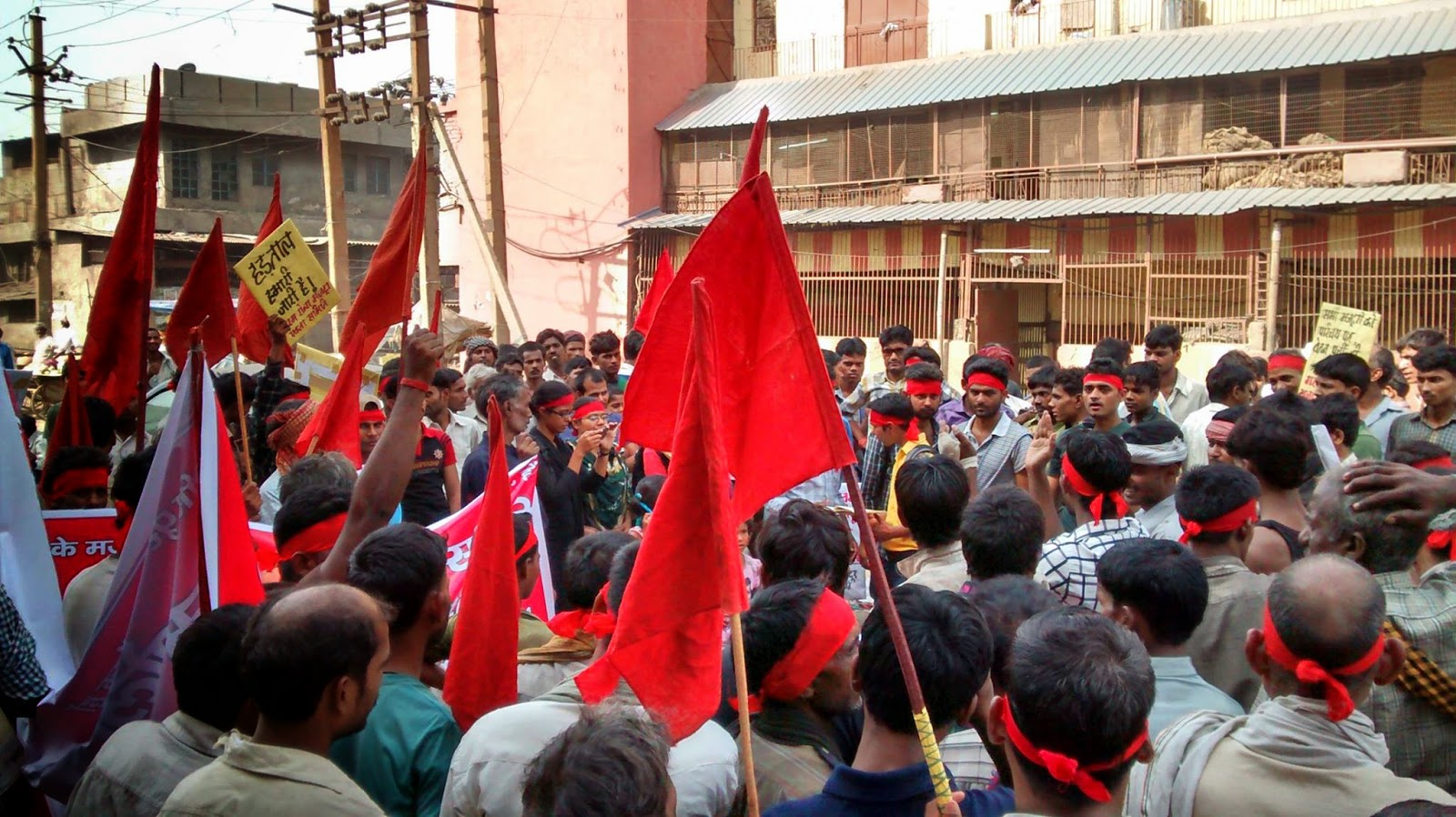
Lesson for the Saner Segments of the Margins
– Ravi SinhaThe margins just got bigger. Many among those who customarily inhabit the centre have been pushed to the periphery. They are not my concern. There are analyses galore about why and how this has happened. I am not going to add one more to those. Margins exist on all sides. They encircle the political mainland from left and from right. Some might say there are no margins on the right. Everything on that side is mainstream. In any case, I will have little to say about the margins on the right.My concern is with the left-side margins that now harbour the entire Left, although it is perhaps too soon for much of the traditional Left to acknowledge that. They are not likely, in any case, to listen to those of us who have spent a lifetime on the margins – partly because of our own follies and frailties but also because we have refused to succumb to the unsavory demands of the times. It is, after all, not our fault that we are born in a valley of historical time where the descent on the slopes of past glories has already come to an end and the ascent to the future ones is yet to begin.The adjective “saner” in the title is an evaluative term and one could be accused of being judgmental and arrogant. Either one should spell out the criteria underlying such evaluations or admit that the judgment is a subjective one. I will begin with the second option for the simple reason that I do not wish to be pedantic about counting criteria that can be discerned, in any case, from what I have to say. Of course, one does not even need to point towards the lunatic fringe that lives by hurling accusations of revisionism, treachery and worse at everyone else. Whether one likes it or not, they too are part of the Left. I cannot say that they are not my concern. But they are almost hard-wired for not understanding the world as it is and thoroughly incapable of reflection and self-reflection. I do not expect them to draw any lessons from anything except for petty and selfish ends or for picking up an internecine fight.Let me begin with what to expect in the aftermath of May 16. There is much talk about how bad it is going to be. Of course it is going to be bad, but not necessarily in the expected ways, although that too might happen. There should not be any doubt that the people of India, in their wisdom, have given a massive mandate to a person and a parivar capable of the diabolic. It is not helpful to conveniently change the meaning of the term “mandate” and say after the victory of the brutes that two thirds of Indians did not vote for them. There is no point consoling ourselves that they did not win the elections; the incumbents lost it. Nor should we draw much comfort from the fact that the horse of Ashwamedh was stopped in the far out kingdoms in the east and the south where local deities had their own divine powers. We are not entirely wrong when we attribute the victory to money-power and the corporate-controlled media. But, then, we also have the task of reconciling this with our faith in the wisdom of the people who can be thus navigated.It is to be plainly accepted that it is a resounding victory. It has been, as the man himself acknowledged in his victory speech, in the making for sixty years and it has taken the “labour” and the “sacrifices” of four generations. The six decade long march of today’s victors has left a trail of riots and carnages and steeled hundreds of thousands of men and women to have the capacity and the stomach for medieval barbarity. The question is – will they continue to do the same after this decisive victory?The answer has to be in the negative. There could always be a riot here or a riot there. It cannot be ruled out in a society like ours. But the victors do not have to continue with what they were doing before the victory. Non-occurrence of riots in Gujarat after 2002 is a telling story. In fact they do not even need to repeat in rest of the country their experiments with Gujarat, where – to take just one accomplishment of theirs as an illustrative example – Hindus and Muslims can no longer live in the same neighborhoods.Our first lesson, however, should be drawn not from what they can or cannot do to the social fabric. It should rather be drawn from what they can or cannot do to the state and its structures. The lesson here is going to be counter-intuitive for a regular leftist. The sources of the savage power of the victors lie primarily in the society, but this power cannot re-mould the state structures in the shape of its social ideology. Some might say – why would they even think of attempting such a thing? After all, it is a capitalist state. Having gained its control they can merrily get on with serving the corporate interests that have helped them come to power. Such an observation would be true as far as it goes. It states the obvious but misses a crucial point.Capitalist interest can be served by a fascist dictatorship like Hitler’s and it can be served by an enlightened bourgeois-democratic welfare state such as in Canada or in Sweden. Can one say that the difference does not matter to a leftist who is fighting to bring about socialism or to a people who are supposedly waiting for it? Indian state sits in the lap of a society that can, at times, enthrone men who would like to take the fascist-dictatorial path. Fortunately they will not be able do so despite their desires and ideologies. They may not even try because they can read the writing on the wall. A leftist would be inclined to credit the people for forestalling the emergence of an Indian Hitler. She would not be entirely wrong. After all, anything that happens in the social world is, in the final analysis, a deed of the people. But such long-range analyses are often tautological and do not contribute to understanding.The lesson, then, is about the Indian state and its rather puzzling relationship with the Indian society. One ought to notice that the society gives rise to savage forces and entrusts them with state power, but the state compels the savages to become civil and act in accordance with the constitutional framework. History has carved a modern polity out of a yet-to-be-modern society. Many parts of the cultures and practices that make up this society are ill-at-ease with the modern political structure. And yet the political structure is fairly secure. The child sits in the lap of a mother who finds the child alien and at times hostile, but holds the child nevertheless in her lap.The lesson is not without practical implications. If, for example, the new ruler were to come after the leftists, how will they fight back? They are likely to assert that they will go to the people and fight on the basis of their strength. They will not be entirely wrong. But one should not forget that the new ruler can go to an even larger number of people. If the Left, for example, cannot fight theTrinamool in the streets and fields of West Bengal, how can it fight the new Prince of Darkness in the cities, towns, villages and forests of the entire country even in the unlikely event of all other leftists coming together with it? The fact that the Prince, like the Greek gods, presently feeds on the admiration, fears and prayers of the masses makes the challenge even more formidable. One should think very hard before drawing him and his forces on the street for a political fight. That will have to be done another day. For now it is more likely, and wiser too, that the leftists would defend themselves within the existing political framework – in the parliament, assemblies, courts and other institutions while taking help of the Constitution and the laws. One should not forget that the courageous fight of a Mukul Sinha or a Teesta Setalvad on behalf of the victims of Gujarat 2002 has happened mostly in the courts and not on the streets of Ahmedabad or Gandhinagar.Perhaps a caveat needs to be inserted here. One should not be complacent about the power of a modern polity to civilize the savage forces. The state structures are definitely affected by those who come to occupy the posts. In their persons they bring in those elements of cultures, practices and world-views that do not sit well with the character and the architecture of a modern bourgeois state. They do find ways to bend this architecture to their own ends. But the main point of the argument above remains valid.This brings us to the second lesson which is closely related to the first one. It is about the forms and processes of democracy. There is a remarkable consensus across the ideological spectrum about the desirability of a thickly participatory grass-root democracy. The New Age philosophers and seers, who inspire a whole range of social movements, NGOs and Magsaysay awardees, have long preached about the virtues of strong democracy in which state power is decentralized and a vigorously active citizenry rules over itself through local self-government.There have emerged on the Indian political scene new knights in shining armors who have their own visions of Swaraj. Many admired, even if from afar, when ministers in the short-lived Delhi government were “shaking up the system” by patrolling the streets through the nights. Many among the more sophisticated advocates of strong democracy may have cringed at the vigilantism and the excessively earthy oratory of the new ministers. They may also have wished that real people living in the real mohallas, such as Khirki Extension, were more tolerant of cultural diversity. But all this, in their view, would be no more than a minor irritant in an otherwise radical development that is robustly anchored in the grass-roots. Few among the more learned votaries of this viewpoint may yet be ready to accept the citizenship of the Republic of Khirki Extension, let alone of a village republic run by a Khap Panchayat, but all of them would admire the audacity of experimenting with a participatory democracy wherein every mohalla will write its own manifesto, take full control of all aspects of governance and development, and espouse, protect and put into practice cultural values and ethical norms organically rooted in the life of a community.Left comes from the other end to join the consensus about strong democracy. Here the argument proceeds from an understanding that bourgeois democracy is nothing but a handmaiden of capital. Representative electoral democracy is merely a mechanism for acquiring popular legitimacy for the bourgeois state. This is why no element of bourgeois democracy – not a single one of its institutions and practices – will be allowed to survive when socialism comes around. This is also the reason why, even under capitalism, the struggle of the left should be aimed at making democracy more direct, more participatory and more decentralized.There can be little dispute about the goal of empowering people, but the arguments in favour of strong democracy miss the big picture on several counts. At its best strong democracy can play a supplementary role in the larger framework of constitutional-representative-liberal democracy. Without such a framework and in the absence of a democratic tradition it cannot work. At its worst strong democracy can play havoc with democracy itself. Examples of such disasters are littered across the ages and all over the planet. Our Khap Panchayats, tribal councils across the world and especially in Africa, Afghanistan and north-west Pakistan, and the ferocious mob democracy during the Great Proletarian Cultural Revolution in China can be some of the illustrative examples for anyone brooding over this question.The leftist commonsense that no component of bourgeois democracy would be carried over to socialism arises from a view that the evolution of this democracy has been driven completely by the interests and designs of capital. People did nothing for bringing about this democracy and there is nothing in it for them. This, however, is a mistaken view. The history of modern democracy overlaps with that of capitalism but that does not mean one is synonymous with the other. Socialist democracy would imbibe much of the democratic ethos and tradition of the modern era and it would also take in many of its institutions and practices modified according to the core principles and values of socialism. The key point here is that democracy, even of the bourgeois variety, is not only a mode of constituting the state and other structures of power. It also carves out a domain of rights, choices and freedoms for the individual citizen.At the same time, the fact remains that democracy is primarily a mode of constituting the state and other power structures. All power structures are, in the final analysis, inimical to freedom. The goal of human progress is to make them increasingly dilute and transparent and eventually to make them go away. That is how the state is expected to wither away in the very long run. Whether or not this actually happens, it does point towards the desirable forms of democracy and state structures. State should gradually shrink and release increasingly larger domains of life from its grip. This cannot really happen under capitalism because anything released by the state will be taken over by the market and subsumed under the animal kingdom of profit. But even under capitalism, state must be transparent, which is possible only if it is rule-bound, non-arbitrary and constitutional. Those who think that state can be made transparent by strong democracy are thoroughly mistaken. Strong democracy makes the political process thick and viscous. It makes the designing and implementation of policies muddied and opaque. More importantly, it is not possible for strong democracy to imbibe uniformly the democratic ethos of the modern era. If one has doubts about such assertions, one can, once again, look at the Khap Panchayats and tribal councils.One hopes that this argument is not construed as a lesson in how to dis-empower people and how to exclude them from the democratic process. A transparent, constitutional and rule-bound state can as much be constituted by the people as any, and the process to do so can be made as democratic as strong democracy. In fact it is more so because policies and proposals can be debated rationally, transparently and on a larger scale. The tragedy of this election – indeed of all Indian elections – has been that socio-psychological and other non-transparent aspects dominate. They do not allow debates on ideologies, programmes and policies. The messiah who emerged victor this time simultaneously appeared many things to many people – many were reassured about his staunch Hindu credentials, others were happy about his authoritarian personality and yet others about his promises of miracles about growth, jobs and national pride. There was hardly any need to scrutinize his promises and examine his policies. The same factors that spoil the prospects of strong democracy contaminate the constitutional-representative-liberal democracy too, except that, in the long run, the latter is better equipped to deal with these conditions.The third major lesson has to be about our approach to the programmes and policies of the bourgeois state. This should not be confused with the strategic goal of bringing about socialism which can be accomplished only by replacing the bourgeois state by a socialist state. However, the struggle around the programmes and policies of the present state remains a matter of critical importance. It affects people’s lives now while it also feeds into the prospects of advancing the struggle for socialism.Indian capitalism is in a particularly rapacious stage. Capital here is like a hungry beast with a prey in sight that it can pounce upon in just one leap. In such a stage, capitalist growth is rapid on account of two major factors – one, abundantly available cheap labour and second, the fact that most natural resources, such as forests and mines, and most of the small assets so ubiquitous in the entire economy, such as the land of small landholders, are yet to be turned into capital. Cheap labour is always a condition for good profits, but grabbing resources and assets for a song is a real windfall. Such a prospect makes the beast real hungry and desperately impatient. Capital always plays a big role in bourgeois elections, but this time it had a far more pressing reason to play this role more aggressively than ever.The most effective way to resist this plunder – if one has to do that within the bounds of bourgeois democracy – is to fight for two things. First, one must fight for a welfare state that would collect adequate revenues from enhanced taxation of profits and other higher incomes and take full responsibility of the basic needs and services such as food, shelter, health, education, water, and all other civil services for every citizen. The second fight should be for a legal framework that would prevent capitalization of natural resources and dispossession of small asset-holders unless the state in the first case and asset-holders in the second are made permanent share-holders in the upcoming enterprises. This should be done over and above the monetary compensation determined on the basis of an appropriate and mutually negotiated combination of the current and the post-acquisition market prices of the assets and resources.Left is the most natural force to put up this resistance. But it has failed miserably. The blame cannot be put entirely on the global dominance of neo-liberalism under which welfare state and regulation of capital are considered dead horses. One has to fight in a given environment and the best way to do so is to base oneself on hard facts and just demands even if they are considered outdated under the current dispensation. Facts are so obvious that even the Congress Party tried to position itself on a welfare-oriented and rights-based left-of-centre plank when confronted with the nakedly neo-liberal and rightwing plank of the adversary. That it too failed miserably had many causes but the facts behind that positioning were not among them.The worrisome aspect about the left is its double affliction with dogma and populism. Dogmatism operates as blinkers that keep the view focused on the bygone world of early and mid twentieth century. Imperialism of the colonial times and resultant nationalism appear to have gone into the leftist blood. This impairs the ability to forge effective strategies against Indian capital and against global capital as well. It also leads to foolish steps in the arena of parliamentary politics. It is not only the Left who are paying the price of walking out of the UPA1 on the issue of the Nuclear Deal. The entire political scenario, which gave such a shock on May 16, would have been quite different but for that grievous mistake.Dogmatism also prevents the left from presenting the outline of a socialist future that can supersede the capitalist present not only on the criteria of equality and justice but also on those of productivity, creativity, prosperity and freedom. Despite the fact that many talks and articles of some of the tallest ideologues contain phrases like “Future Socialism” or “Twenty-first Century Socialism”, they are not able to free themselves from the grip of the view that holds Twentieth Century Socialism as the canonical model of socialism. The failure to present socialism as a viable and superior alternative has gravely negative political implications for the entire left.Populism, on the other hand, deprives them entirely of ideological and political courage. Even the socially progressive sections of liberal bourgeoisie are far bolder in pushing the masses towards closing the gap between the actually existing popular consciousness and the historical consciousness of the era. On the left side one comes across celebrated theoreticians and scholars who still talk nostalgically about nationalist period and about the Gandhian-communitarian ethos when the communist party was so organically linked with the peasantry. Such an attitude puts all the blame for left’s failure on the severing of links with the masses. No one can claim that delinking with the masses is not a serious problem. But if one elevates it to being the only problem and advocates steps aimed solely at establishing this link, one would not be prepared to face the full challenge confronting the left.Importance of the lesson about programmes and policies of the state is not only for the left. Realization for a comprehensive and well-orchestrated fight for welfare state and regulation of capital has been waylaid in more recent times by the populist anti-corruption movement and by the subsequent emergence of the AAP phenomenon. Populist anti-corruption movements led by messianic and demagogic leaders have invariably helped, despite their radical postures and popular appeal, the conservatives and the rightwing. Such an outcome is not yet established beyond dispute in the present case. But indications are already there. The shock of May 16 cannot be attributed in any major way to a new electoral arithmetic created by AAP. But it can certainly be attributed in a significant measure to the political atmosphere created first by the India Against Corruption supported from behind by the Sangh Parivar and later by the AAP phenomenon strengthened by the participation of activists and leaders of social movements, sections of Lohiaite socialists, many leftists and other radicals, and a large number of politically uninformed idealist citizens.From here we can easily move on to the last lesson on my list which is not really a lesson and it does not relate only to the recent political developments in India. It is more like a question that needs to be raised about a much wider global phenomenon. The phenomenon in question comprises of lightly organized, largely spontaneous and suddenly erupting mass movements. Some of them are movements focusing on economic and political issues, others on social issues and yet others bring together cultural, social and systemic dimensions to question an entire way of life characterized by modernity. These movements are favourites of unaffiliated leftists and other heterogeneous radicals, peace activists, environmentalists, NGOs and social activists of various kinds. They are theorized and applauded by post-structuralist, post-modernist, post-Marxist, post-colonialist and similar varieties of scholars and theorists.Late sixties of the previous century was a turning point for this phenomenon. The anti-racism civil rights movement in the USA, the anti-war movement against America’s Vietnam War, student movements in Europe and in many other parts of the world, the feminist movement in much of the west, the underground samizdat (self-publishing) movement of intellectuals in the Soviet Union that was supported from the west by the Cold War Right as well as the anti-authoritarian New Left, and the global spread of radicalism spearheaded by the Great Proletarian Cultural Revolution in China – all this melded together to herald an era of great movements that were very different from the working class revolutions led by communist parties and anti-colonial movements led by nationalists as well as communists. Among many facets of these movements, one may also note that towering intellectuals like Sartre and Marcuse inspired, participated in and theorized about these movements.The overall impact of these movements has been uneven. Some had great success and transformed the social-political-cultural-ideological landscape of humanity. Others came as immediate responses to issues and crises of the times and subsided as the world moved on to other things. The purpose here is not to make an appraisal of this history – an impossible task, in any case, for my abilities. My purpose is to underline the necessity of re-examining certain widely held views about this phenomenon.It is often claimed that rigorously organized political movements led by tightly structured parties are a thing of the past. They have been superseded for all times to come by the spontaneous and loosely organized social movements. It is this view that needs to be brought under scrutiny. New Social Movements are not so new any longer. They have had a history of half a century. There is enough evidence by now to examine their track record. In more recent times one has witnessed the advent of World Social Forum and short-lived eruptions like the Occupy Movement. Their impact is very limited and their future is unclear. Even the outcomes of Tehrir Square, and of the Arab Spring in general, which were more overtly political than the classical examples of social movements, are at best ambiguous. How long will the advocates and the theorists of such movements continue to point towards the failures of leftists and the absence of political and class-based movements as a proof that there are no alternatives to social movements when it comes to changing the world?Left has not ignored the importance of social movements and it has not failed because it has refused to imitate them. Left has failed because it has not been able to come up with a grand strategy to challenge capitalism and its political framework of bourgeois democracy. It knows how to fight the feudalism, colonialism, monarchy and military dictatorships. But these are, by and large, adversaries belonging to a bygone era. Left has failed because it has no strategy against its current adversary. It should focus on remedying this grave shortcoming.***********Ravi Sinha is an activist-scholar and a leading member of New Socialist Initiative (NSI) who has been associated with the left movement for nearly four decades. Trained as a theoretical physicist, he has a doctoral degree from MIT, Cambridge, USA. He worked as a physicist at University of Maryland, College Park, USA; at Physical Research Laboratory, Ahmedabad; and at Gujarat University, Ahmedabad before resigning from the job to devote himself full time to organizing and theorizing. He is the principal author of the book, Globalization of Capital, published by Lal Parcham and Lok Dasta in 1997, and a co-founder of the highly acclaimed Hindi Journal SANDHAN.