1 May 2014 10 AM RALLY & Public Meeting Freedom Park to Banappa Park May Day 2014 Not a HOLIDAY to sit at home. Not a day for distribution of SWEETS. But a Day for PLEDGE! Pledge – To weed out anti-worker policies and parties. To relaunch the fight for 8 hour work day. To […]
Blog
-
Syria: Evidence of Rebel Chemical Attack on Syrian Soldiers
WARNING GRAPHIC FOOTAGE 18+ : Not meant for shock but documentation of war crimes.Video shows circumstantial evidence that Al Qaeda have access to chemical weapons, and have used it against Syrian soldiers
See Also: http://democracyandclasstruggle.blogspot.co.uk/2014/04/sy-hersh-reveals-potential-turkish-role.html
-
Tsundur Massacre: Normalising Injustice the Judicial Way
– Subhash GatadeTsundur, Guntur, A.P. which had made headlines way back in 1991 when eight dalits were lynched by a 400 strong armed mob of Reddys is again in the news. The recent judgment of the A.P high court has overturned the judgment of the Special courts and has acquitted all the accused involved in the case for ‘want of evidence’.As rightly noted by Human Rights Forum (HRF) the judgment is ‘brazen injustice’ and is ‘reflective of upper caste anti-dalit bias’ and ‘betrays insensitivity in the judiciary to an inhuman caste atrocity.’ It is expected that the state does not waste time in moving the Supreme Court to get this retrograde judgment overturned and render justice to the families of dalits.What is more disturbing and shocking is the fact that when the Special Court formed to deliberate on the case had finally given its verdict seven years back, it was considered a ‘historic’ in very many ways. The conviction of the perpetrators – twenty one of the accused were life imprisonment and 35 of the accused were asked to serve one year rigorous imprisonment – was considered a significant milestone in the ongoing dalit emancipation movement.IIThe judgment by the special court had demonstrated the immense possibilities inherent in the SC and ST Prevention of Atrocities Act (1989) which till date remain on paper. As rightly noted it was the first time in the nearly twenty year old trajectory of this act that special courts had to be set up at the scene of offence.It is noteworthy that Dalits in Tsundur were so united that they neither accepted any summons from the courts nor they ever went to court which was situated at some distant place from the village. They demanded in unison that the courts should come to them and the government had to concede to their demand and set up special courts in a school premises.They had also demanded that they be provided with a Public Prosecutor and a judge who has a positive track record while dealing with cases of dalit atrocities. After lot of dilly-dallying the government had complied with this demand also.It has been normal in all such cases of dalit atrocities that as time passes, people including victims and their families loose interest in continuing their fight for justice. They come under pressure or are coerced into changing their statement in the courts etc. The significance of the Tsundur struggle was that the people leading the campaign were successful in keeping the people mobilised all these years. Tsundur became a rallying point for different left and democratic forces in the state and it was harbinger of a new turn in the left politics also which resolved to take up the issue of caste oppression.IIID Dhanraj was a crucial witness to the whole case. He did not falter for a moment despite tremendous pressure brought upon him by the powerful Reddys. One could see that Tsundur, the small village in Guntur, had created many such ‘unsung heroes’ – ordinary looking people who faced heavy odds so that they get justice. Merukonda Subbarao, a fifty six year old daily wage-worker, who had served as the first president of the ‘Tsundur Victims Association’ was another such ‘hero’ who identified and named forty of the accused standing in the court room, from among the one hundred and eighty three accused. It was clear that the whole incident was etched in his memory so strongly that he did not falter despite the judges requests to repeat the identification. And who can forget Martyr Anil Kumar, a young man in his twenties who was in the forefront of the struggle so that the perpetrators of the massacre are punished without delay. Anil was killed in a police firing during one of those struggles.As is clear in every other atrocity against the dalits, the Reddys who have dominated the state politics since independence, tried with all their might so that they are allowed to go scot free. Utilising their contacts in the Judiciary, bureaucracy or police administration they tried to delay the process of justice as long as they could do it.Attempts were made to buy or coerce the dalits in very many ways and the state also tried to play second fiddle to the Reddy’s. It felt that by distributing largesse to the dalits, giving jobs to few of them, awarding compensation to the victims’ families they could calm down their yearning for justice. But dalits in Tsundur wanted nothing less than severe punishment for the perpetrators.Unitedly they raised a slogan ‘Justice not Welfare’. It was worth emphasising that with their continued resistance they were able to make Tsundur a key issue in state politics.
IVA brief recap of the events in this ‘historic case’ tells us that the upper caste (namely the Reddys’ ) used the pretext of of alleged harassment of a Reddy girl by a dalit youth in a cinema hall to attack the dalits. The planned nature of the attack was evident also from the fact that within no time a few hundred strong mob of Reddys wielding traditional weapons (and few of them carrying modern firearms) descended on the dalit hamlet and unleashed their fury against the innocents. In fact, sensing an imminent attack, most of the menfolk had already left the village. Once the marauders came to know of this they literally chased the dalits on the road adjoining the Tungabhadra canal and lynched them one by one.Looking back it is clear that the preplanned attack against the dalits was another futile attempt by the Reddys to reassert their age-old authority which had seen fissures with the growing assertion of dalits. The changed atmosphere in the village was for everyone to see. Not only many of the dalits boys and girls had benefitted from the affirmative action programmes in education, a few among them had even surpassed the Reddys in many respects. Many of the dalits from the village were working with Indian Railways. Overall the situation was such that the Dalits had refused to follow the medieval dictats reserved for them under the Varna system.VAll that is passe now. The judgment of the high court which has overturned the verdict of the Special Courts reminds us that the journey to achieve justice is going to be a long one.Any cursory glance at the cases of mass crimes against dalits tells us that the high court judgement is no exception rather it is the norm.It was only last year that Patna highcourt acquitted nine out of 10 accused in the Miyapur massacre for ‘lack of evidence,’ overturning a lower court’s order. (July 2013) The Aurangabad Scheduled Castes and Scheduled Tribes (SC and ST) special court judge, Krishna Kant Tripathi, had earlier awarded life imprisonment to 10 persons on September 20, 2007. The Miyapur massacre was a major carnage in which the Ranvir Sena killed 32 people, mostly Dalits, supposedly to avenge an earlier Naxal attack in Senari village of Jehanabad. A 400-500 people had entered the village and began firing at the villagers. (16 th June 2000).The same year one witnessed Patna high-court overturning another judgment by the lower court where 11 accused involved in the killings of ten activists of CPI (ML) in November 1998 had been convicted. One had witnessed similar reversals in the Bathani Tola massacre – which involved 23 accused – and Laxmanpur Bathe massacre – which saw 58 deaths. In all the above cases Ranveer Sena was said to be involved but it was allowed to go ‘scot free’.No doubt that the lower courts had convicted the accused – which the high court later reversed – but a close reading of the cases would make it clear that loopholes were deliberately left which could facilitate the accused. e.g. the police had pronounced Ranvir Sena supremo Brahmeshwar Singh “Mukhiya” the prime accused, an “absconder”. It is a different matter that this dangerous criminal was languishing in Ara jail since 2002. It may be added here that when Nitish Kumar, assumed reins of power in 2004, one of the first thing he did was to disband Justice Amir Das Commission when it was nearly ready with its report. This commission was appointed in the immediate aftermath of the Bathe massacre and had gone into great details about the political patronage, which Ranvir Sena received, from different mainstream political formations.VIIt is possible that all this details where the state and its different organs comes out in rather unflattering terms could be brushed aside as a story repeated ad nauseam. All the talk of dalit atrocities could be presented as another extension of the way in which ‘state in the third world’ unfolds itself. But the key point worth emphasising is that caste atrocities much like gender oppression or racial atrocities have a specificity which transcends the binary of ‘state as perpetrator’ and ‘people as victims’ . In fact they implicate the partisan role played by the people themselves.The ‘Report on Prevention of Atrocities against SCs ‘ prepared by NHRC ( 2004) presents details of the way in which the civil society presents itself . Here civil society itself becomes a distinct beneficiary of caste based order and helps perpetuate the existing unequal social reactions and frustrates attempts to democratize the society because through the customary arrangements the dominant classes are assured of social control over people who can continue to abide by their commands without any protest.Of course the uncivil nature of the civil society presents before us a unique challenge where the need then becomes to rise above a mere discourse on civil and constitutional rigths and address the failure of the largest democracy of the world to go beyond mere form. We have to appreciate that it concerns the greater hiatus that exists between constitutional principles and practice and corresponding ethical ones based on a diametrically opposed ideal.Everyone has to see that under the purity and pollution based paradigm which is the cornerstone of our caste system, inequality receives not only legitimisation as well as sanctification. As inequality is accepted both in theory and practice, a legal constitution has no bearing on the ethical foundation of caste-based societies. In fact Dr Ambedkar, the legendary leader of the oppressed had this very reality in his minds, when he emphasised the difference between what he called ‘political democracy’ and ’social democracy’, the difference between ‘one person having one vote’ and ‘one person having one value’.VIITo conclude, one can go on enumerating cases of dalit oppression and explain the manner in which perpetrators of atrocities against dalits are ‘saved’ judicially.
Protest against the judgement by Dalit Adivasi Bahujan Minority Students Association Perhaps one can make a beginning with the first massacre of dalits in independent India when 42 dalits – mainly children and women – were burnt alive by a gang of marauders belonging to the local upper castes (1969) in Kizzhevanamani, Thanjavur, Tamil Nadu. Dalits and other exploited people in that area of Thanjavur had launched an agitation under the leadership of Communist Party on the question of wages which had infuriated the dominant caste people.Here also the judgment by the Courts was disturbing to say the least. The courts had acquitted all the accused with the specious argument that ‘it appears unbelievable that all these members of the upper caste’ would have gone walking to the dalit hamlet/basti.’It is said that shadows of Kizzhevanamani have continuously hovered around atrocities against Dalits and adivasis in post independent India. Question arises how long it is going to continue?**********Subhash Gatade is a New Socialist Initiative (NSI) activist. He is also the author of Godse’s Children: Hindutva Terror in India, and The Saffron Condition: The Politics of Repression and Exclusion in Neoliberal India. -
9 Mythbusters: Lest We Forget the Genocide of 2002
– Shehzad Poonawala[Note: DNA newspaper buckling under pressure from Team Modi: This article was published yesterday in the web edition of DNA at 1 pm under the headline “Mamata Banerjee calls Narendra Modi ‘Butcher of Gujarat’: Here are 9 Mythbusters on 2002 Riots”. Within couple of hours of publication the article went viral with more than 1000 shares on facebook and twitter. DNA itself tweeted it thrice so did senior journalist like Siddharth Varadarajan (link here). But this morning, without any explanation, the piece was pulled down by DNA from its website. If you click on the link it says “The requested page cannot be found”. Here, we are reproducing the article so that it remains in public domain.]
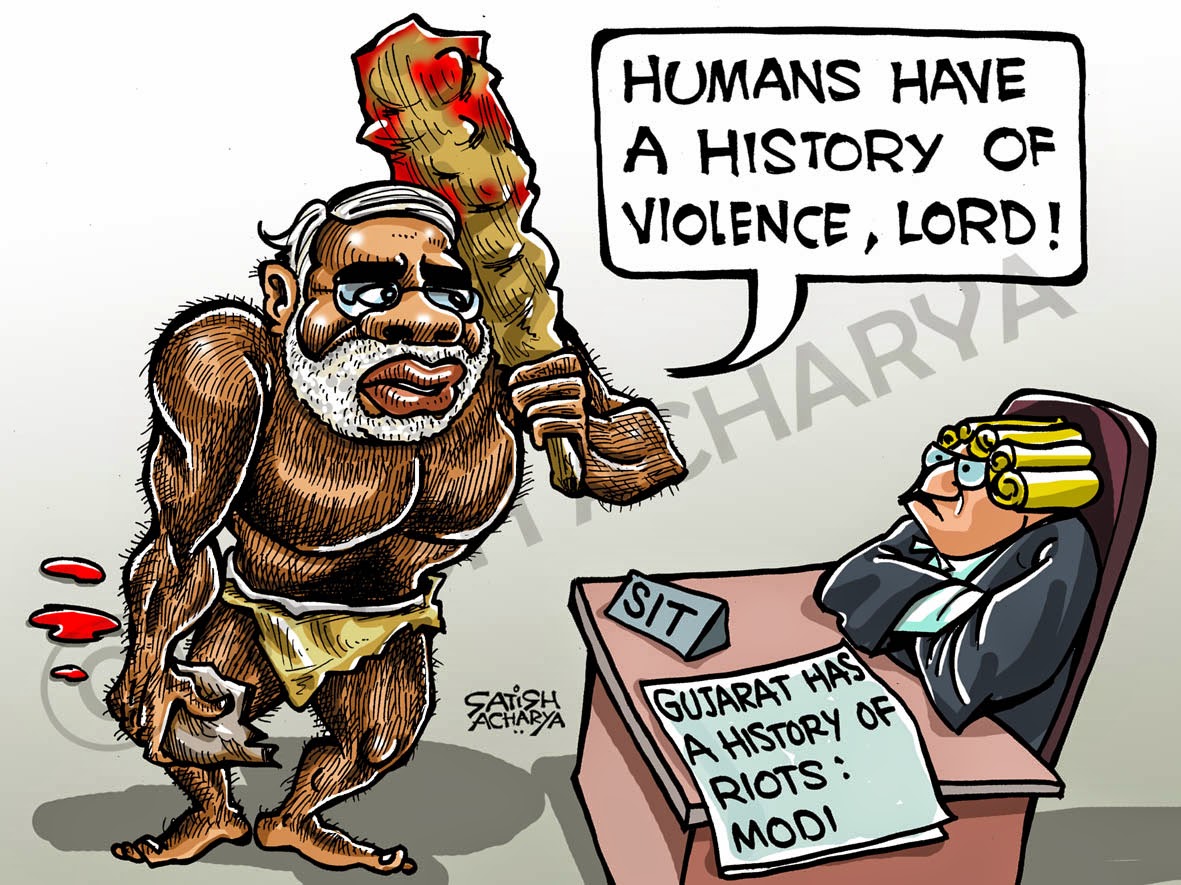
Cartoon: Satish Acharya For those who have developed “selective and motivated” amnesia about the Truth of 2002 riots in Gujarat and are suddenly buying into the myths being perpetrated by the PR machinery of Mr. Narendra Modi, here are a few myth-busters to refresh your memory and perhaps your conscience.
Myth No. 1: Post-Godhra Violence was brought under control within 2-3 days by Narendra Modi’s Government…Truth: “The violence in the State, which was initially claimed to have been brought under control in seventy two hours, persisted in varying degree for over two months, the toll in death and destruction rising with the passage of time.”Source: Final Order of the National human Rights Commission chaired by the very respected Justice J.S Verma. Available hereMyth No. 2: Gujarat Police acted fairly by taking action against rioters from every side…Truth: “We women thought of going to police and telling the police as in the presence of police, the houses of Muslims were burnt, but the police told us ‘to go inside, it is doom’s day for Muslims”Source: PW219 testimony which was admitted as part of Naroda Patya judgment that led to conviction of Mayaben Kodnani, Narendra Modi’s cabinet minister who led murderous mobs during 2002 riots! Available hereMyth No.3: No conspiracy by the Gujarat government, Post-Godhra violence was a spontaneous reaction…Truth: “A key state minister is reported to have taken over a police control room in Ahmedabad on the first day of the carnage, issuing directions not to rescue Muslims in danger of being killed. Voter lists were also reportedly used to identify and target Muslim community members”Source: Report of Human Rights Watch- April 2002, Vol. 14, No. 3(C). Available hereMyth no. 4: Modi allowed a fair prosecution of those accused in rioting and hence even his cabinet colleague Mayaben Kodnani was convicted…Truth: “The modern day ‘Neros’ were looking elsewhere when Best Bakery and innocent children and helpless women were burning, and were probably deliberating how the perpetrators of the crime can be saved or protected.”“Law and justice become flies in the hands of these “wanton boys”. When fences start to swallow the crops, no scope will be left for survival of law and order or truth and justice. Public order as well as public interest become martyrs and monuments.”“From the facts stated above, it appears that accused wants to frustrate the prosecution by unjustified means and it appears that by one way or the other the Addl. Sessions Judge as well as the APP (Shri Raghuvir Pandya, the public prosecutor in this case at the time was a member of the ruling Bharatiya Janata Party (BJP) and contested elections from Ward 20, Vadodara in the 1996 Corporation Elections on a BJP ticket!) have not taken any interest in discharge of their duties.”Source: Supreme Court in Zahira Habibulla H Sheikh And Anr vs State Of Gujarat And Ors on 12 April, 2004 CASE NO.: Appeal (crl.) 446-449 of 2004 . Available hereMyth No.5: Narendra Modi never justified post-Godhra killings…Truth: “Responding to queries regarding various statements attributed to him by the media, Mr Modi denied citing Newton’s law. Nor had he spoken of “action-reaction”; he had wanted neither the action (at Godhra) nor the subsequent reaction. When we cited footage in Zee to the contrary (Annexure 4A), there was no reaction from Mr Modi.”Source: Editors Guild Fact Finding Mission Report dated 2002. Available hereMyth No.6: Narendra Modi speaks only about development in his speeches. Even after 2002 riots, his speeches were never laced with communal poison..Truth: Narendra Modi’s reported speech: “For several months, the opposition has been after me to resign. When I did, they did not know what to do and started running to Delhi to seek Madam’s help. They realised that James Michael Lyngdoh, the Election Commissioner of India, is their only saviour.Some journalists asked me recently, ”Has James Michael Lyngdoh come from Italy?” I said I don’t have hisjanam patri, I will have to ask Rajiv Gandhi. Then the journalists said, ”Do they meet in church?”. I replied, ”Maybe they do.” James Michael Lyngdoh came and visited Ahmedabad and Vadodara. And then he used asabhya basha (indecent language) with the officials. Gujaratis can never use such language because our rich cultural heritage does not permit it. Then he gave a fatwa ordering that the elections can’t be held. I want to ask him: he has come to this conclusion after meeting only members of the minority community. Are only minority community members citizens of India? Are majority community members not citizens of this country? Is the constitutional body meant only for the minority community? Did he ever bother to meet the relatives of those killed in the Godhra carnage? Why didn’t he meet them? Why didn’t he ask them whether the situation was conducive for polls? Why? James Michael Lyngdoh ( says it slowly with emphasis on Michael), the people of Gujarat are posing a question to you.”Source: Reported speech of Narendra Modi, 30th September 2002. Available hereMyth No. 7: Narendra Modi never applied for a US Visa (when it came to light that he was denied one)..Truth: “The Chief Minister of Gujarat state, Mr. Narendra Modi, applied for a diplomatic visa to visit the United States. On March 18, 2005, the United States Department of State denied Mr. Modi this visa under section 214 (b) of the Immigration and Nationality Act because he was not coming for a purpose that qualified for a diplomatic visa.Mr. Modi’s existing tourist/business visa was also revoked under section 212 (a) (2) (g) of the Immigration and Nationality Act. Section 212 (a) (2) (g) makes any foreign government official who “was responsible for or directly carried out, at any time, particularly severe violations of religious freedom” ineligible for a visa to the United States.The Ministry of External Affairs requested that the Department of State review the decision to revoke his tourist/business visa. Upon review, the State Department re-affirmed the original decision.”This decision applies to Mr. Narendra Modi only. It is based on the fact that, as head of the State government in Gujarat between February 2002 and May 2002, he was responsible for the performance of state institutions at that time. The State Department’s detailed views on this matter are included in its annual Country Reports on Human Rights Practices and the International Religious Freedom Report. Both reports document the violence in Gujarat from February 2002 to May 2002 and cite the Indian National Human Rights Commission report, which states there was “a comprehensive failure on the part of the state government to control the persistent violation of rights of life, liberty, equality, and dignity of the people of the state.”Source: Statement by David C. Mulford, U.S. Ambassador to India, March 21, 2005. Available hereMyth No. 8: Vajpayee never asked Modi to observe “Rajdharma”, did not rap him for 2002 riots..Truth: “In comments which appeared to back criticism of the state authorities, Mr Vajpayee said he would speak to political leaders about allegations that they had failed to do their job. “Government officials, political leaders, need to respond to the task. The constitution guarantees equal rights for all,” he said.The state government is controlled by the BJP, and the Chief Minister, Narendra Modi, has come in for particular attack over the way the authorities reacted to the violence.At the Shah Alam camp in Gujarat’s commercial capital, Ahmedabad, Mr Vajpayee said that the Godhra attack was “condemnable” but what followed was “madness”. “The answer to madness is not madness,” he said in an emotional speech.”The duty of our government is to protect the property, life and honour of everybody… there is no scope for discrimination,” he said in an apparent reference to allegations that local officials had turned a blind eye to the killings.”Source: Vajpayee says riots “shameful” – BBC News report April 4th 2002. Available hereMyth No.9: It’s not sheer opportunism that well-known Modi-baiters like Smriti Irani, have today become his cheerleaders..Truth: “Smriti Irani who unsuccessfully contested from Delhi’s Muslim-dominated Chandni Chowk constituency in the April-May parliamentary elections, blamed Modi for BJP’s recent electoral reverses. “Whenever people mention Gujarat they only talk about the riots and try to corner the Gujaratis on the issue. So, in order to maintain the respect that I have for Atalji and the BJP, I won’t hesitate to take this step( of going on a fast to seek Modi’s removal) ,” she said.”Source: Times of India report dated 12th December 2004. Available hereThese myth-busters took me just one hour to compile. So it’s quite surprising that none of the stalwarts who interviewed Modi, (some of whom saw the events of 2002 unfold in front of their very own eyes), never counter-questioned him further and exposed the glaring gaps in his “rebuffed” narrative.**********
Shehzad Poonawala is a Delhi based columnist. -
Gujarat : Nine mythbusters on 2002 post-Godhra riots
[This article, written by Shehzad Poonawalla, which originally appeared at <http://www.dnaindia.com/node/1983270>, seems no longer available online. We reproduce it for wider and continued circulation. – Ed] For those who have developed “selective and motivated” amnesia about the truths of 2002 riots in Gujarat and are suddenly buying into the myths being perpetrated by Narendra Modi’s […]
-
Eastern Ukraine dissatisfied not only with the policy of Kiev, but also with their own oligarchs by Alex Verhoyantsev
Protest against the self-proclaimed Kiev government begins to take on a social meaning. On the streets of Lugansk miners came April 23, protesting against the dismissal of 30 of their colleagues who participated in rallies in Lugansk. This site reports “Russian Spring”
However, miners make demands for higher wages. Striking during the day while buses blocked roads.On the square in
-
Ukraine : Anti-Kiev protesters take control of govt buildings in Lugansk Region
The police guards from the building have gathered in the courtyard. They are standing holding their shields, while protesters, who are also present there, cheer them for not confronting the activists with violence.
Protesters rallied towards the regional administration building when none of the officials responded to their ultimatum to local government issued on Sunday. The people -
April 29: US and Philippines How strategic is the partnership
http://www.aljazeera.com/indepth/opinion/2014/04/us-philippines-how-strategic-pa-201442871034598657.html US and Philippines: How strategic is the partnership? Jose Maria Sison Hyped as a major advance in the strategic partnership of the US and the Philippines, the Enhanced Defense Cooperation Agreement (EDCA) highlights the meeting of US President Barack Obama and Philippine President Benigno Aquino in Manila this week. EDCA circumvents the ban on […]
-
Norway: Serve the People interviewed the recently released partner of Kjell Gunnar Larsen.
Serve the People interviewed the recently released partner Kjell Gunnar Larsen.
We call her Helga since the name has not been made public in the case so far . Helga has been active in anti-racist activity for thirty years, mainly in SOS Racism .She was arrested along with Kjell Gunnar Larsen on April 28 and is now charged with ” money laundering “.
Hey comrade, first of all we will say -
Philippines : Anti-Obama protest water-cannoned in Manila – Red Salute to Philippine Patriots against US bases
Riot police in the Philippines used water cannon on hundreds of anti-US protesters on Tuesday as they rallied against President Barack Obama’s visit and their country’s signing of the Enhanced Defence Cooperation Agreement with the US.
See Also: http://democracyandclasstruggle.blogspot.co.uk/2014/04/philippines-confront-obamas-visit-and.html