– Subhash Gatade
“The epitah for the RSS volunteer will be that he was born, he joined the RSS and died without accomplishing anything.”-V. D. Savarkar
(D.V.Kelkar, “The R.S.S.” Economic Weekly ( 4 Feb 1950: 132) Page 36, The Brotherhood in Saffron,The RSS and The Hindu Revivalism, Andersen and Damle,Vistaar, 1986, Delhi)
Veer Savarkar was a Veer Purush who was not scared of death. He was a Shastra Upasak and Shaasrta Upasak: Shri Narendra Modi. May 29, 2013 Author: admin (www.narendramodi.in)
I
Celebrations at the central hall of Parliament are a marker of the political ambiance in the country.
The change of guard at the centre was very much visible at the place recently where the entire top brass of BJP including PM Narendra Modi were present to celebrate the birth anniversary of Savarkar. Modi described Savarkar as a prolific writer, poet and social reformer. “Tributes to Veer Savarkar on his birth anniversary. We remember and salute his tireless efforts towards the regeneration of our motherland.”
People would recall that normally it used to be a low-key event. Last year, the celebrations were further muted. Only few prominent leaders of the BJP were present there. The ascendance of BJP led government had clearly made the difference.
A trip down memory lane would tell us that even for the Sangh Parivar and its affiliated organisations this has not been the case always. The iconisation of Savarkar in the Parivar is not very old. Late nineties when Shiv Sena-BJP ran a coalition government in Maharashtra they did not even think of putting his portrait in the state the assembly. For them this discovery of Savarkar happened during the BJP led NDA regime at the centre (1998-2004).
Perhaps neither Modi nor any of his cabinet colleagues, most of whom started their social political life in the RSS or Rashtra Sevika Samity ( which is meant for women of the Hindutva brigade), would like to remember today that they are singing paens to the man who when alive had castigated the Hedgewars-Gurujis’ – founders and pioneers of RSS – and their Swaymsevaks umpteen times ( Sample the quote above) and the Hedgewars’-Golwalkars’ had also returned the compliment in the same vein.
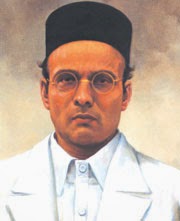 |
| Savarkar |
Even a cursory glance at the trajectory of Hindu Mahasabha under the leadership of Savarkar or the way in which RSS unfolded itself during those days makes it quite clear that the differences in priorities between the two organisations was already visible from the day Savarkar was elected president of the Hindu Mahasabha after his release from jail ( 1937).In a sympathetic study of RSS “The Brotherhood in Saffron,The RSS and The Hindu Revivalism,” the authors Andersen and Damle clearly explain (Page 40, Vistaar, 1986, Delhi) that in fact Savarkar’s emphasis was on turning Mahasabha into a political party in opposition to the Congress when Hedgewars’ had already decided to insulate RSS from any active politics and concentrate on ‘cultural work’. Hedgewar and later Golwalkar also neither wanted to be associated with a formation whose confrontational activities would place the RSS in direct opposition to the Congress. According to him there were apprehensions regarding each other’s role in the Hindu Unification Movement. The souring of relations between the two organisations is visible in a angry letter issued by Savarkar’s office in 1940 advising that:
“… When there is such a serious conflict at a particular locality between any of the branches of the Sangh RSS and the Hindu Sabhaites that actual preaching is carried out against the Hindu Mahasabha …, then the Hindu Sabhaites should better leave the Sangh …and start their own Hindu Sabha volunteer corps.( Letter from V.D.Savarkar to S.L.Mishra, 3 March 1943, Savarkar files, Bombay)”
Definitely the fact that this ‘Veer Patriot’ (to quote title of a write-up which appeared in ‘Panchajanya’ sometime back discussing Savarkar) died a lonely man abhorred especially by the thriving ‘Parivar’ then, which made special efforts to maintain distance from him in those days, did not bother these ‘legatees’ then. It did not perturb their conscience a bit that it took more than thirty four long years after his death that they ultimately decided to claim their lineage from this pioneer of the Hindutva project.
Just to recapitulate, a decade back, when the Vajpayi led NDA was ousted out and UPA I led by Congress, had assumed reins of power a controversy had erupted about removal of Savarkar’s plaque from Port Blair’s cellular jail where Savarkar was jailed, Vikram Savarkar, Savarkar’s own nephew in an interview to a national daily exposed BJP’s lack of interest in him and castigated them for their sudden love for him. (Savarkar nephew hits out at BJP, August 30, 2004, Indian Express)
It may be noted that he had accused the senior leaders of the BJP for ‘keeping mum despite noticing the removal of his uncle’s quotations from Port Blair’s Cellular Jail’. According to him Ram Kapse, the then incumbent Lt. governor of Andaman and Nicobar and former M.P Ram Naik ( both BJP workers) “..did not utter a word when the plaque was removed.” The report further says that ,’ ..he is not surprised at BJP’s lack of interest in Savarkar. “We know very well that the BJP and RSS did not appreciate his (Savarkar’s) philosophy.”..’ ..The report further says that ‘ (Vikram- author) Savarkar insists BJP’s sudden love for the legend is an eyewash.’ “It is an effort to woo voters for the Assembly elections in Maharashtra.”
II
“Many people worked with the inspiration to free the country by throwing the British out.After formal departure of the British this inspiration slackened.In fact there was no need to have this much inspiration.We should remember that in our pledge we have talked of the freedom of the country through defending religion and culture. There is no mention of departure of the British in that”. – M.S. Golwalkar alias Golwalkar Guruji ( Sri Guruji Samgra Darshan,Volume IV, p.2 )
“ In 1942 also there was a strong sentiment in the hearts of many. At that time too the routine work of Sangh continued. Sangh decided not to do anything directly”. – M.S. Golwalkar alias Golwalkar Guruji ( Sri Guruji Samgra Darshan, p.41)
Ofcourse even a layperson can understand that this ‘discovery of Savarkar’ which happened in late 90s or or the first decade of the 21 st century and the memory recall experienced by the R/SS brigade vis-a-vis Savarkar did not have spiritual but purely temporal considerations. As an aside it need be mentioned here that Savarkar’s portrait was unveiled in the Parliament in the year 2003 – exactly five years after they BJP came to power at the centre. It is clear that apart from the immediate task on hand this complete claim over Savarkar’ serves a larger purpose for them and it relates to their utter compromising role during the anti-colonial struggle.
Everybody knows that the RSS came into being in the mid twenties when the anti-colonial struggle was surging ahead but preferred to keep itself aloof from this upsurge and concentrate on its supposedly ‘cultural work’. Not even once during this twenty plus year journey till we reached independence did it give any call specifically opposing the Britishers, rather it penalised those activists who wanted to participate in the people’s movement for freedom. Even its founder Mr Hedgewar went to jail only once after the founding of RSS and that also under the Congress banner. It has been well documented how sheepish their behaviour was during those days when even the secret reports of the Britishers did not write anything averse about them. The Britishers even ‘appreciated’ their immediate compliance when they were ordered to stop military type training in the late 1930s. Not content with their opposition / non participation in the independence movement they even made special efforts to break the broad anti imperialist unity of the Indian people by dividing them on communal lines.
Anybody can vouch that this ‘controversial past’ of theirs cannot be erased from public memory. The ‘iconisation’ and the ‘glorification’ of Savarkar thus serves a dual purpose.The projection of Savarkar as a great freedom fighter and claiming lineage from him whitewashes the ‘Parivar’s’ silence during those stormy days then and Savarkar’s later transformation from a nationalist into a Hindutva Supremacist serves them equally well.
It is also evident that there are many aspects of Savarkar’s life which they find rather discomforting.In fact, it would not be incorrect to state that they find themselves in catch 22 situation while defending him e.g. The controversy surrounding the clemency petitions sent by Savarkar to the Britishers for his release while he was in the Andamans still simmers. While his detractors have been able to show his clear cut surrender before the Britishers by presenting documentary proofs which includes Savarkar’s own petitions his die hard supporters have rather adopted a more ‘flexible’ strategy to buttress their case. Initially they challenged the veracity of his clemency petitions themselves but when that could not be sustained they have portrayed the whole exercise as a tactical move on his part to get out of jails so that he could join the struggle outside. In fact this whole exercise to discover ‘tactics’ behind Savarkar’s petitions for clemency are a great insult to the memory of those known and unknown revolutionaries who braved heavy odds to persist in their struggle many of which embraced death rather than seek amnesty.
Definitely there are many loopholes in this defense. One is surprised to find that a leader of his stature whose heroic deeds in the prime of his youth for the cause of freedom struggle had electrified the nation had started sending letters of apology and demanding amnesty immediately after being sent to Andamans as part of his punishment for life imprisonment. He even disregarded the fact that an All India Defense Committee had already come up for his release and the Congress Party then had urgently taken up his case before the British regime.But as the book ‘Penal Settlement in Andamans’ by Mr R.C. Mazumdar ( Gazettees Unit, Department of Culture, Ministry of Education and Social Welfare, Govt of India, 1975, P.221) vividly demonstrates he was really so demoralised with the tough conditions existing there that he promised to serve the government in any capacity in exchange of his release.
Sample this concluding part of a mercy petition which Savarkar personally presented to Sir Reginald Craddock, Home Member of the Government of India when he came to visit Cellular Jail in 1913 (November 14, 1913). The mercy petition concluded with the following words :
I am ready to serve the Government in any capacity they like, for as my conversion is conscientious so I hope my future conduct would be. The Mighty alone can afford to be merciful and therefore where else can the prodigal son return but to the parental doors of the Government. (R.C. Mazumdar, op cit. Page 213)
The assassination of one of the noblest sons of the Indian people namely Mahatma Gandhi and the role played by Savarkar in it has also been a major controversy revolving about it. Despite enough evidence to show that he had a hand in the conspiracy to kill the Mahatma, his supporters have glossed over all the facts on mere technical grounds.
Kapur commission also examined Savarkar’s role in the assassination. As things had unfolded in the trial court of Atma Charan, Godse had claimed full responsibility for planning and carrying out the attack, in absence of an independent corroboration of the prosecution witness. Here Badge’s testimony was not accepted as it lacked lacked independent corroboration. This was later corroborated by the testimony of two of Savarkar’s close aides – Appa Ramachandra Kasar, his bodyguard, and Gajanan Vishnu Damle, his secretary, who had not testified in the original trial but later testified before the Justice Kapur commission set up in 1965. Kasar told the Kapur Commission that they visited him on or about January 23 or 24, which was when they returned from Delhi after the bomb incident. Damle deposed that Godse and Apte saw Savarkar in the middle of January and sat with him (Savarkar) in his garden.
Justice Kapur concluded: “All these facts taken together were destructive of any theory other than the conspiracy to murder by Savarkar and his group.”. “First Terrorist of Independent India” – Subhash Gatade.
A few other crucial aspects of his personality which could help us in reaching a balanced conclusion have either not been considered or have been dropped as irrelevant for the debate. It is time one revisits some of these aspects and also take a fresh look at his weltanshaung (world view) through which many of the tragic as well as bloody events in the history of Independent India can be foretold.
In fact the myth makers engaged in building a ‘halo’ around Savarkar about his ‘bravery’ do not want to uncover that he preceded Jinnah in propounding the ‘two nation theory’.If Jinnah is portrayed as a ‘villain’ in the popular imagery supposedly for demanding partition how it is proper to wrap Savarkar in the garb of hero if he was the one who forcefully laid down the principle much before him. The presidential address delivered by him in Ahmedabad at the 19 th session of the Hindu Mahasabha in 1937 not only explained his understanding of Hindutva but also declared that India comprises of two nations. According to him:
there are two antagonistic nations living side by side in India, several infantile politicians commit the serious mistake in supposing that India is already welded into a harmonious nation, or that it could be welded thus for the mere wish to do so.These our well meaning but unthinking friends take their dreams for realities.That is why they are impatient of communal tangles and attribute them to communal organizations. But the solid fact is that the so-called communal questions are but a legacy handed down to us by centuries of cultural, religious and national antagonism between the Hindus and Moslems … India can not be assumed today to be a Unitarian and homogeneous nation, but on the contrary there are two nations in the main : the Hindus and the Moslems, in India.
( V.D.Savarkar, Samagra Savarkar Wangmaya Hindu Rasthra Darshan ( Collected works of V.D.Savarkar) Vol VI, Maharashtra Prantik Hindusabha, Poona, 1963, p 296
It is now history how in 1942 when the Britishers were engaged in the World War II and the Congress’s call for ‘Quit India’ reverberated throughout India, thousands of people engaged in government jobs including police and military left their jobs to protest continuation of British regime. It is worth noting that while the RSS preferred to keep itself aloof from the ‘Quit India Movement’ and concentrate on its divisive agenda when the broad masses of the Indian people were fighting the Britishers the pioneer theoretician of the project of Hindu Rashtra went one step further. At that time ‘Veer’ Savarkar preferred to tour India asking Hindu youth to join the military with a call ‘Militarise the Hindus, Hinduise the nation’ . While on one hand Subhash Chandra Bose was engaged in building Indian National Army to fight the Britishers and on the other hand this ‘Veer of a different kind’ was unashamedly strengthening British efforts to suppress the rising tide of people’s movement. It is interesting that the myth makers of Hindu Rashtra never forget to talk about Subhash Bose’s alleged meeting with Savarkar before he proceeded for Germany communicating a sense that Bose’s effort had Savarkar’s blessing. But they never try to wriggle themselves out of this contradiction that while Savarkar ‘blessed’ the formation of Indian National Army, he himself was helping the Britishers to find recruits for their army. The rationale provided to justify Savarkar’s help in this war effort is convoluted.
It was during the same period that when anti imperialist forces led by Congress and other radical sections of society were waging a ‘Do or Die’ struggle against the Britishers, Hindu Mahasabha under Savarkar’s leadership was running coalition governments in Sind and Bengal sharing power with Muslim league. And while at the level of rhetoric Savarkar had unleashed an attack against the composite, inclusive nationalism of such forces and had no qualms in categorising them for their ‘appeasement of Muslims’, at the practical level he was busy unashamedly defending this power sharing:
in practical politics also the Mahasabha knows that we must advance through reasonable compromises.Witness the fact that only recently in Sind, the Sind Hindu Sabha on invitation had taken the responsibility of joining hands with the League itself in running coalition government.The case of Bengal is well known. Wild Leaguers whom even the Congress with all its submissiveness could not placate grew quite reasonably compromising and socialble as soon as they came in contact with the Hindu Mahasabha and the Coalition government , under the premiership of Mr Fazlul Haq and the able lead of our esteemed Mahasabha leader Dr. Shyama Prasad Mookerji, functioned successfully for a year or so to the benefit of both the communities.
( V.D.Savarkar, Samagra Savarkar Wangmaya Hindu Rasthra Darshan ( Collected works of V.D.Savarkar) Vol VI, Maharashtra Prantik Hindusabha, Poona, 1963, p 479-480
Is it not surprising that despite many such acts which by any stretch of imagination could be called ‘patriotic’ Savarkar is still being portrayed as a ‘patriot’ by the Hindutva Brigade. One fails to understand what was ‘patriotic’ about this when the Indian masses were shedding their blood at the hands of the Britishers this ‘Veer’ was engaged in not only providing legitimacy to their regime but was also engaged in winning over a section of Hindu masses to join the British forces.
Ofcourse the ‘Veerhood’ of this Patriot of a different kind did not end here. Neither could he hide his glee over the ‘banning of Congress’ and ‘its removal from political field.’ He did not mind hurriedly applauding Aiyar, the Dewan of Travancore, when he had exhibited the audacity of declaring the state independent. Qutoed in Frontline, A.G.Noorani, (in his review of two biographies of C.P. Ramaswami Aiyar in -) says that:
Sir C.P.Ramaswamy Aiyar, the Dewan of Travancore, had declared the state independent of India! The perfidy did not stop there. He gallantly and speedily appointed an ambassador from Travancore to Jinnah’s Pakistan, thus affirming once more his credentials as an inveterate enemy of India free and whole.And, for this treason, who lustily applauded Aiyar in all of India? Who else but “Veer” Savarkar?
Savarkar should have been tried for treason. They let him go in those days of national euphoria. It only whetted his passion for more treason and grosser crime, culminating in Gandhi’s assassination.
III
The epic of bravery of this ‘Veer of a Different Kind’ would remain incomplete if one does not take into account the way he propagated politics of revenge in general and even went to the extent of propagating rape as a political weapon to further the cause of Hindu Rashtra. The way Savarkar justifies violence against innocents, the way he castigates the greatest Maratha king Shivaji for his chivalry towards women is reprehensible.
Dhanjay Keer in his biography of Savarkar narrates an incident of Savarkar’s childhood when as a 12 year old child he had gone to stone a local mosque. Savarkar’s own description of the incident is noteworthy:
“We vandalised the mosque to our heart’s content and raised the flag of our bravery on it. We followed the war strategy of Shivaji completely and ran away from the site after accomplishing our task.”
As expected when the Muslim boys in the village reacted to this incident, Savarkar and his buddies from the village did not hesitate to retaliate violently with knives, pins etc. Savarkar cannot hide his glee over the victory of their side in this ‘religious war’.
In fact Savarkar’s valorisation of violence against English women and children is also problematic.Mr Jyotirmaya Sharma in one of his articles ‘Invented Enemy : Savarkar’s Politics of Revenge’ published in Times of India also gives an example about the way Savarkar narrates the event of 1857 in Kanpur. Discussing the 1857 siege of Kanpur Savarkar tells the reader in an unemotional comment the way:
‘butchers were called by the Begum Saheb of Bibigarh, the chief officer of Bibigarh when the prison guards refused to massacre the English.’
According to Savarkar:
‘…As soon as they entered with their swords and knives, they butchered 150 women and children. While going in, the butchers walked on the ground and while coming out they had to journey through blood.’
Ofcourse Savarkar’s ‘magnum opus’ Bhartiya Itihasatil Saha Soneri Paane (‘Six Golden Epochs in Indian History)’ can be considered to be a representative of his new weltanshauung where he carefully departs from his earlier nationalist philosophy and focuses his attention on the project of Hindu Rashtra. Ajit Karnik in his comment ‘Savarkar’s Hindutva’ (Economic and Political Weekly, April 12,2003) tells us how Savarkar condemns Marathas for not taking revenge on Muslims. According to him:
“…On pages 390-391 of the above-mentioned book, Savarkar takes to task the Marathas for not taking revenge on Muslims in response to the atrocities committed around the year 1757 by Abdalli. Savarkar would have liked the Marathas to not just take revenge, but to annihilate Muslim religion (Mussalmani Dharma) and exterminate the Muslim people and make India “Muslim-free”. He reports with great approval how Spain, Portugal, Greece and Bulgaria had done a similar thing in the past and ensured the safety of Christianity. Presumably, Savarkar would have liked India to be rid of Muslims to make the country safe for Hindutva. Clearly, the India he wanted to create had no place for Muslims: the country had to be cleansed of Islam and the followers of Islam.”
It is worth noting that in this much discussed book Savarkar propounds the thesis of the ‘collective guilt of Muslims’. He lays down the thesis that Muslims need to be punished not only what they themselves have done but what their coreligionists had done. In a way he presents himself as the father of the language of Pratishodh, Pratikaar, all synonyms for revenge, retribution and retaliation and a pioneer thinker who inspired a wide spectrum of individuals and organisations ranging from the Sangh Parivar, Shiv Sena and Hindu Mahasabha to the Hedgewars, Golwalkars to the Thakres, Togadias.
Karnik further adds :
Further (page 392), Savarkar is unrelenting in his criticism of the Marathas for failing to exact revenge, not only on Abdalli and his forces for their atrocities on Hindus, but on those ordinary Muslims who continued to live in Mathura, Gokul, etc. According to Savarkar, the Maratha army should have killed ordinary Muslims (i e, not soldiers), destroyed their mosques and raped Muslim women. The revenge was to be taken, not on the perpetrators of the earlier atrocities, but on those who had nothing to do with the earlier episodes, on those who were ordinary residents of these places and whose only crime was that they shared their religion with the perpetrators of the earlier atrocities.
The act of ethnic cleansing has come in lot of criticism in the civilized world of late. The way ultra-nationalists of Serbia engaged in such campaign in Bosnia has not only been well documented but for such acts against humanity its ‘architect’ Slobodan Milosevic faced trial before the world court. The events in Gujarat when the Hindutva fascists enacted one of the worst genocides of the minorities have also received lot of condemnation and even the Supreme Court of the country has categorically stated that it was ‘terrorism’ which was spearheaded by ‘Modern Day Neroes’.
While Savarkar was long dead when these events occurred but it is not difficult to surmise how he would have reacted to such incidents if one compares his approach towards similar incidents in the past.One knows that the advent of Pushyamitra Shung in the early part of the first millennium had lead to ethnic cleansing of Buddhists on a mass scale. It is the same period when Brahminical revival took place and Manusmriti was codified. In his book Savarkar had no qualms in justifying the large scale massacre of Buddhists by Pushyamitra Shung (Veer Savarkar Prakashan, Kurla, Mumbai,1997, 9th edition, Chapter 2, P 51-74).
But one of the most reprehensible but also the least known part of Savarkar’s life is the way he criticised Shivaji for his chivalry towards the daughter in law of Nawab of Kalyan who was captured and brought before him by his army. He calls this act perverted virtue. (Bhartiya Itihasatil Saha Soneri Paane, Chapter 4 and 5, P. 147-74). The legend goes that when one of his enthusiastic assistants presented before him the daughter in law of Nawab expecting to get some special favour, Shivaji not only reprimanded him for such act but also punished him and sent back the women to her place with full honour. But Savarkar condemns this act by Shivaji and says that he was wrong as this cultured and human treatment could not evoke in those fanatics the same feelings about Hindu women. It may be shocking to note that thus Savarkar gives a theoretical justification for the innumerable rapes of the ‘other’ women by the terrorists of the Hindutva brigade ranging from Bhagalpur to Gujarat. In fact like Shivaji, Chimaji Appa another Maratha warrior had also dealt with a similar situation in a similar manner to the wife of the Portugese governor of Bassein. Savarkar is quite unambiguous when he discussed the import of these chivalrous acts and not only condemns Chimaji Appa as well as Shivaji. He sees a problem with the fact that why people in general have been favourably inclined towards these noble acts. According to him :
Even now we proudly refer to the noble acts of Chhatrapati Shivaji and Chimaji Appa, when they honourably sent back the daughter in law of the Muslim governor of Kalyan and the wife of the Portugese governor of Bassein respectively. But is it not strange that when they did so, neither Shivaji nor Chimaji Appa should ever remember the atrocities and the rapes and the molestation perpetrated by Mahmud of Gazni, Muhammad Ghori, Alla-uddin Khilji and others on thousands of Hindu ladies and girls like the princess of Dahir, Kamaladevi, the wife of Karnaraj or Karnawati and her extremely beautiful daughter, Devaladevi…
But because of the then prevalent perverted religious ideas about chivalry to women, which ultimately proved highly detrimental to the Hindu community, neither Shivaji Maharaj nor Chimaji Appa could do such wrongs to the Muslim women. ( Six Glorious Epochs of Indian History, P. 461, Delhi, Rajdhani Granthagar, 1971.)
Ofcourse Savarkar does not stop in the medieval period. For him all these incidents have a contemporary import which needs to be properly looked into. And while discussing the Indo-Pak conflict Savarkar remarks :
He said that Pakistan’s inhuman and barbarous acts such as kidnapping and raping Indian women would not be stopped unless Pakistan was given tit for tat. Two years earlier Savarkar had expressed his opinion that the liberal policy adopted by Shivaji in case of Muslim women was wrong as this cultured and human treatment could not evoke in those fanatics the same feelings about Hindu women. They should have been given tit for tat, he observed frankly, so that they might have realised that the horrors of these brutalities.
( Dhanjay Keer, Veer Savarkar, Bombay, Popular Prakashan, 1966, p. 539)
IV
As already stated the search of the foot soldiers of the Hindutva brigade is finally over with the ‘discovery’ of Savarkar. Definitely they can have the liberty of having an icon who after playing a heroic role in his youth metamorphosed himself into a fanatic who preferred to become a theoretician and practitioner of hate. But they have no right to impose such an icon on the Indian people as a freedom fighter par excellence. It is pure insult to the memories of the martyrs of India’s freedom struggle.
The cohorts of the Hindutva Brigade can derive solace from the fact that this ‘Veer’ systematically turned virtue itself into perversion a la Shivaji and Chimaji Appa but for all those persons who are committed to gender sensitivity and gender equality it signifies sheer exhortation to rape and nothing else.
Prime Minister Modi and his cabinet members have every right to iconise or glorify whom they consider their own, especially within the confines of the ‘Shakha’ (basic unit of RSS), but as leaders of a country of more than 1.2 billion people who have taken oath to abide by the constitution, they cannot wish away the fact that their every idea and action – in the public domain – would be put to scrutiny.
And they will have to explain to the people why they consider a man who sent mercy petitions to the Britishers, a man who according to Justice Kapoor commission was part of the ‘conspiracy to assassinate the Mahatma’ , a man who opposed preparation of a new constitution then at the time of independence under the stewardship of Dr Ambedkar and instead proposed ‘Manusmriti’ as newly independent India’s constitution , a man who justified sexual violence against innocents to teach them a lesson, as their Hero, as their icon.
The sixty plus year old experiment in democracy which is being practised here – with all its limitations – has unleashed the last wo/man’s capacity to question, debate and argue and seek answers. It does not fear history rather draws strength from it. And it can no more be silenced.
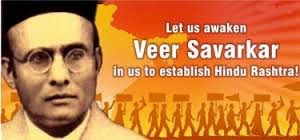 |
| An online poster circulated on 28th May (Veer Savarkar Jayanti) |
**********
Subhash Gatade is a New Socialist Initiative (NSI) activist. He is also the author of ‘Godse’s Children: Hindutva Terror in India’ ; ‘The Saffron Condition: The Politics of Repression and Exclusion in Neoliberal India’ and ‘The Ambedkar Question in 20th Century’ (in Hindi).


