By Priyanka Dass Saharia,
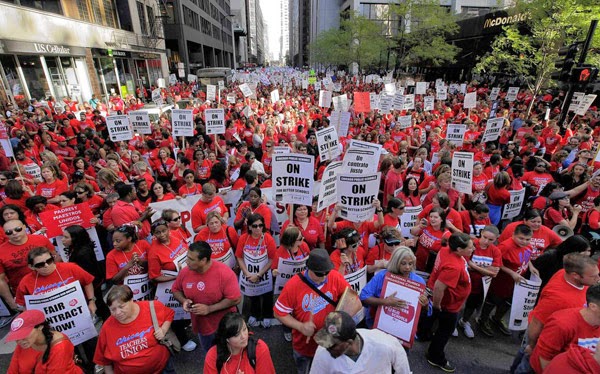
The occasion was apt. 8Th March 2014 – International Women’s Day. Jantar Mantar has always been that space symbolising democracy that is soon fading from the day to day lives of every Indian. Constitutional documentation has never been able to preserve the notion from slowly eroding in the nation. A Women Network had collaborated with the Chin Refugees to organise a protest and a meeting for discussions and proliferation of the recent happenings of the community.
Burmese refugees are divided primarily various groups on the basis of their ethnicities and religion. This event saw the Chin community deliberating on issue ranging from workplace abuse to food security rights. To begin with, there has always been a ghetto culture for refugees in the capital, where they are cramped in extremely crowded, inconvenient setups with minimal amenities of food, shelter and protection. There are over 8000 refugees, with half of the population being women, being the worst hit.

“We are helpless when we face sexual abuse of any kind. We go to the police with the complaint, but more often they would side with the locals. Our culture, for wearing western clothes makes them think we might have called the abuse on us” says Celina (name changed) a voracious participant in the congregation. This points to a sub domain of vulnerable targets, the women of the community who by the virtue of their sex end up facing a subculture of discrimination apart from the marginalisation faced by the community due to their refugee and ethnic statuses.
Manoha (name changed), who has been communicating with several officials of the UNHCR for justice at the face of atrocities faced by the community in East Delhi pockets states, “ Our government has failed to take the responsibility for what has forced us to leave the country. Our livelihoods were destroyed due to the militancy and we came here. The UNHCR is helpless for the lack of cooperation by our government and India, not being a permanent signatory to Refugees laws in the UN can’t be legally blamed for not providing adequate rehabilitation. We are victims from all sides.”
Kim (name changed), another member of the community adds on, “I was travelling in the bus one day and two men followed me around. Maybe they wanted to rob me of my belongings or worse. I was scared. I went to the police, but they fled thereafter. Even if I would have gone for help, people rarely do come forward for us. We look different and that has been my biggest curse here. Delhi has given me respite from the violence back home, but has shown me a new face of trouble. It’s all a nightmare.”
More often, they don’t abuse assault of any kind for fear of social stigmatization. Malini (name changed) talks of a similar note, “I have a young son and I am trying so hard that he studies well. That is the only hope for us to get out of this situation. Jobs are so difficult and then you get underpaid and you can’t do a thing. There are no laws which safeguard our rights in this country and the UN really cannot push the government to do much. Therefore I keep mute about a lot of trouble we face so that our children can be comfortable in their schools. It’s very tough for him. He is ridiculed for looking different and that his mother is a maid.”
The community is demanding for help lines for women seeking asylums and effective partnerships with different Human Rights agencies across the world for aid. Rosaline (name changed) a correspondent worker comments, “We want the government to reassess their policies regarding the refugees. Language has been another problem in this regard. Many speak Mizo, which people around cannot understand and Hindi becomes very tough for us. The abject poverty and lack of employment opportunities make it worse”
Due to the pervasive gender based violence, the women are in constant state of anxiety and fear. They are aware of the vulnerability of their socio-political status for they don’t fit into any domain of assured security in the country. The lack of institutional legal support makes them the scapegoats in workplaces and in their personal ghettos. They are grossly exploited of their labour and their complaints are neither followed up or given any effective redress.
Signifiers of their physical dissension in the capital make them identifiable targets of implosive racial profiling and violence. Add to this, the financial hardships, and it boils down to them being an abysmally vulnerable section of humanity, where the label of political asylum seekers does nothing in the name of normative legal aid of altruism and global comradeship. These events are not isolated but emblematic of the challenges that refugee Diasporas face in India. Hate crimes and ethnic cleansings have not been something new, but the rotting picture of old times.
When one talks of local integration as an effective route to solving many related problems, it is not merely an abstracted concept that can be transplanted in the diversity that India is, with its numerous fissures in its social fabric. Social structures have inherent hierarchies and institutionalised stratification deriving legitimacy from old traditions and political bodyguards. These structures can’t be broken down in a day with any Eurocentric fast tracked solutions. As believed by many optimist policy makers, voluntary repatriation will never become a normalised approach to seeing things in this regard with a ‘wait-and-see’ attitude.
Ethnic, transnational problems are very complex and require a thorough understanding of cultures, ethnicities and contextualised ethnic conflicts and differences. They require a change in the approach of studying the issue before a change in policy. Third country resettlements as a durable condition needs to be chalked out in a socially sensitive, comprehensive manner, inclusive of the local problems that a nation faces with the entry of foreign refugees in terms of accommodation, food, facilities and employment.
Forced migration, be it proactive or reactive, and mass expulsion due to religious and political persecution, poses an unprepared challenge to the host country in terms of structural constraints and resulting precipitating events with the amounting predisposed factors of the cause and the challenges of rehabilitation. One need to be very careful to parallel study the implications of migration on the receiving societies for that is one ignition point of fuelling further dissatisfaction and discord with the new crowds converging into a common denominator of violence.
The case of “protracted refugees”, commonly known as the ware house refugees, in exile for 5 years of more in a developing country is quite different from that of those in developed, first world nations. These sections are confined to segregated compartments and need to be constantly assisted with humanitarian needs, which pose a whole new challenge to countries who are themselves struggling to make their own ends meet. The marginalisation of these communities in spaces of transit camps comes with its own share of deplorable security and living conditions. The lack of a social and economic integration with the local spaces and culture due to structural bottlenecks of a requisite legal provision, or social assimilation, may have detrimental effects of the economic and social security of these sections. One has to be mindful of the irregular networks that are born out of the deprivation and desperation of these communities and ways to channelize their anxieties into productive ventures.
Any humanitarian agendas should be inclusive of all the humanitarian agents’ and actors. Establishing interdisciplinary approaches and experiential learning to engage and advocate for these communities a step forward. Research and education off campus also aids in gaining an insightful perceptive into their lives which helps to strengthen their voices.
Priyanka Dass Saharia is a Final year Post Graduate student at the Delhi School of Economics. She can be contacted at priyankadasssaharia5@gmail.com