Author: Richard Mellor

  • 1.5 Million Black Men “Missing”

    We reprint this article from The Black Agenda Report

     We Charge Genocide: 1.5 Million Black Men “Missing”

    A Black Agenda Radio commentary by executive editor Glen Ford

    Where did all the Black men go? Analysis of population data shows so many Black males have gone to prison, died of disease of accidents, or by violence, that Black females in many communities outnumber Black men by ratios of 6 to 10. A national policy of mass Black incarceration is the primary factor – a factual basis for a charge of genocide.

    We Charge Genocide: 1.5 Million Black Men “Missing”

    A Black Agenda Radio commentary by executive editor Glen Ford

    There are more Black men missing from their communities than the combined Black male populations of Los Angeles, Philadelphia, Houston, Washington and Boston.”

    A new analysis of population data confirms what has long been obvious to every minimally conscious Black person in the United States: a huge proportion of the Black male population is missing, physically absent from the daily life of the community. Many are prematurely dead, but the largest group has been consigned to the social death of incarceration. According to a study by the Upshot unit of the New York Times, when prison inmates of both sexes are taken out of the equation, there are now 1.5 million more Black women in the country, age 25 to 54, than there are Black men. In some locations – for example, Ferguson, Missouri – there are only six Black men physically present in the community for every ten Black women.

    In white America, there is almost no imbalance in gender among the 25 to 54 age group. For every 100 white women, there are 99 white men.

    There are more Black men missing from their communities than the combined Black male populations of Los Angeles, Philadelphia, Houston, Washington and Boston. Six hundred thousand of them are in prison, and that’s not counting Black male prison inmates that are younger than 25 and older than 54. The analysts estimate that roughly half, and maybe as many as three-quarters, of the other 900,000 missing Black men have died before their time from diseases and accidents, and that 200,000 are no longer here due to homicide.

    The war of attrition is a race war.”

    Black life in America does not start out with these bizarre imbalances between the sexes. There is no gender gap among Blacks in childhood. Roughly the same number of boys and girls are born, and the ratio stays stable until the teenage years, when the war of attrition begins mercilessly grinding down the numbers of Black males. How else is this phenomenon to be described except as a war, in which 600,000 are held captive during their most productive years, 200,000 are killed by violence, and most of the rest go to early graves from accidents and diseases that cause far lower casualties among whites.

    The data show that U.S. society has become much more toxic for Black men during the very period in which Blacks were supposedly making such fantastic “progress.” The numbers show that the missing-Black-men phenomenon “began growing in the middle decades of the 20th century.” The increasing ratio of Black women to men is primarily a product of the age of mass Black incarceration. The war of attrition is a race war deliberately and methodically initiated by the U.S. government, the effects of which have been devastating to Black society on the most fundamental level: stunting the formation of Black families and the Black American group as a whole by physically removing and eliminating the men.

    The data support a totally plausible, factually grounded charge of genocide, based on international law. The U.S. government, through its mass Black incarceration policies of the last half century, has been guilty of a) “deliberately inflicting on the group conditions of life calculated to bring about its physical destruction in whole or in part,” as well as b) “causing serious bodily or mental harm to members of the group.”

    The facts bear witness to the indictment. So do 1.5 million missing Black men.

    For Black Agenda Radio, I’m Glen Ford. On the web, go to BlackAgendaReport.com

  • Ferguson erupts again. Workers, youth, it’s time to fight back

    Ferguson Missouri: Land of the free
    From John Reimann in Ferguson. *
    http://oaklandsocialist.com/

    First I should say this: The most impressive thing about what is happening here is again the huge number of young people who are coming out and really taking the lead. Their leadership is in ways that old timers like me never would have thought of, and the main thing is in revving up and keeping the spirit going. People gather in the lot of the QT that was burned to the ground, but they also line the street. From time to time, a young person will march up and down the street leading chants. “Hands up! Don’t shoot!” is the main one, but “No justice, no peace!” is also changed.

    Then there are the carloads of young people slowly driving up and down the street blowing their horns,, hanging out the doors and windows, hands raised…
    It all really looks like a new movement being born.

    This afternoon there was a huge rally at a church a couple of miles away from the main gathering point for the protest.  The big names spoke there – Al Sharpton, local Democrats, etc. The way it was set up, and given that the cops block off the main street where the protest is, even before it was over it was impossible to drive back to the protest and difficult to drive anywhere near it.
    Could it be that that was the plan – to try to keep people off the street?

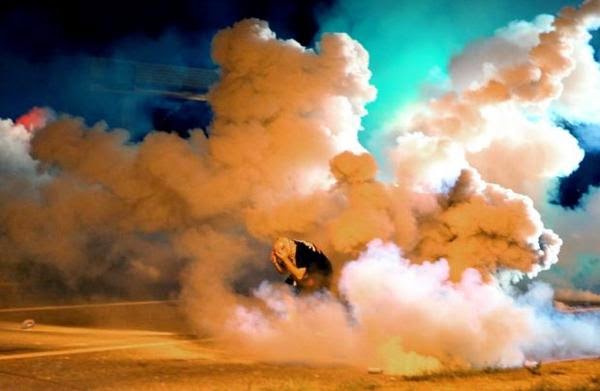
    If it was, it didn’t work very well, because by nightfall the crowd was at least twice the size of Saturday night. Up and down the street we marched. Until suddenly the people at the front came running back. The cops had shot off tear gas. As far as I could see, this was totally unprovoked, as the mood was angry, yes, but also festive and there was absolutely no vandalism or anything like that.
    There was massive confusion, but also order in the confusion.

    I would like to write more and also post photos and video, but it’s late here and it’s been a long day. I will have a lot of photos and video up on a day or two, so to all of those I met in Ferguson: Please check back later.

  • Killing of Seattle youth by Sheriff sparks protest.

    The police in the US can kill youth, especially youth of color with impunity. The murder and incarceration of youth of color in this country is at epidemic levels. We reprint this from the blog Dark Are The Days  for our reader’s interest. Please spread the word about yet another youth murder by police.  We are interested in what Kshama Sawant has to say about this issue and will contact her office to find out.  It is important that socialists stand in the forefront of the attacks on youth.

    Oscar Perez-Giron and the Fight for Justice

    1648577_1404407103.4505
    (more…)
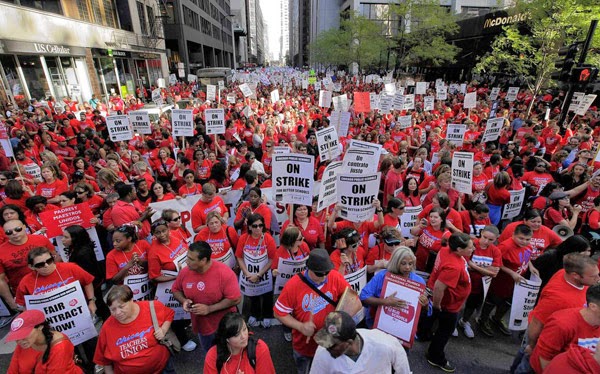
  • The Chicago Teachers Union (CTU) Strike of 2012- beyond mythology

    CTU Strike Analogy

    By Earl Silbar
     
    The Chicago Teachers Union (CTU) strike of 2012 is widely believed to be a major success, a big win for progressive, member-driven leadership. Indeed, there were big successes won both  by  the strike preparation and from  support for the strike among  members, the wider public, and esp. by parents. However, there were major problems both in strike strategy and the settlement itself.
     
    The 2012 Chicago Teachers Union strike was the first strike in 25 years.
     
     
  • The Hidden History of Women’s Liberation

    Wed, May 28, 2014

    by Susan Rosenthal

    BOOK REVIEW: Women and Class: Towards a Socialist Feminism (2011), by Hal Draper, August Bebel, Eleanor Marx, Clara Zetkin, and Rosa Luxemburg.
    * Edited by E. Haberkern.

    The organic connection between women’s liberation and socialism has been shoved so deeply down the Memory Hole that most people know nothing about it. Women and Class brings this rich history to light, revealing important lessons that our rulers prefer we not learn.
    Part 1: “The Class Roots of the Feminist Movement” explains how the world’s first revolutionary women’s movement developed during the French Revolution, disappeared during the reaction, then re-emerged when the working class rose again in the mid-1800s.
    Part II: ‘The Debate in the Social Democracy” chronicles the resurgence of the socialist and women’s movements during the later 1800s and early 1900s with a focus on efforts to combat capitalist feminism (commonly called ‘bourgeois’ feminism) in society and also inside the socialist movement.

    A movement of women

    As Draper explains, various women (and men) had written about women’s rights prior to the French Revolution, but no organized movement of women was possible until the mass of society began to move.

    “[I]nsofar as a revolutionary upheaval reaches down into the recumbent strata of society to set them in motion, women too are set in motion; and insofar as popular social forces are inert and passive, the women’s movement too is quiet or only partial.”(p.13)

    During the height of the French Revolution, between 1789 and 1793, the masses rose against their feudal oppressors, and the mass of women was an integral part of that uprising.

    “[The women] had to feed hungry families. This formed their politics; this was their politics in the first place; and so they were not imbued with the superstition that only men could act politically. And in acting on their “politics” they did not typically react to issues by writing declarations or pamphlets; they went into the streets. And in the streets they assumed equal participation in the teeming life of sansculotte politics, without anyone’s say-so.”(p.45)

    Working women were central to the capture of the Bastille, key to returning the king to Paris from Versailles, crucial to the storming of the Tuileries, and actively involved in every protest, insurrection, and battle to defend the revolution. In 1792, the women of Lyons seized control of their city in response to intolerable economic conditions.

    “They dominated the city for three days. ‘Women police commissioners’ established controls over price schedules, which the city authorities were forced to countersign.”(p.42)

    The emerging capitalist class rode to power on the back of this movement. After the last remnants of feudalism were dismantled, the Church disempowered, and the aristocracy defeated, the capitalists had to stop the revolution from growing into a force that would also sweep them away.

    “The danger of invoking revolution even for a class-limited objective is that it suggests to all oppressed people that the power on top can be overthrown; in that sense, it is infectious or contagious. This is one reason why revolutions – real revolutions, that is, social upheavals that turn society upside down – are so often truly creative, fructifying, and personally liberating for masses of people. This belies the common historical myth that revolution is nothing but a bestially destructive force.”(p.12)

    The Revolutionary Women

    Having overthrown one class of tyrants, the masses were unwilling to submit to a new class of tyrants. Legal equality meant nothing to those with no property, so the left wing strained to push the revolution forward to achieve social equality and mass democracy.
    In May of 1793, the most militant women organized themselves into The Society of Revolutionary Women (La Société des Citoyennes Républicaines Révolutionnaires) also called the Revolutionary Women (Femmes Révolutionnaires). They did not counter-pose women’s rights to the needs of the revolution; they fought for women’s rights to advance the revolution.

    “[The Society of Revolutionary Women] was one of the few citywide political clubs, as distinct from section clubs and assemblies. It was the first all-women’s revolutionary vanguard association. It was the extreme left of the Revolution in organized form.”(p.43)

    In order to bring the masses to heel, the Jacobins (the capitalist party) moved to crush the left opposition and, in particular, the Revolutionary Women.
    In September 1793, the Jacobin government slandered and then arrested a leader of the Revolutionary Women, Claire Lacombe, on trumped-up charges. A month later, the RW meeting hall was sacked. After that, women’s societies were outlawed. The following year, all women were denied the right of association. These escalating attacks on the movement were resisted, but the newly-born working class was neither large enough nor economically important enough to build an alternative to capitalism.
    The history of all battles is written by the victors, in this case, the capitalist class. As a result, the achievements of the Society of Revolutionary Women and its leaders – Claire Lacombe, Etta Palm, and Pauline Léon – have virtually disappeared from the record. Instead, histories of the period highlight the writings of bourgeois feminists like Olympe De Gouges, Mary Wollstonecraft, and George Sand who had nothing but contempt for the mass of women who had fought to change society from below.

    Continue reading:

  • São Paulo unions threaten general strike for World Cup

    The bosses courts here in California have just issued a legal decision attacking teachers tenure and seniority rights.  This is a major assault on teachers and their Unions.  The teachers are being blamed for a crisis in  education system that the bosses want to privatize.  The crisis in public education as in all public services and society as a whole is a crisis of capitalism, not teachers. No doubt the US trade union hierarchy, wedded as they are to the view that workers and bosses are on the same team, have the same economic interests, will file a lawsuit protesting this vicious assault on the teachers and it’s even possible they might send Obama and email.  A bit of a different situation in Brazil isn’t it?
     
    And the state is deploying 100,000 troops and 57,000 police for the event.  The cost of the World Cup would possibly eliminate poverty in Brazil. The military is there to keep the workers and poor at bay.  The players should refuse to play there until the subway workers demands are met, but to my knowledge they have no independent organization of their own.  RM.
    ***************
     
    São Paulo unions threaten general strike for World Cup amid subway protests 
    Daily Telegraph UK

    Days of subway strikes raise fears of transport chaos during tournament in Brazil; union leaders say other sectors could join industrial action

    Subway train operators, along with some activists, clash with police at the Ana Rosa metro station on the second day of their metro strike in Sao Paulo, Brazil (Friday, 06 June 2014)

    The police blamed the strikers for Friday’s clashes at the main station of Ana Rosa, insisting they were forced to act after fighting broke out Photo: NELSON ANTOINE/AP
    Brazilian President Dilma Rousseff on Saturday claimed that protests ahead of the World Cup were part of a “systematic campaign” against her government, as São Paulo union leaders threatened a general strike to coincide with the opening of the tournament in the city.
    São Paulo, which is due to host the opening match on Thursday, has been paralysed by days of strikes and protests by subway workers which have led to clashes with police and deepened fears of chaos for visiting fans.
    The cost of staging the event – at an estimated $11.5 billion (£6.9 billion) the most expensive World Cup ever – has ignited public anger at economic woes, corruption and poor social provisions. But Ms Rousseff said that criticism of spending amounted to “disinformation”.
    “Today there is a systematic campaign against the World Cup – or rather, it is not against the World Cup but rather a systematic campaign against us,” she said, without revealing who she believed to be behind it.
    Police fired tear gas and beat back protesters at one São Paulo subway station on Friday night, leading Altino de Melo Prazeres Júnior, the head of the Union of São Paulo Subway Workers, to insist members would not be deterred and instead would reinforce their presence at key interchanges in the city.

    He vowed that any further use of force by authorities would trigger a day of citywide industrial action to coincide with the first game of the tournament, which is to be held in the city on Thursday.

    “If the beating continues, we are going to talk to all the sectors. If our people bleed, we are going to ask for help from the metalworkers, from the bank workers, and have a day of general strike at the opening of the Cup,” Mr Prazeres said.

    The country’s largest unions – the Central Workers Union and Conlutas – as well as the Homeless Workers Movement, all pledged to join a wider strike if the violence continued, according to the Estado de São Paulo newspaper.

    The police blamed the strikers for Friday’s clashes at the main station of Ana Rosa, insisting they were forced to act after fighting broke out between commuters trying to enter and strikers blocking their path.

    Ana Rosa station, one of the most central stations, was closed and numerous users tried to enter. Clashes broke out between picketing strikers and users and the police had to intervene”, a military police spokesman said.

    The strike, in a dispute over pay and lay-offs, has brought gridlock to the Brazilian city with almost half of subway stations closed and 125 miles of traffic jams snarling the roads during Friday’s rush hour.

    As the main transport link to the World Cup stadium in the sprawling city of 20 million people, the strike on the subway has raised concerns that fans could find themselves unable to reach matches.
    It has also fuelled fears of unrest during the tournament.

    On Saturday Brazil’s Fifa executive committee member, Marco del Nero, played down the prospect of a general strike as “a minor problem”, but the organisation’s head of security, Ralf Mutschke, said he was concerned about the impact such action might have on the opening game.

    Last year over a million Brazilians took to the streets during a warm-up tournament ahead of the World Cup and disgruntled workers have seized upon the international attention to press their causes. Indigenous groups have also joined protests in a number of cities as they seek to highlight environmental and land disputes.

    Failures to deliver many of the infrastructure projects promised for the World Cup have only added to frustration ahead of the event.

    Ms Rousseff in May called in the army to protect infrastructure and ensure security for teams and fans, after a bus carrying the Brazilian team was attacked by protesters.

    100,000 police and 57,000 troops are to be deployed during the tournament.

  • Real incomes in the UK still falling; global growth slows

    by Michael Roberts

    The latest data on unemployment rate in the UK show a fall in the official rate to 6.6% in the three months through April, down from the 6.8% recorded in the first quarter, and the lowest level in more than five years. That sounds good but at the same time, average weekly earnings rose just 0.7%, including bonuses, significantly lower than the pace of inflation. So the real income for the average British worker is still falling, as it has done since the Great Recession began in 2008, or for over six years. And for the last four years, the trend in pay rises has been down, not up.

    UK pay and prices (yoy %)
    UK pay

    The reason is clear: people in relatively better paid jobs in finance and in the public sector have lost their jobs and those getting jobs since have mainly done so in much lower paid sectors like retail, tourism etc. And we also know that there has been a very large increase in ‘zero hours contracts’, casual labour and self-employment (15% of the workforce now) where incomes are generally lower than paid employment.
    UK self employed

    The other bad piece of economic news for the prospects of the capitalist economy was global. The World Bank substantially reduced its forecast for global real GDP growth this year from 3.2% to just 2.8%. If that turns out right, for the fourth year running, the world economy will have expanded at less than 3% a year and the world economy is growing way below the trend rate before the Great Recession. Aside from the financial-crisis bounce-back in 2010, it will be the sixth sub-3% rate in the past seven years.
    World bank GDP

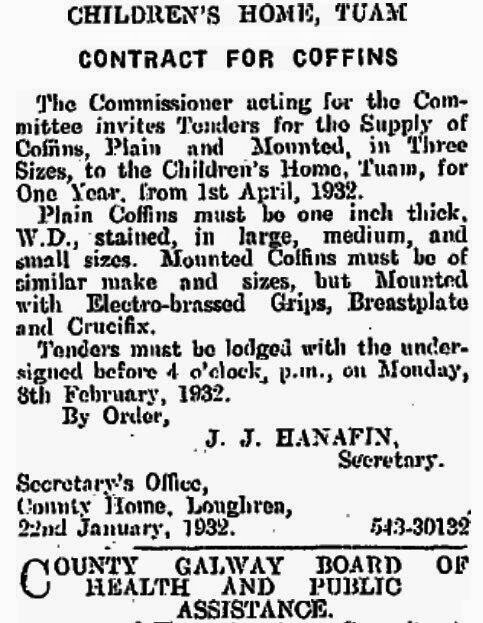
  • Ireland: Babies deaths, the left, and Catholic Church power.


     As children of unwed mothers, the dead babies were not baptized
    By John Throne

    When my father would come home drunk all I ever heard from my mother was “You will put us all in the workhouse with your drinking.” The workhouse was the great terror in her life. Its name was then changed to the County Home. It was in Stranorlar. 

    I am very keen to hear what demands Comrades who read this blog, or left Comrades in general are putting forward on the issue and the power of the role of the Catholic Church in Ireland. I see where a Protestant organization/church in Dublin has now also been caught with a mass grave. This makes things both easier and more urgent to clarify and raise demands. 
    Comrades I have to say that over the recent years I have been surprised at the reluctance of people on the left to take on the structure of the Catholic Church in Ireland and point out its role and power. Paddy Devlin was one of the few well-known left politicians to do so for all his faults. He said that the Catholic Church blocked the development of the left at every turn and as a result every radical movement from below had nowhere to go except sectarian republicanism. 
    I was recently in Derry and had to meet a man there that I knew. He was not a socialist. But he knew me and my opinions very well. He said he had to call a few places to collect something and then we would go on to our destination. I said fine and thought no more about it. After a few stops we arrived at the Catholic Church and in he went and delivered the money he had been collecting at the stops he had been dragging me—-an atheist and Marxist—–around to. I was enraged that he had involved me in collecting money for that outfit. I broke off all relations with him after this. 
    I raised this with a Comrade who is an atheist and former leading member and full timer of the old CWI, the socialist organization from which I was expelled. I said how about if I had taken that other man, the devout Catholic, around and collected money for the Orange Order and never told him what I was doing? Would he not be enraged? This Comrade said he would never have thought about it like this. I was and am astounded that he would not. It shows the depth of the indoctrination of the Catholic Church over its members. The difference between the Orange Order and the Catholic Church is mainly one of power.  
    The Catholic Church campaigned from the pulpit for the move to the National Wage agreements in

    Onward Christian soldiers

    the early 1970’s. The Catholic Church set up a committee at the time to set the wage for its lowest rank male full time workers that it calls priests. Donal Nevin, a top trade union official was brought on to the committee. This was to pretend that the labor movement was involved. This committee set a wage for these full time church workers which was three times that of the income of a single mother with three children. Am I not also right in thinking that when it looked like the Stalinist WP was going to take over the ITGWU the Catholic church mobilized its brainwashed members in the trade union and labor bureaucracy and merged the ITGWU and the FWUI and kept the “commies” out. We are dealing with an extremely powerful and conscious political organization of capitalism in the Catholic Church. The Protestant churches are also churches of capitalism but the Catholic Church with its 1.1 billion members, its own state and with diplomatic rights in countries it has a presence, is the main one. 

    The US ambassador to the Vatican said that the moral power of the Catholic Church and the

    economic power of the US would bring down Stalinism. He was not far wrong. the Catholic hierarchy held many meetings with top strategists of US imperialism as Stalinism began to crack. Google this and you will be astounded at how much information comes up. The popes of the time made trip after to trip to the Stalinist countries to whip up their supporters and make sure that Stalinism was followed by capitalism and not democratic socialism.

    So back to Ireland. There will be no successful socialist revolution in Ireland that does not take on the Catholic Church just as there will not be on in the US that does not take on institutionalized racism or sexism. Look at the role such outfits played in the Russian revolution and the Spanish Civil war and the dirty wars in Latin America. The Catholic Church will use the sword by means of mobilizing its members. The left must not be intimidated in the present situation. There is a chance now to strike a serious blow at all the churches and their support for capitalism. For this some cutting edge demands must be developed. I am not in Ireland so I cannot be sure. But some I would suggest: 
    No religious organizations to be allowed to control any school, place of education or hospital. 

    All who see themselves as progressive and revolutionary leave any organization that is based on sectarianism. 

    All organizations that discriminate on gender or LGBT basis to be shunned and all who think of themselves as progressive to leave these organizations. If they cannot leave them build opposition groups within them. 

    All who think of themselves as progressive not to allow their children to be named in such organizations and not themselves to marry or be buried in these outfits. 

    Tax all religious organizations. 

    Open up a debate on whether organizations such as the churches and houses of all religious organizations with their criminal records should be banned from owning property. 
    Readers of this blog that know me will know that I was born into a Protestant Orange Order family. My uncle who brought me up was the “Worshipful District Master” they use the fancy titles too like the churches. I broke from that background ended up in the Bogside where I was on the Bogside Citizens Defense Association. I went on to become a revolutionary socialist and remain so and also an uncompromising atheist. Revolutionaries in Ireland must consider have they fully broken from their religious indoctrination whether Protestant or Catholic. 
    If what I hear is right and there is not a united front of direct action to force the issue of the mass graves of children on to the parliaments North and South and to end the control by the religious organizations over so much of society then I am worried.  
    If this is the case then a great opportunity is being missed. And if as some Comrade says FF and FG are taking up this issue then of course they are. But the question is why can they? They can only do so with any impetus if the left does not take it up and takes it up in the way I suggest that is by showing how weak Irish capitalism made a deal with the Catholic church and gave it control over the workhouses, children’s homes, schools and hospitals. It was in a hospital like this that the Indian doctor, Savita Happanavar died after her pleas to terminate her pregnancy due to a miscarriage were refused.  She was told, “This is a Catholic Country.”
    As I pointed out in a previous blog, the Irish capitalist class were too weak to lead the struggle for independence in Ireland. (See Trotsky’s Theory of the Permanent Revolution. The capitalist parties will not take on the Catholic Church and its control over Irish society.  Irish capitalism and the Catholic hierarchy are both responsible, this alliance is responsible for the mass graves just as this alliance is responsible for the Magdalene Laundries, orphanages and women who were imprisoned in them.

    The issue must be taken up in this way because now the mass media is trying to blame the “Irish People.” Anything to get their class and its allies the Catholic and Protestant hierarchies off the hook. 

  • Draghi fights the drag

    by Michael Roberts

    After the European Central Bank (ECB) announced a battery of new credit easing measures at its council meeting yesterday, the European stock markets hit six-year highs, while Wall Street also reached another record. Indeed, the FTSE All-World equity index surpassed its previous high touched in late 2007 when the financial crisis began to unfold. Investors in the stock market (and in property) just love news that interest rates on borrowing are being lowered further and there will be all sorts of new cheap credit facilities to invest with.

    Mario Draghi, the ECB chief, is worried that the Eurozone economy is not recovering and instead is in danger of slipping into a debt deflation spiral. So the latest measures: cutting interest rates; providing four-year cheap loans to banks if they lend onto to small businesses; and talking about buying bonds directly from banks (so-called quantitative easing, QE); all these are designed to boost the economy and lower the value of the euro against other currencies to help Eurozone exports, raise inflation and thus corporate profits.

    The ECB downgraded its latest forecasts for growth in the Eurozone to just 1% this year and still expects real GDP growth to be below 2% even in 2016 (1.8% is the forecast). As for inflation, the ECB has a mandate to keep Eurozone inflation under 2% a year. It will have no problem with that. On the contrary, the inflation rate is falling not rising. The ECB now expects Eurozone inflation to be just 0.7% this year and be only 1.4% in 2016, and that assumes economic ‘recovery’ and the ECB’s credit easing works.

    Can all this cheaper credit make a difference and stimulate the capitalist economy and not just stock, bond and property markets? Well, all the measures so far introduced by the Bank of England, the Bank of Japan and the ECB have failed to increase lending to industry. Net lending by the commercial banks to businesses (particularly small businesses) is negative.

    The belief of mainstream economics (particularly the monetarist and Keynesian wings) that low interest rates and plentiful credit can get a capitalist economy going continues to be proved wrong. What matters for businesses is whether sales and profits are rising sufficiently to suggest that investment and borrowing is worth doing. Instead, large corporations around the major economies have been stockpiling cash in low tax havens and then borrowing (raising debt through bond issues) to buy back their shares to boost the price and pay out bigger dividends to shareholders. Small companies want loans to keep going but cannot get them because they are seen as bad credit risks by the banks, which are still trying to deleverage their previous bad debts. An ECB measure is hoping to get round that.

    But it is demand for loans that matters not supply. More credit in an environment of low profitability in Europe , austerity and falling real incomes is really like pushing on string. Or to use another cliché, you can take a horse to water but you cannot make it drink. Many corporations are unwilling to invest while profitability remains lower than before the Great Recession. That is the case in all the major economies, even the US, where the nominal mass of profits (and measured against GDP) has been at record levels. And as I reported in a previous post, US profits have started to turn down (see http://thenextrecession.wordpress.com/2014/06/02/is-americas-profit-explosion-over/).

    At the same time, real wages are falling in most parts of Europe, the UK and in Japan, while stagnating in the US. This is no environment for capital accumulation.
    US median
    The latest figures for the so-called Flow of Funds in the US economy reveal that, while total debt to GDP has been falling from a peak in 2009, this has been due only to banks going bust and ‘deleveraging’ and households defaulting on their mortgages and walking away. Corporate debt has risen as companies issue more bonds to buy back their own shares and raise dividends for shareholders. The economic recovery remains very much a ‘fictitious’ one.
    US total debt
    I have argued in the past that getting corporate debt down is a necessary part of the process of devaluing capital and restoring profitability for sustained accumulation (see http://thenextrecession.wordpress.com/2013/02/25/deleveraging-and-profitability-again/). As Bank of America economists recently concluded: “In our view, further required balance sheet adjustment in the (non-bank) private sector weighs on the outlook for investment.” The level of debt had reached unprecedented levels before the Great Recession. But near-zero central bank interest rates and guaranteed credit has encouraged large companies to borrow even more. That poses a risk ahead: if interest rates were to start to rise, many companies would be pushed into bankruptcy.

    The flow of fund data also show that the US corporations are maintaining large surpluses rather than investing in technology (red block). So the US economy is unable to expand (falling black line) at the rate it did between 2002 and 2008. Instead, corporate spending in the real economy has stagnated and so the US economy has failed to expand much (tightening black line) since 2009.
    US fin bal

    Economic growth in the major economies remains stuck at well below trend despite the efforts of central banks. The US is doing little better than 2% a year and that’s the same as Japan (and probably the UK), while, as the ECB says, the Eurozone area will only manage about 1% a year.

    Will the ECB measures change that? Well, it has not worked elsewhere, except to help the rich investors in stock markets (US household wealth has jumped up 10% this last year as a result of higher financial asset and property prices). Indeed, if the ECB succeeds in raising inflation rates and lowering the euro, that is only more bad news for the average European household. The measures of the BoJ in Japan have raised inflation but not reduced unemployment or raised wages. So Japan’s ‘misery index’ (unemployment plus inflation rate) is at a 30-year high!
    Japan misery index
    Governments in Europe are starting to talk about new measures of fiscal stimulus as well as monetary stimulus from the ECB. But as in Japan, the one announced by the Spanish government this week is mainly to cut the taxes on corporate profits, not to boost real incomes or get unemployment down. If you start from the premise that there is only the capitalist economy to work with, and more business investment won’t happen without higher profitability, then cutting taxes for business makes sense. But it has not worked so far to get things going.

    Ironically, the ECB measures did not lower the euro’s value against the dollar and the pound as hoped. That’s because the US and other governments tried to talk down their currencies too and investors were not convinced that the ECB had done enough. So the most important part of ECB’s plan, a lower euro, has not happened so far. Every government wants a weaker currency to stimulate exports with world trade growth slowing (see my post (http://thenextrecession.wordpress.com/2014/05/12/world-economy-still-crawling/) – it’s a race to the bottom for currencies.

  • Putting the Catholic Church in Its Place

     JUNE 02, 2014
    Jimmy Gralton’s Ireland

    by HARRY BROWNE

    Ken Loach and Paul Laverty’s Jimmy’s Hall is as near as makes no difference to being a sequel to their superb 2006 film, The Wind That Shakes the Barley. The earlier film showed how the Irish independence struggle gave way to a brutal counter-revolution that preserved aspects of British colonialism and entrenched a reactionary Irish bourgeoisie to run the new state.

    The great new film picks up ten years later and nearly 200 miles north of the Cork setting of The Wind… in the beautiful, boggy landscape of County Leitrim. The revolution that was crushed in 1922-23 attempts one last, jazzy kick in the arse of the new establishment, as an unapologetic republican-socialist returns from New York after a decade’s exile and re-opens a community hall that accepts no authority except that of the people who built it. And in Ireland in 1932, that means defying the Catholic Church.

    The story of Jim Gralton and his hall is absolutely true, though director Loach and writer Laverty have taken plenty of liberties with it. Gralton, who had US citizenship, was deported back to New York from the country of his birth in 1933, ironically by a government that was supposed to be truer to the republican ideals of the Irish rebellion than the one that ruled the first decade after independence. Gralton was gone and nearly but not quite forgotten, with a few leftists and local-historians clinging through the decades to his ideas and to a story that knits together Marxist internationalism with Irish anti-imperial resistance; a love for Irish music and culture with the irresistible strains of American jazz. I can remember a quarter-century ago marching through the lanes of a Leitrim village with a few dozen of the assorted clingers, at a very lovely and thought-provoking event called the Jim Gralton Summer School.

    Irish actor, playwright and activist Donal O’Kelly became the latest to draw a spark from the Gralton flame when in 2012 he produced a sort of multimedia, audience-participation pageant, directed by Sorcha Fox, called Jimmy Gralton’s Dancehall. (O’Kelly turns up in Loach’s film in a bit part; Fox is wonderful in a more substantial one.) The ‘play’ gets credited by Loach and Laverty, and so it duly turns up with a mention in many of the (mixed) reviews of the film. But I’m going to go out on a limb and guess that none of the international film-critic fraternity actually saw O’Kelly boogy-woogying as JIm Gralton in any of the handful of performances of Jimmy Gralton’s Dancehall that were staged, with the involvement of scores of local people, in remote locations in the west of Ireland.

    I saw it in the old ‘Rainbow Ballroom of Romance’ in Glenfarne, County Leitrim, and wrote about it for the Irish edition of the Sunday Times. (My article is behind Rupert Murdoch’s paywall.) As in Loach’s film, Gralton’s stand-off with his parish priest, hater of both Gralton’s politics and his African-Americanised cultural baggage, was the dramatic centre of the affair; but  the dancing, during and after the ‘play’, was the highlight of the show, great Irish highsteppers mixing with African asylum-seekers, and anyone else who showed up, to try some old and new steps, with the floor heaving beneath us. I wrote at the time:

    “… there’s nothing terribly radical in 2012 about mocking and chiding the 20th-century Catholic Church for its oppressive terror, even if the story of Ireland’s jazz rebellion can always do with more telling. Jimmy Gralton’s Dancehall, happily, does more than mock: it invites everyone to come and dance on the church’s grave. This grave-dance is, you suddenly realise as you’re pulled out on to the dance floor, a party that Ireland has been waiting for, especially now that the hollowness of the Celtic “we all partied” Tiger has been revealed. It’s one thing to condemn the Church for its failings and consign it to history, it’s another thing to celebrate the passing of its power and genuinely let everyone join in.

    O’Kelly and Fox used a range of visual and textual tricks, mostly involving slides projected on the back wall of the ballroom, to connect that celebration to various present-day struggles, including that of asylum-seekers fighting against deportation. (The results of the 2004citizenship referendum, the tenth anniversary of which will be marked next week, mean that the strange spectacle of an Irish-born person being deported as an alien is no longer just a frontman anomalous old footnote tied to Gralton’s name.)

    Loach and Laverty, with their fundamental devotion to realism and verisimilitude, can’t quite play it that way. To be sure, they splendidly capture the joyous defiance of the dancefloor; and cinematographer Robbie Ryan uses Loach’s beloved, dying medium of 35mm film to infuse scenes with a watery Leitrim-light magic. But while playing the story straight, they’ve got a political trick up their sleeves all right: instead of dancing on the Church’s grave, they breathe complex human life into their repressed and repressive clergymen, and remind us that there was (and is) more to reactionary Ireland than the power of the Catholic hierarchy.

    It helps that they’ve got great actors to play the young and old priests of the parish: Andrew Scott and Jim Norton. For British and Irish audiences, the latter actor reveals a sort of in-joke that colours our understanding of the film-makers’ purpose. In an absurdly brilliant TV sitcom of the 1990s, Father Ted, produced in London but with Irish writing and acting talent, Norton played Bishop Len Brennan, an occasional character and a nasty, hypocritical piece of work who turned up to bully and discipline the eponymous Father Ted Crilly. In one of the series’ most memorable episodes, Ted, having lost a bet, was required to “kick Bishop Brennan up the arse”.

    The joke of the episode (okay, one joke of the episode) is that the beleaguered Ted pursues the arse-kicking task methodically and without rancour, to the extent that when it is completed, the speechless bishop literally cannot believe it has happened. That didn’t stop the TV moment from being enjoyed and understood as a new Ireland’s symbolic revenge for centuries of repression and cruelty (including sexual violence, as the episode’s casual repetition of the phrase “up the arse” keeps insisting). There’s even, inevitably, an academic book called Kicking Bishop Brennan Up the Arse.
    So when some of us see actor Jim Norton in clerical garb, part of our reaction is, “Oh yes, we kicked the Church up the arse. In 1998. And in regular repeats since then.” Whether Loach and Laverty intended the connection — and trust me, Jimmy’s Hall  can be enjoyed without prior knowledge of Gralton, O’Kelly or Father Ted — they clearly grasp that the idea of the Church as the sole villain of the piece has been done, and it just doesn’t cut it, not in 1932, not in 2014.

    In Jimmy’s Hall, Norton’s Father Sheridan calls Gralton’s attention to a painting on the wall of his study, John Lavery’s 1922 The Blessing of the Colours: it shows a patriotic Irish soldier kneeling, head bowed and flag in his grip, in front of a bishop: State subordinate to Church. This, says the priest, is as it should be. But as the film develops, it becomes clear that the relationship is not as simple as the old priest might wish, and that the Church is not Gralton’s only, or most dangerous, enemy. Gralton moves repeatedly into open conflict with the powerful when he challenges their class power, as when he and his followers restore an evicted tenant family to a rural estate that Irish ‘freedom’ hasn’t freed from its near-feudal lord. When the local big landowners and petty bourgeoisie confer with the priests about what should be done with Gralton, they address the clergy with a striking lack of respect; and by the end Father Sheridan appears to realise dimly that his culture-war with Gralton has been providing cover for an economic war being waged by local and national bosses and proto-fascists.

    There is nothing trivial or academic about such an analysis today. For decades in Ireland, the liberal-left has been fighting the authority of the Church; even after (incomplete but culturally real) defeat of its power over the last two decades, Irish public life is dominated by retrospective revelations of the horrifying cruelty of the institutions through which bishops, priests and Catholic religious orders ran and ruined the lives of the disenfranchised: just last week we learned of a mass grave for babiesat a home for unmarried mothers in County Galway.  By refusing to paint the Church only in shades of black and blacker, Loach invites us to consider on whose behalf Mother Church crushed the lives, hopes and joys of generations of Ireland’s poor.

    After all, the ruling class here has long since stripped off its ecclesiastical garb. The Taoiseach (prime

    minister), Enda Kenny, is a direct political descendent of the nationalist clerico-fascists so brilliantly captured by Loach, but he conspicuously made his mark early in his term with a stirring retrospective denunciation of the Church, earning him a great rush of liberal kudos. Meanwhile, though, he has ruled with an iron fist on behalf of international bondholders in Ireland’s casino banks, and on behalf of the multinational companies that are happy to make a low-tax home in post-Catholic Ireland.

    Love of Ireland lives in every frame of Jimmy’s Hall, in the scenery, in the chat, in the faces of Loach’s usual mix of professional and undiscovered actors. Barry Ward is magnetic as Gralton, Simone Kirby beautifully blue-eyed and careworn as his comrade and love-interest, Oonagh; and Francis Magee visibly channels Robert Mitchum in a key supporting role. It seems that Loach and Laverty love Ireland enough to know that (some electoral grounds for optimism aside) it still needs a Jim Gralton, or a few, not to fight the Church, but to fight the class that now rules without wrapping itself in Christian piety.

    Harry Browne lectures in Dublin Institute of Technology and is the author of The Frontman: Bono (In the Name of Power). Email:harry.browne@gmail.com, Twitter @harrybrowne